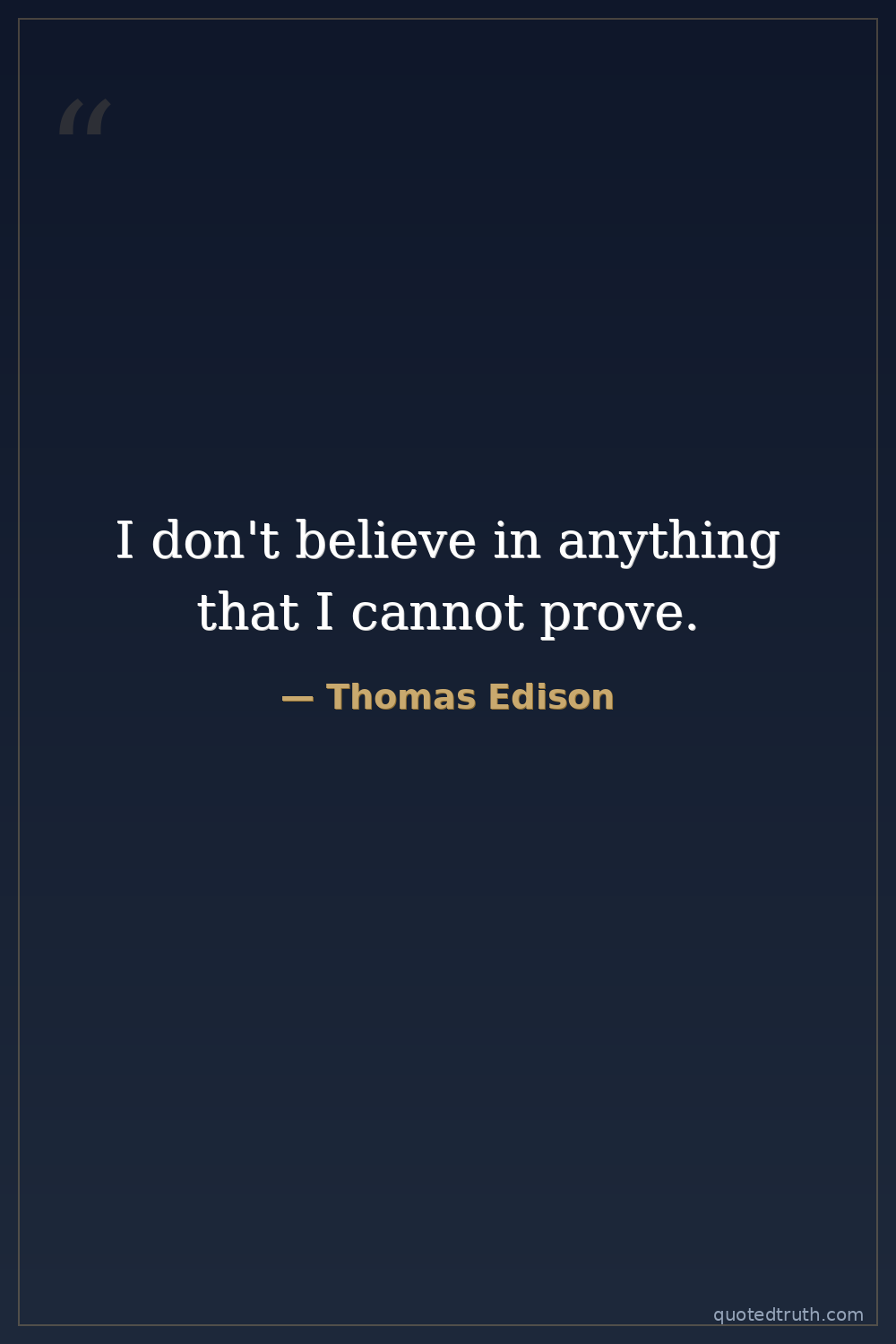
Thomas Edison — "I don't believe in anything that I cannot prove."
I don't believe in anything that I cannot prove.
I don't believe in anything that I cannot prove.
Click any product to generate a realistic preview. Up to 3 at a time.
* Initial load can take up to 90 seconds — revising the preview in another color is nearly instant.
"I am long on ideas, but short on time. I expect to live to be only about a hundred."
"I owe my success to the fact that I never had a clock in my workroom. Seventy-five of us worked twenty hours every day and slept only four hours — and thrived on it."
"I can hire half of the people in the country to do the thinking for me, but I can't hire people to be enthusiastic."
"I have a theory that the human voice is immortal. It is a form of energy that never dies. It just changes form. I believe that we can record the voices of the dead and play them back."
"Anything that won't sell, I don't want to invent."
Found in 1 providers: grok
1 source checked
The speaker refuses to accept claims without evidence. Belief should rest on demonstration, testing, and verifiable results, not on tradition, authority, or intuition. If something cannot be shown to work or be true through experiment or observation, it does not deserve confidence. It is a commitment to empirical thinking: trust only what reality itself confirms through reproducible proof.
Edison built his career on trial-and-error experimentation, famously testing thousands of filament materials before settling on one that worked for the incandescent bulb. He ran Menlo Park as an invention factory where results, not theory, decided everything. Publicly skeptical of organized religion and spiritualism, he insisted measurable outcomes were the only honest standard. The quote captures the working philosophy behind his phonograph, motion picture, and electrical-system breakthroughs.
Edison worked during the late 1800s industrial and scientific revolution, when electricity, chemistry, and engineering were replacing folk knowledge with laboratory method. Darwin, Pasteur, and Maxwell had reshaped how educated people judged truth, and American industry rewarded inventors who could demonstrate patents before investors. Spiritualism and patent-medicine quackery were also booming, making public declarations of empiricism a meaningful stance distinguishing serious inventors from showmen and mystics.
AI-generated insights based on extensive research and information for context. Factual errors? Email [email protected].
Your cart is empty