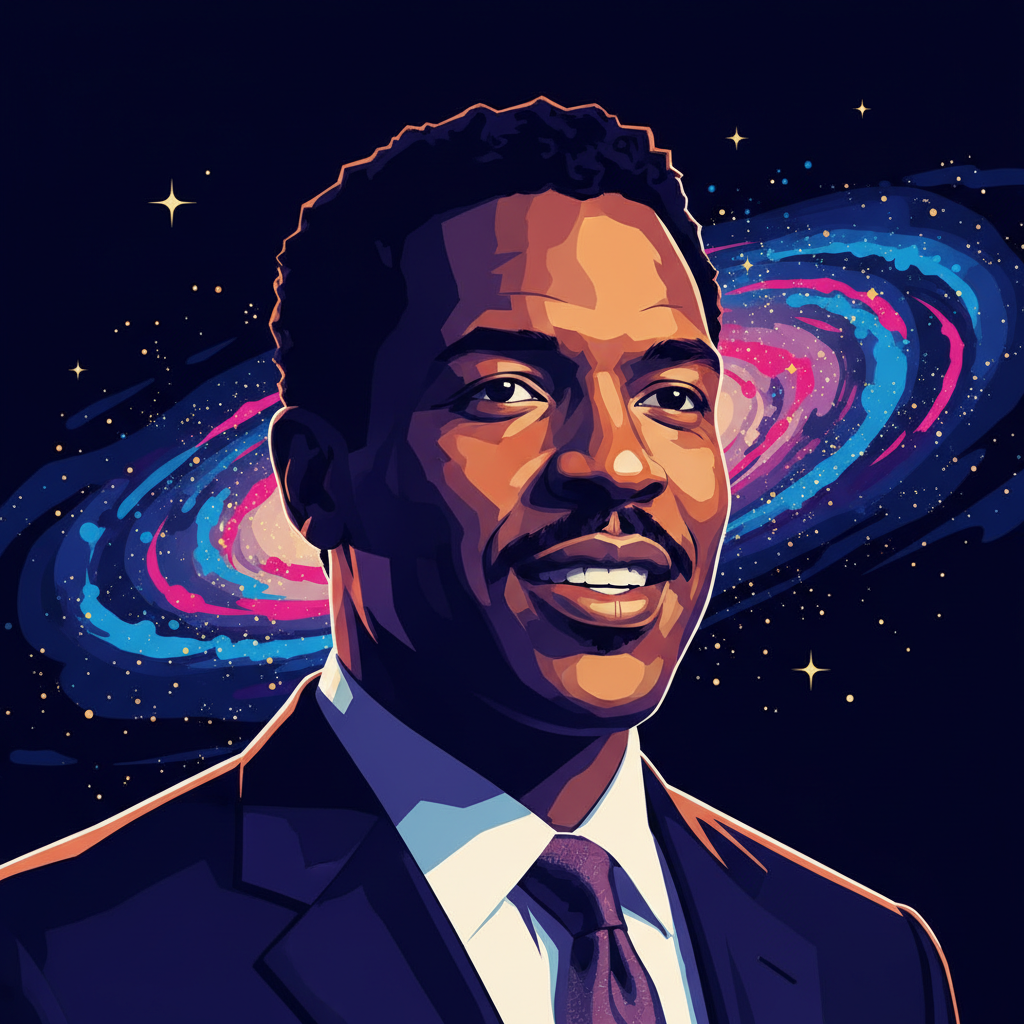
Neil deGrasse Tyson — "I don't believe in magic. I believe in science. And science is far more magical …"
I don't believe in magic. I believe in science. And science is far more magical than anything magic could ever be.
I don't believe in magic. I believe in science. And science is far more magical than anything magic could ever be.
Click any product to generate a realistic preview. Up to 3 at a time.
* Initial load can take up to 90 seconds — revising the preview in another color is nearly instant.
"I'm not a fan of people who say, 'I believe in science.' Science is not a belief system. Science is a method."
"The universe is a journey, and we are all travelers."
"I don't think there's any such thing as a 'dumb question' when it comes to science. There are just questions that reveal a lack of information."
"We spend the first year of a child's life teaching it to walk and talk and the rest of its life telling it to sit down and shut up. Is it any wonder the world is in the mess it's in?"
"The universe is a hostile place. It will kill you if you're not careful."
American astrophysicist, Hayden Planetarium director, and Cosmos: A Spacetime Odyssey host who carries the Carl Sagan public-science mantle. Closely associated with Bill Nye (fellow science communicator) and Brian Greene (theoretical physicist and string-theory popularizer). For an intellectual contrast, see Ken Ham, founder of Answers in Genesis and the Creation Museum — Ham's career has been organized around defending biblical 6-day creationism — exactly the science-education position Tyson's mainstream-science communication is structured to refute.
Found in 1 providers: grok
1 source checked
Science doesn't strip away wonder—it multiplies it. Real phenomena like quantum entanglement, black holes absorbing light, stars forged inside dying supernovae, and life emerging from chemistry are stranger than any fantasy. Rejecting magic isn't pessimism; it's choosing verified, reproducible reality over comfortable fiction. The universe's actual mechanics outperform human invention in generating genuine astonishment, making science the greater source of awe.
Tyson built his career on this exact conviction. As director of the Hayden Planetarium and host of 'Cosmos: A Spacetime Odyssey,' he translates astrophysics—dark matter, neutron stars, the Big Bang—into emotional experiences for mass audiences. Inspired by mentor Carl Sagan, he consistently argues that scientific literacy and wonder reinforce each other. His viral media presence frames empirical understanding not as cold reduction but as the deepest available form of reverence.
During Tyson's era, the internet simultaneously democratized scientific knowledge and amplified pseudoscience—flat-earth communities, anti-vaccine movements, and creationist lobbying surged alongside unprecedented discoveries: gravitational waves detected by LIGO in 2015, CRISPR gene editing, thousands of confirmed exoplanets. Public trust in science fractured sharply around COVID-19. Against this backdrop, science communicators faced urgent pressure to make empirical reasoning emotionally compelling enough to compete with misinformation's narrative power.
AI-generated insights based on extensive research and information for context. Factual errors? Email [email protected].
Your cart is empty