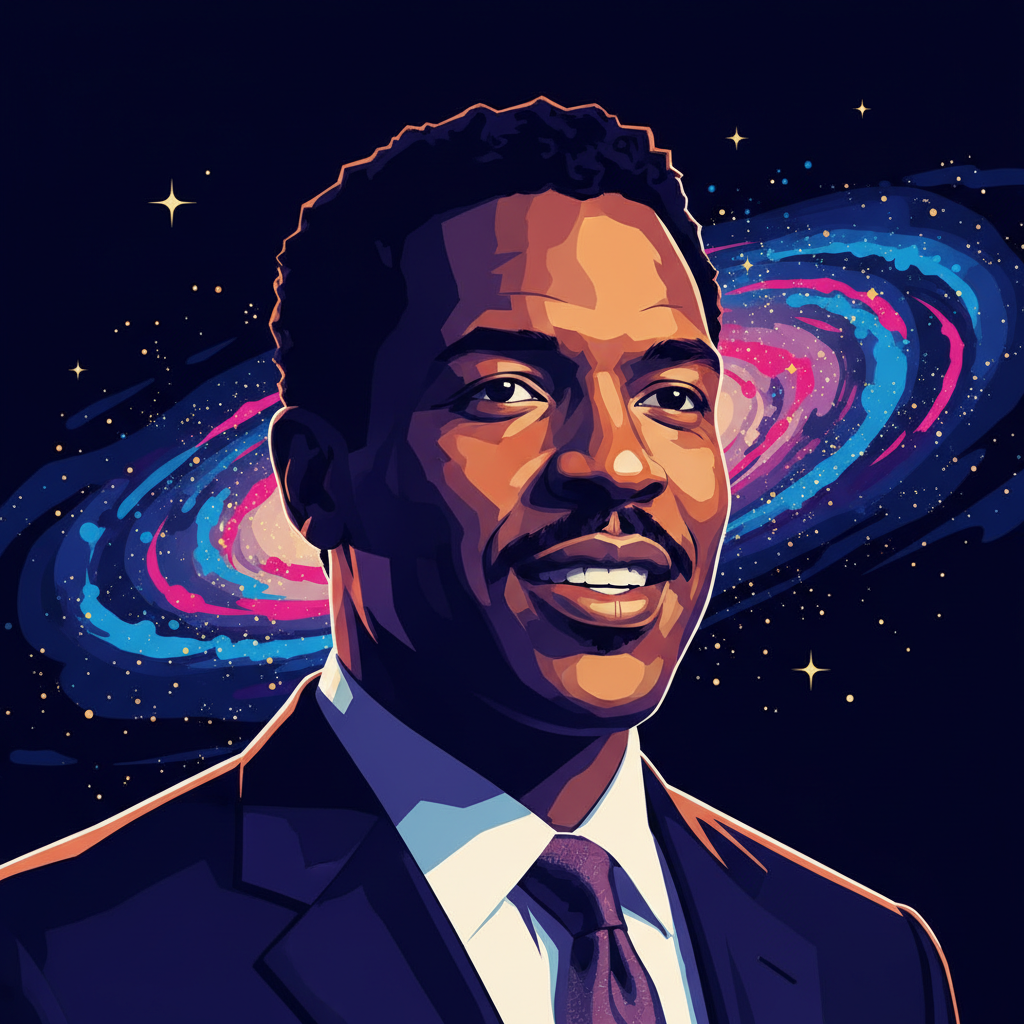
Neil deGrasse Tyson — "The more I learn about the universe, the less convinced I am that there’s some s…"
The more I learn about the universe, the less convinced I am that there’s some sort of benevolent intelligence behind it.
The more I learn about the universe, the less convinced I am that there’s some sort of benevolent intelligence behind it.
Click any product to generate a realistic preview. Up to 3 at a time.
* Initial load can take up to 90 seconds — revising the preview in another color is nearly instant.
"I'm not saying I'm smarter than anyone. I'm just saying I've read more books."
"I'm not afraid of death. I'm afraid of dying without having lived a full life."
"The universe is a symphony, and we are all instruments in it."
"The universe is a vast and mysterious place, and we are just beginning to understand it."
"The universe is not just a collection of facts. It's a story."
American astrophysicist, Hayden Planetarium director, and Cosmos: A Spacetime Odyssey host who carries the Carl Sagan public-science mantle. Closely associated with Bill Nye (fellow science communicator) and Brian Greene (theoretical physicist and string-theory popularizer). For an intellectual contrast, see Ken Ham, founder of Answers in Genesis and the Creation Museum — Ham's career has been organized around defending biblical 6-day creationism — exactly the science-education position Tyson's mainstream-science communication is structured to refute.
Found in 1 providers: deepseek
1 source checked
The quote expresses that gaining deeper scientific knowledge of the universe — its vast indifference, cosmic violence, mass extinctions, and random destruction — undermines belief in a caring, purposeful god. A universe governed by impersonal physical laws, where billions of stars explode and galaxies collide without consequence, looks nothing like something designed by a conscious being with humanity's welfare in mind.
Tyson directs the Hayden Planetarium and has spent decades studying phenomena like black holes, supernovae, and dark energy — forces of staggering destructiveness and indifference. He publicly identifies as agnostic, deliberately resisting the atheist label, yet consistently challenges supernatural cosmology. Years measuring the universe's scale and violence, where Earth is an insignificant speck, directly shaped his skepticism about benevolent cosmic design.
The early 21st century saw the New Atheism movement — Dawkins, Hitchens, Harris — bring science-versus-religion debates into mainstream culture. Simultaneously, intelligent design battles played out in American schools and courtrooms, including Kitzmiller v. Dover in 2005, while evangelical Christianity held significant political power. Tyson emerged as a prominent science communicator navigating this battleground, where astrophysics directly challenged religious narratives about Earth's special place and a creator's intentions.
AI-generated insights based on extensive research and information for context. Factual errors? Email [email protected].
Your cart is empty