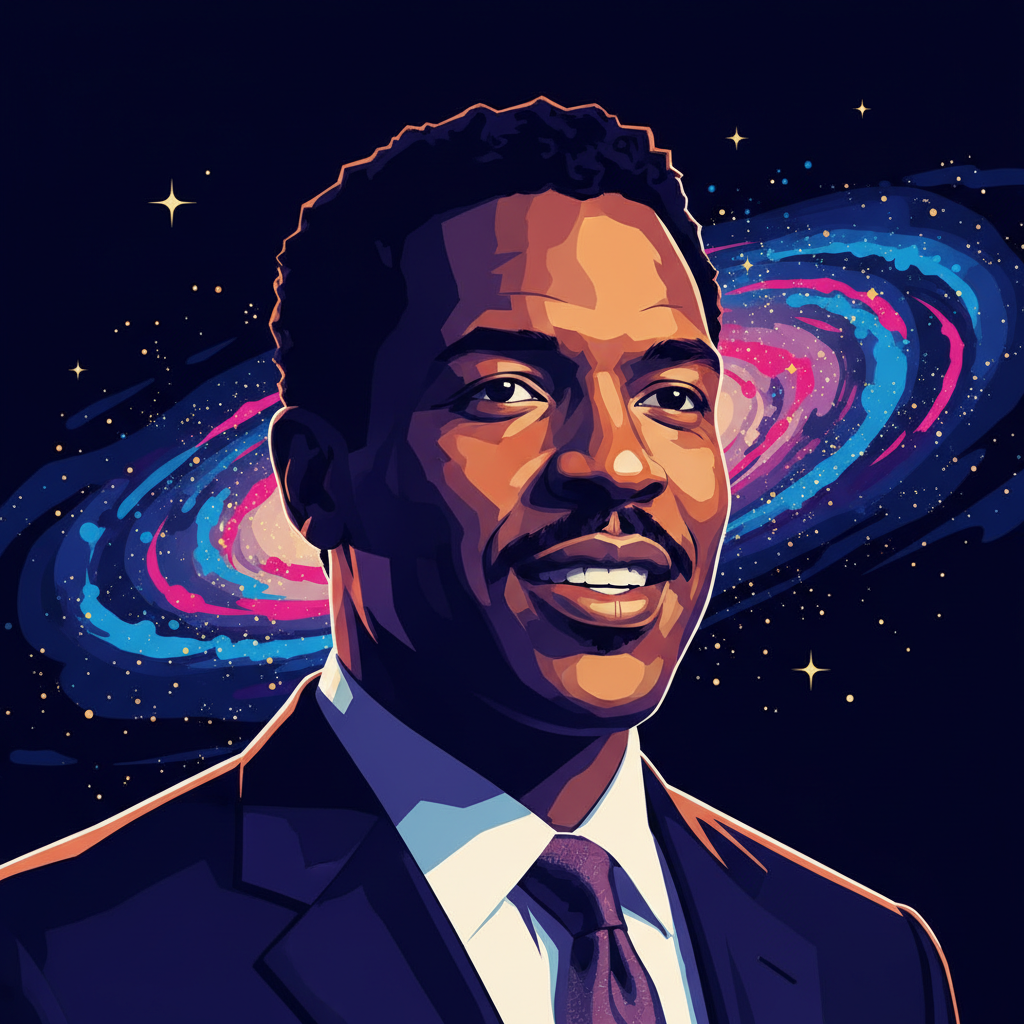
Neil deGrasse Tyson — "I don't care if people don't like me. I care if they're wrong."
I don't care if people don't like me. I care if they're wrong.
I don't care if people don't like me. I care if they're wrong.
Click any product to generate a realistic preview. Up to 3 at a time.
* Initial load can take up to 90 seconds — revising the preview in another color is nearly instant.
"I'm not a morning person. I'm a 'whenever I wake up' person."
"The universe is expanding. We are all expanding. Everything is expanding. What are you doing?"
"I'm a big proponent of space exploration, not just for scientific discovery, but for the inspiration it provides."
"The universe is a dangerous place. It's full of black holes and gamma-ray bursts."
"My ideal day involves a lot of reading, a lot of thinking, and a lot of looking up at the stars."
American astrophysicist, Hayden Planetarium director, and Cosmos: A Spacetime Odyssey host who carries the Carl Sagan public-science mantle. Closely associated with Bill Nye (fellow science communicator) and Brian Greene (theoretical physicist and string-theory popularizer). For an intellectual contrast, see Ken Ham, founder of Answers in Genesis and the Creation Museum — Ham's career has been organized around defending biblical 6-day creationism — exactly the science-education position Tyson's mainstream-science communication is structured to refute.
Found in 1 providers: deepseek
1 source checked
The quote asserts that intellectual honesty outweighs social approval. Being liked is social currency; being right is a moral and epistemic obligation. The speaker draws a sharp line: personal popularity is irrelevant to the pursuit of truth. Correcting error matters more than preserving warm relationships. Facts hold a higher claim than feelings, and standing alone against a wrong consensus is preferable to comfortable agreement with it.
Tyson built his reputation correcting scientific errors in public—famously tweeting inaccuracies in blockbuster films, challenging flat-earth claims, and disputing cosmic misconceptions on national television. As director of the Hayden Planetarium and host of Cosmos, he made science accessible but never softened facts for comfort. Critics have called him pedantic and he hasn't moderated. His career is a direct embodiment of this quote: precision over popularity, accuracy over approval.
Tyson rose to mainstream prominence during the 2000s–2020s, an era defined by science denialism, viral misinformation, and a post-truth information crisis. Anti-vaccine movements, flat-earth communities, and climate skepticism spread rapidly online. During COVID-19, misinformation directly cost lives. In a culture where influencer likability routinely eclipses expertise, a scientist publicly prioritizing correctness over being liked became a meaningful—and often polarizing—countercultural stance.
AI-generated insights based on extensive research and information for context. Factual errors? Email [email protected].
Your cart is empty