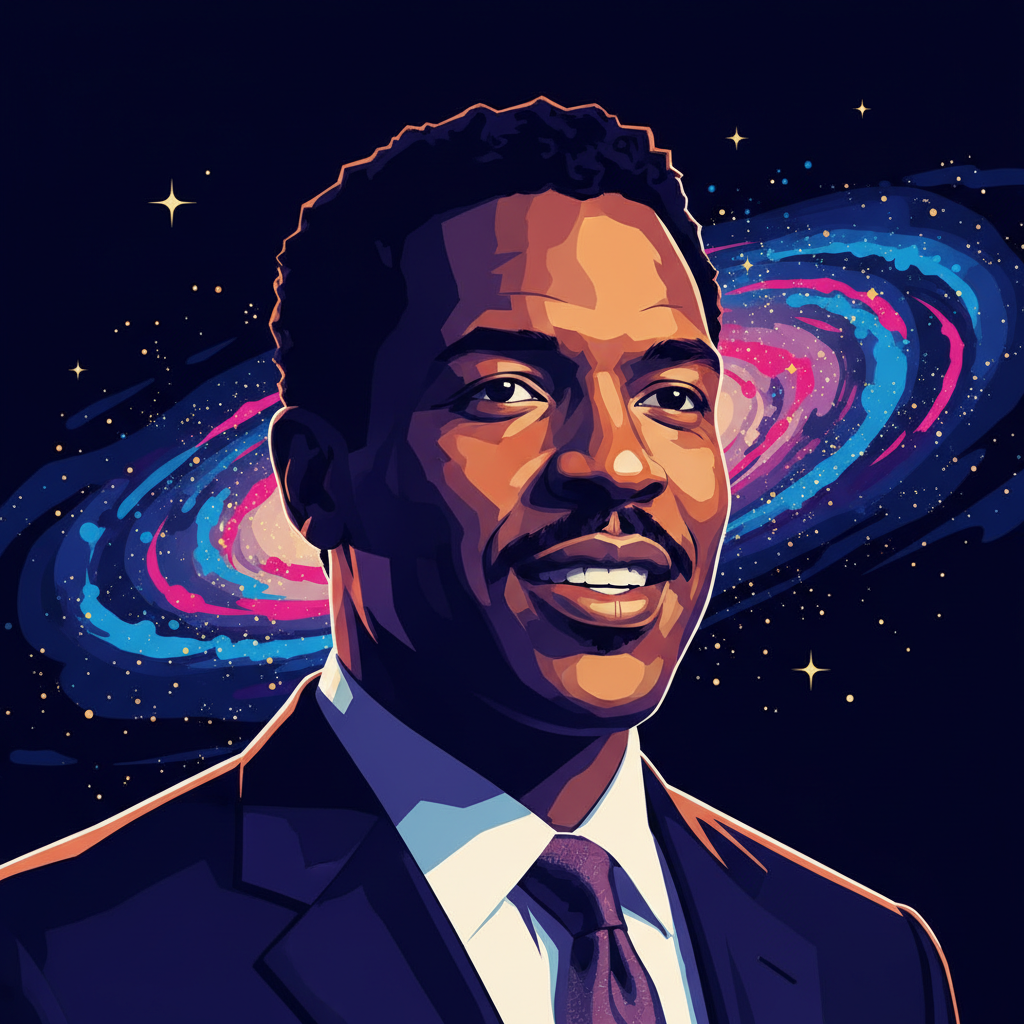
Neil deGrasse Tyson — "I’m not trying to convince you that science is cool. Science IS cool."
I’m not trying to convince you that science is cool. Science IS cool.
I’m not trying to convince you that science is cool. Science IS cool.
Click any product to generate a realistic preview. Up to 3 at a time.
* Initial load can take up to 90 seconds — revising the preview in another color is nearly instant.
"I'm not trying to convert anyone to atheism. I'm trying to convert people to science."
"You know, the universe is a pretty big place. If it's just us, seems like an awful waste of space."
"Knowing what's true is not the same as knowing what's right."
"The universe is full of mysteries. And that's a good thing."
"The universe is under no obligation to make sense to you."
American astrophysicist, Hayden Planetarium director, and Cosmos: A Spacetime Odyssey host who carries the Carl Sagan public-science mantle. Closely associated with Bill Nye (fellow science communicator) and Brian Greene (theoretical physicist and string-theory popularizer). For an intellectual contrast, see Ken Ham, founder of Answers in Genesis and the Creation Museum — Ham's career has been organized around defending biblical 6-day creationism — exactly the science-education position Tyson's mainstream-science communication is structured to refute.
Found in 1 providers: grok
1 source checked
Science doesn't need a marketing pitch — its inherent nature makes it fascinating. The speaker rejects the defensive posture of having to sell science's value, asserting instead that wonder, discovery, and understanding the universe are intrinsically compelling. The distinction matters: convincing implies doubt, while stating removes it entirely. Science simply is what it is — extraordinary by definition.
Tyson built his career on making astrophysics accessible without dumbing it down. As host of Cosmos: A Spacetime Odyssey and frequent media presence, he consistently embodied enthusiasm rather than advocacy. His directness reflects his philosophy that science communicators shouldn't apologize or oversell — the cosmos itself does the work. His infectious confidence mirrors this exact sentiment.
In an era of science denialism — climate skepticism, anti-vaccine movements, and declining STEM interest among youth — science communicators felt pressure to justify their field's relevance. Tyson's statement pushes back against that defensive cultural moment, asserting science's intrinsic value during the 2010s-2020s when public trust in institutions was eroding and misinformation spread rapidly through social media.
AI-generated insights based on extensive research and information for context. Factual errors? Email [email protected].
Your cart is empty