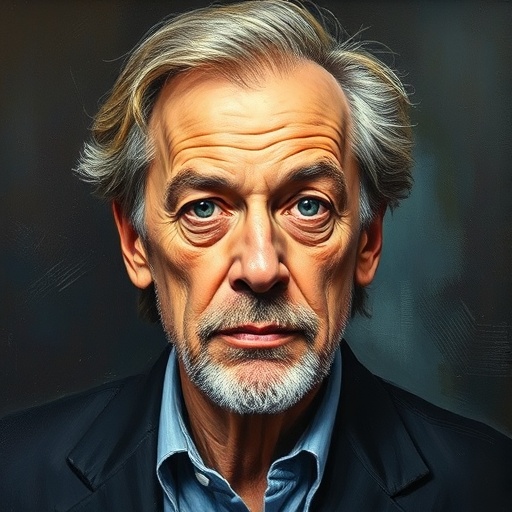
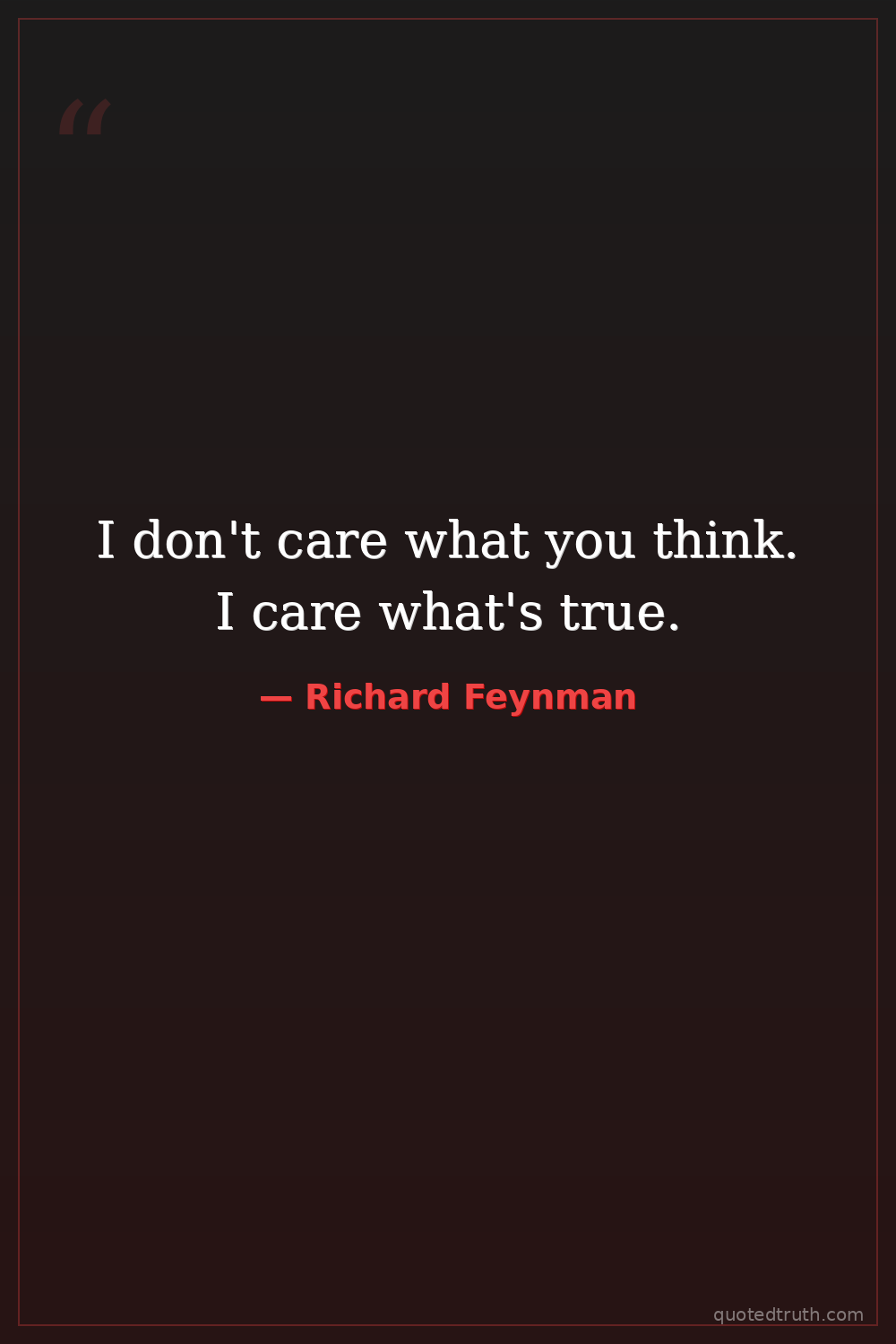
Richard Feynman — "I don't care what you think. I care what's true."
I don't care what you think. I care what's true.
I don't care what you think. I care what's true.
Click any product to generate a realistic preview. Up to 3 at a time.
* Initial load can take up to 90 seconds — revising the preview in another color is nearly instant.
"I have no idea where I'm going. I have no idea where I'm going to be. So it's probably best that I don't know."
"It doesn't seem to me that this fantastically marvelous universe, this tremendous range of time and space and different kinds of animals, and all the different planets, and all these atoms with all th…"
"Science is the belief in the ignorance of experts."
"Study hard what interests you the most in the most undisciplined, irreverent and original manner possible."
"I don't believe in God. I don't believe in anything. I'm a scientist."
American theoretical physicist who shared the 1965 Nobel for QED, developed Feynman diagrams, and wrote the Feynman Lectures on Physics. Closely associated with Julian Schwinger (co-Nobelist for QED) and Murray Gell-Mann (Caltech rival and Eightfold-Way physicist). For an intellectual contrast, see Deepak Chopra, physician and quantum-mysticism author — Feynman's Caltech 'cargo cult science' commencement address is the precise template for what he saw as misuse of physics terminology — Chopra-style appropriation of quantum vocabulary for metaphysical claims is the canonical example of what Feynman called 'fooling yourself'.
Likely an informal remark or part of a discussion on scientific integrity.
Date: Approx. 1960s-1970s
GeneralFound in 1 providers: grok
1 source checked
Prioritizing empirical truth over personal opinion or social consensus, this quote rejects the idea that belief or reputation determines what is real. It insists that facts exist independently of what anyone wishes were true. In a world where people argue from authority, emotion, or popularity, it is a direct challenge: none of that matters if it contradicts demonstrable evidence. Reality does not negotiate.
Feynman built his career on empirical rigor, developing quantum electrodynamics by following mathematics wherever it led, regardless of prevailing theory. He refused institutional pressure most visibly during the 1986 Challenger investigation, dunking an O-ring in ice water on live television to expose NASA's flawed reasoning. His autobiographical writing celebrates intellectual honesty over politeness, and he coined the term cargo cult science to describe research that mimics form without substance.
Feynman worked through the mid-20th century collision of science and ideology — the Manhattan Project, Cold War arms race, and the space program. Institutions wielded scientific authority as political capital, making truth subordinate to agenda. By the 1980s, postmodern philosophy was questioning whether objective truth even existed, while the Challenger disaster exposed how bureaucratic consensus could override hard engineering data, making his insistence on reality over opinion especially pointed.
AI-generated insights based on extensive research and information for context. Factual errors? Email [email protected].
Your cart is empty