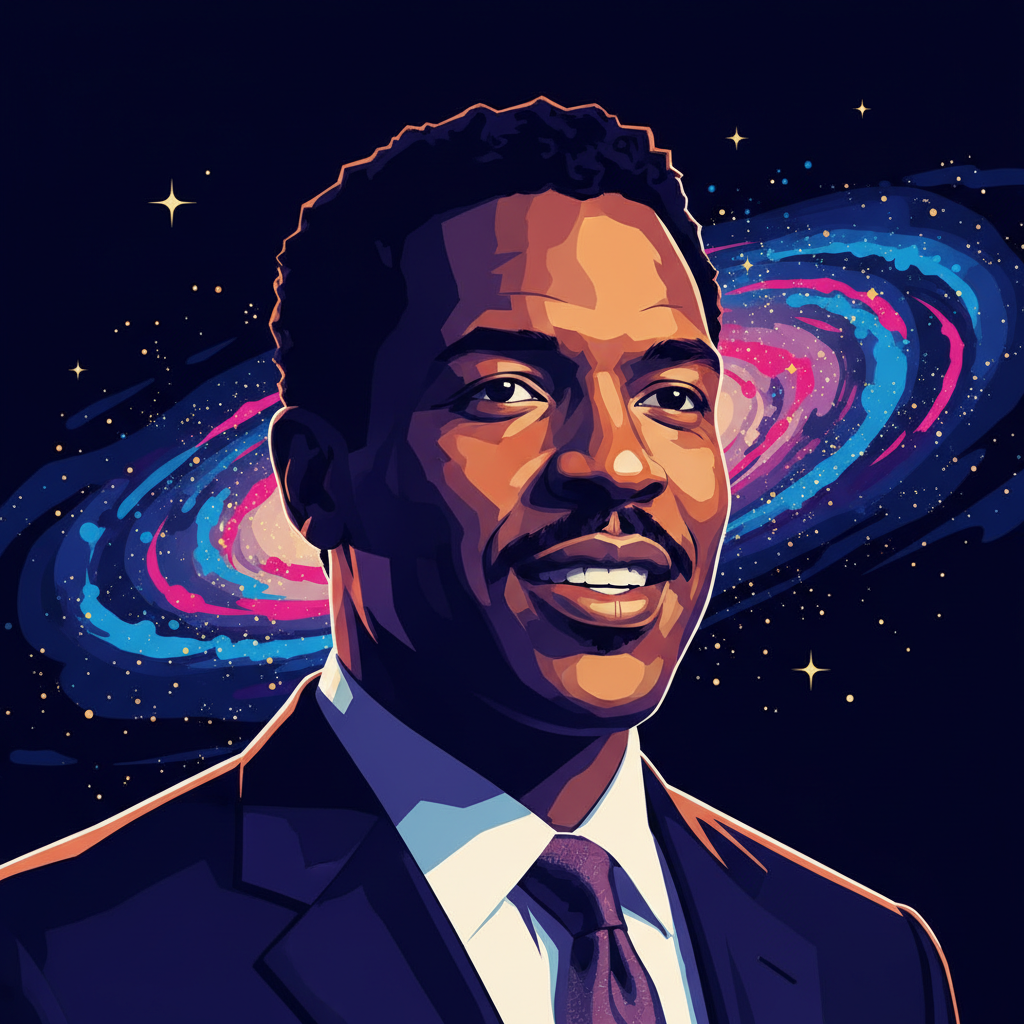
Neil deGrasse Tyson — "I don't have a problem with people believing in God. I have a problem with peopl…"
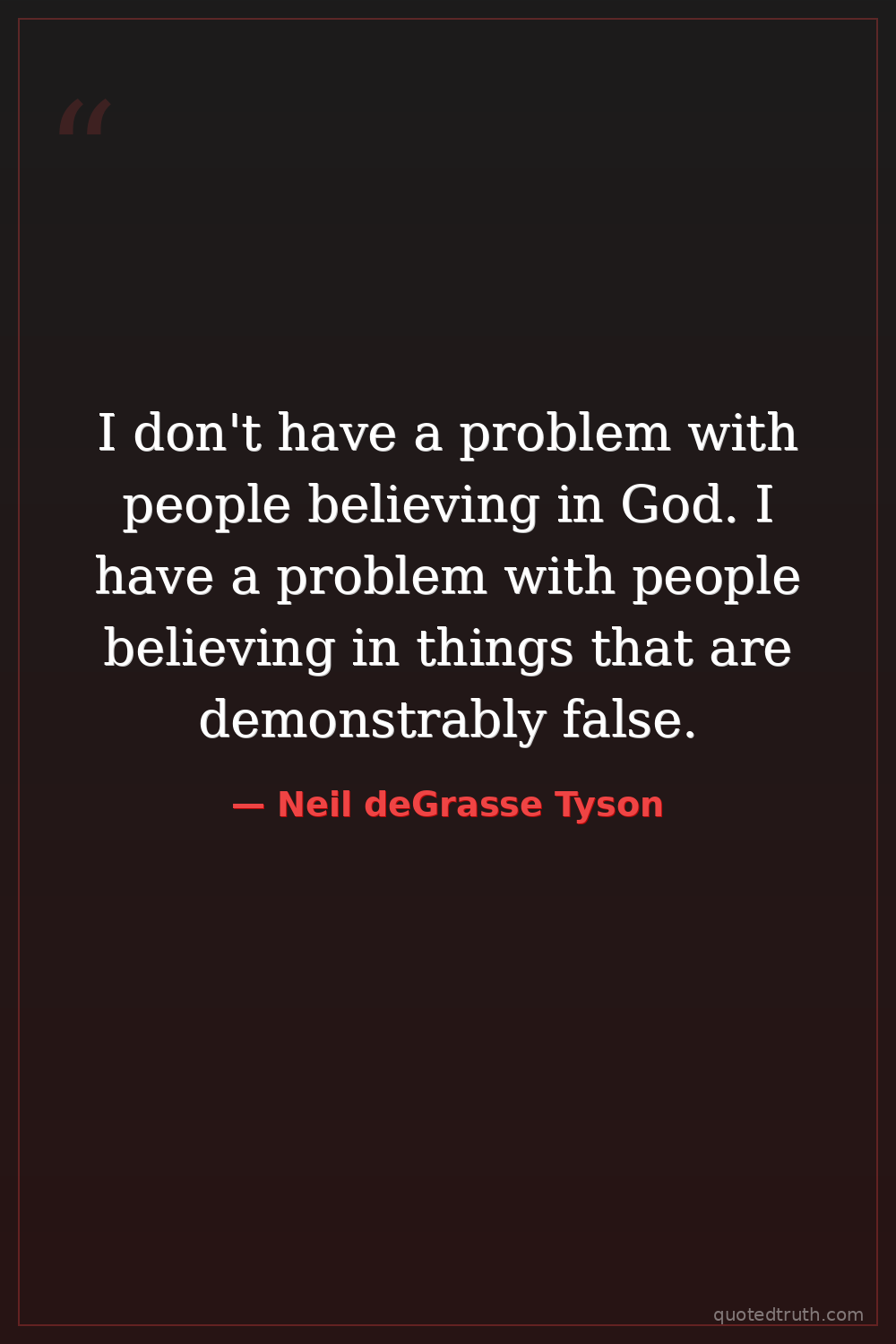
I don't have a problem with people believing in God. I have a problem with people believing in things that are demonstrably false.
I don't have a problem with people believing in God. I have a problem with people believing in things that are demonstrably false.
Click any product to generate a realistic preview. Up to 3 at a time.
* Initial load can take up to 90 seconds — revising the preview in another color is nearly instant.
"I'm not trying to be controversial. I'm just telling you what the universe is telling us."
"I'm often asked if I believe in UFOs. I'm open to the possibility, but I need evidence. I need the aliens to land on the White House lawn, or at least in my backyard, and say hello."
"Intelligent design, as I understand it, means that you have an intelligent designer somewhere. And the problem with that is, if you’re going to invoke an intelligent designer, you have to ask, 'Who de…"
"The problem with the world is that the intelligent people are full of doubts, while the stupid ones are full of confidence."
"I don't believe in magic. I believe in science. And science is far more magical than anything magic could ever be."
American astrophysicist, Hayden Planetarium director, and Cosmos: A Spacetime Odyssey host who carries the Carl Sagan public-science mantle. Closely associated with Bill Nye (fellow science communicator) and Brian Greene (theoretical physicist and string-theory popularizer). For an intellectual contrast, see Ken Ham, founder of Answers in Genesis and the Creation Museum — Ham's career has been organized around defending biblical 6-day creationism — exactly the science-education position Tyson's mainstream-science communication is structured to refute.
Found in 1 providers: deepseek
1 source checked
The quote draws a precise line between personal faith and factual error. Believing in God is a metaphysical position beyond scientific proof or disproof — Tyson accepts that. But when people assert things evidence actively contradicts — flat earth, vaccine denial, young-earth creationism — that crosses into factual territory where being wrong causes real harm. The problem isn't spiritual belief; it's the rejection of demonstrable reality.
Tyson, director of the Hayden Planetarium and host of Cosmos, publicly identifies as agnostic rather than atheist — a meaningful distinction. He frequently engages religious audiences without hostility, arguing science and faith occupy separate domains. This quote captures his core mission: defending scientific literacy, not attacking religion. His career has been defined by championing evidence-based thinking while deliberately avoiding the combative anti-theism of contemporaries like Richard Dawkins.
Tyson rose to cultural prominence alongside the New Atheism movement of the 2000s–2010s (Dawkins, Hitchens, Harris), which often conflated faith with irrationality. Simultaneously, internet-amplified misinformation — anti-vaccine movements, flat-earth communities, climate denial — blurred lines between religion and verifiably false claims. Tyson carved a deliberate middle path: defending scientific consensus against demonstrable falsehoods without dismissing spiritual belief, which resonated amid deepening culture-war polarization over science itself.
AI-generated insights based on extensive research and information for context. Factual errors? Email [email protected].
Your cart is empty