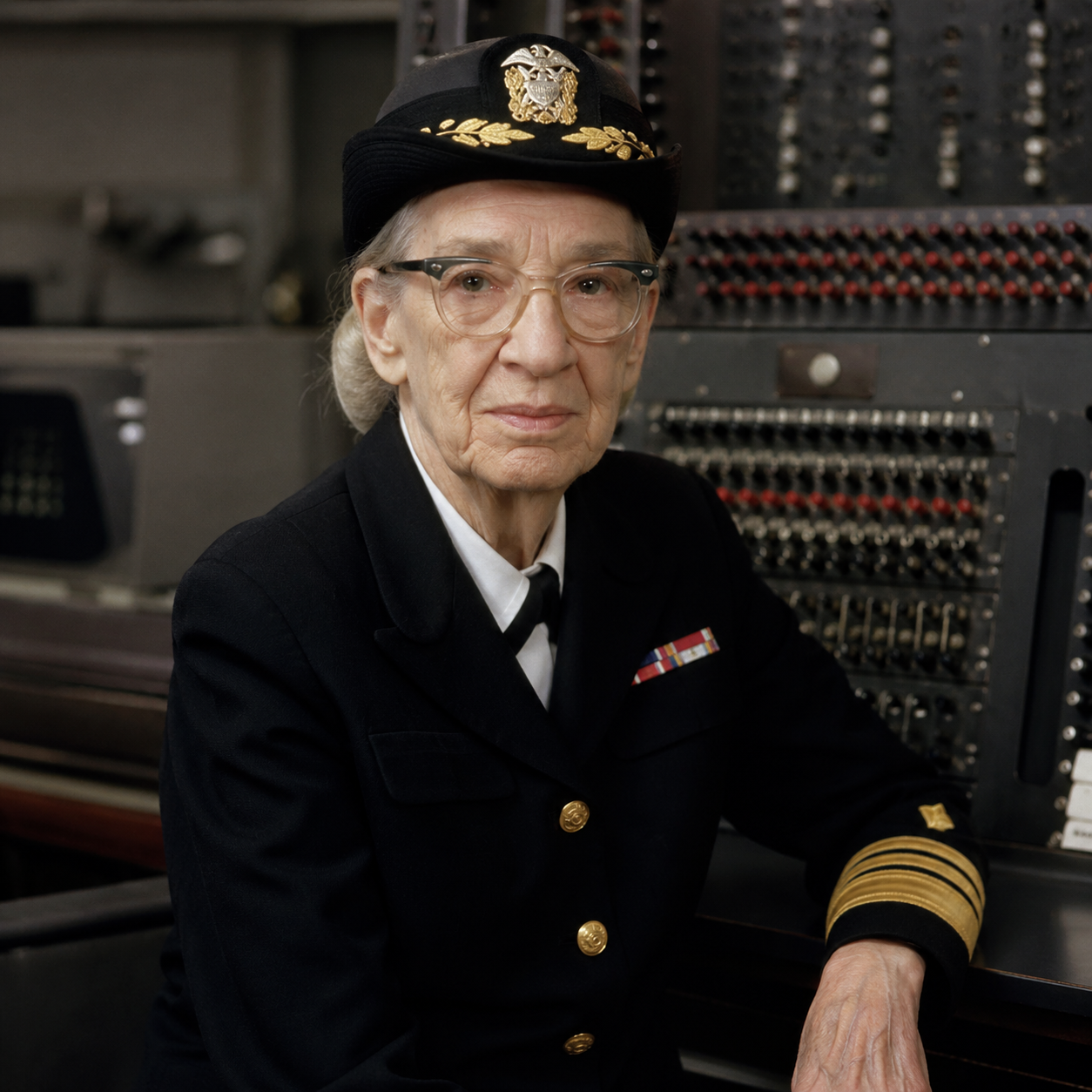
Grace Hopper — "I don't know what the future holds, but I know who holds the future."
I don't know what the future holds, but I know who holds the future.
I don't know what the future holds, but I know who holds the future.
Click any product to generate a realistic preview. Up to 3 at a time.
* Initial load can take up to 90 seconds — revising the preview in another color is nearly instant.
"We're flooding people with information. We need to feed it through a processor. A human must turn information into intelligence or knowledge. We've tended to forget that no computer will ever ask a ne…"
"If it's a good idea, go ahead and do it. It is much easier to apologize than it is to get permission."
"You can't just teach people to do things. You have to teach them to think."
"A ship in port is safe, but that is not what ships are built for. Sail out to sea and do new things."
"I often say I got out of the Navy in 1966, but I never left."
A quote with a slightly spiritual undertone, sometimes attributed to her.
Date: Unknown
Self-DeprecatingFound in 1 providers: grok
1 source checked
Uncertainty about tomorrow doesn't mean helplessness today. The quote distinguishes between predicting outcomes and possessing agency — whoever takes action, builds systems, and makes decisions shapes what becomes real. It's a claim that human initiative, not fate or chance, determines the future's direction. Stop worrying about what you can't foresee and focus on what you can actively do and build.
Hopper embodied this philosophy — she didn't predict computing's future, she built it. As developer of the first compiler and key architect of COBOL, she turned abstract possibilities into real infrastructure millions relied on. Her Navy career extended to age 79 because she kept pushing into new territory. Famous for saying 'it's easier to ask forgiveness than permission,' she believed active people, not passive observers, shape history.
Hopper's career spanning the 1940s through 1980s unfolded during the Cold War and early computing age, when technology's trajectory felt both thrilling and threatening. Automation anxiety, nuclear fear, and rapid industrial change made the future seem opaque and dangerous. Yet computing pioneers like Hopper proved determined individuals could reshape civilization. The space race and programming breakthroughs reinforced that human ingenuity, not geopolitical luck, determined which futures actually materialized.
AI-generated insights based on extensive research and information for context. Factual errors? Email [email protected].
Your cart is empty