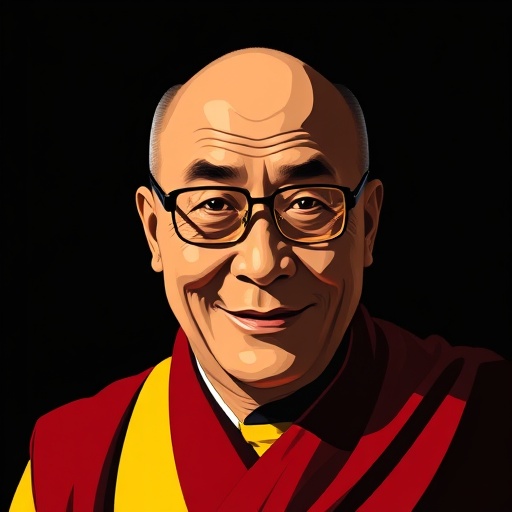
Dalai Lama (14th) — "I don't think I am special. I am just a human being, like everyone else."
I don't think I am special. I am just a human being, like everyone else.
I don't think I am special. I am just a human being, like everyone else.
Click any product to generate a realistic preview. Up to 3 at a time.
* Initial load can take up to 90 seconds — revising the preview in another color is nearly instant.
"I am open to guidance from the universe, and I don’t let my limited perception of reality get in the way."
"My main concern is the well-being of the six million Tibetans."
"Sometimes I think I am a little bit lazy."
"Compassion is the radicalism of our time."
"Sometimes I think I am a Communist."
Found in 1 providers: grok
1 source checked
Despite holding immense religious authority and being revered by millions, this statement insists on radical equality with all people. It rejects the idea that any title, role, or reputation places someone above the common human condition. The speaker claims the same inner struggles, needs, and limitations as everyone else. True humility here isn't self-deprecation — it's an honest refusal to let external reverence distort one's actual identity.
Tenzin Gyatso is regarded by Tibetan Buddhists as the reincarnation of Avalokiteśvara, the bodhisattva of compassion — literally a living deity. He received the 1989 Nobel Peace Prize and commands global reverence. Yet Buddhist philosophy centers on interdependence and the illusion of a fixed self. He openly discusses personal struggles with anger and impatience, insisting his practice remains ongoing — living proof that spiritual stature doesn't exempt anyone from ordinary, shared humanity.
The Dalai Lama has operated as both global celebrity and stateless refugee since China's 1959 annexation of Tibet. The contemporary era produced intense personality cults — from political strongmen to social media influencers — where figures are routinely mythologized. Western audiences in the 1980s–2000s romanticized him as a mystical Eastern sage, projecting otherworldly specialness onto him. His consistent deflection of that mythology critiques how modern culture consumes and elevates spiritual figures into untouchable, unreachable icons.
AI-generated insights based on extensive research and information for context. Factual errors? Email [email protected].
Your cart is empty