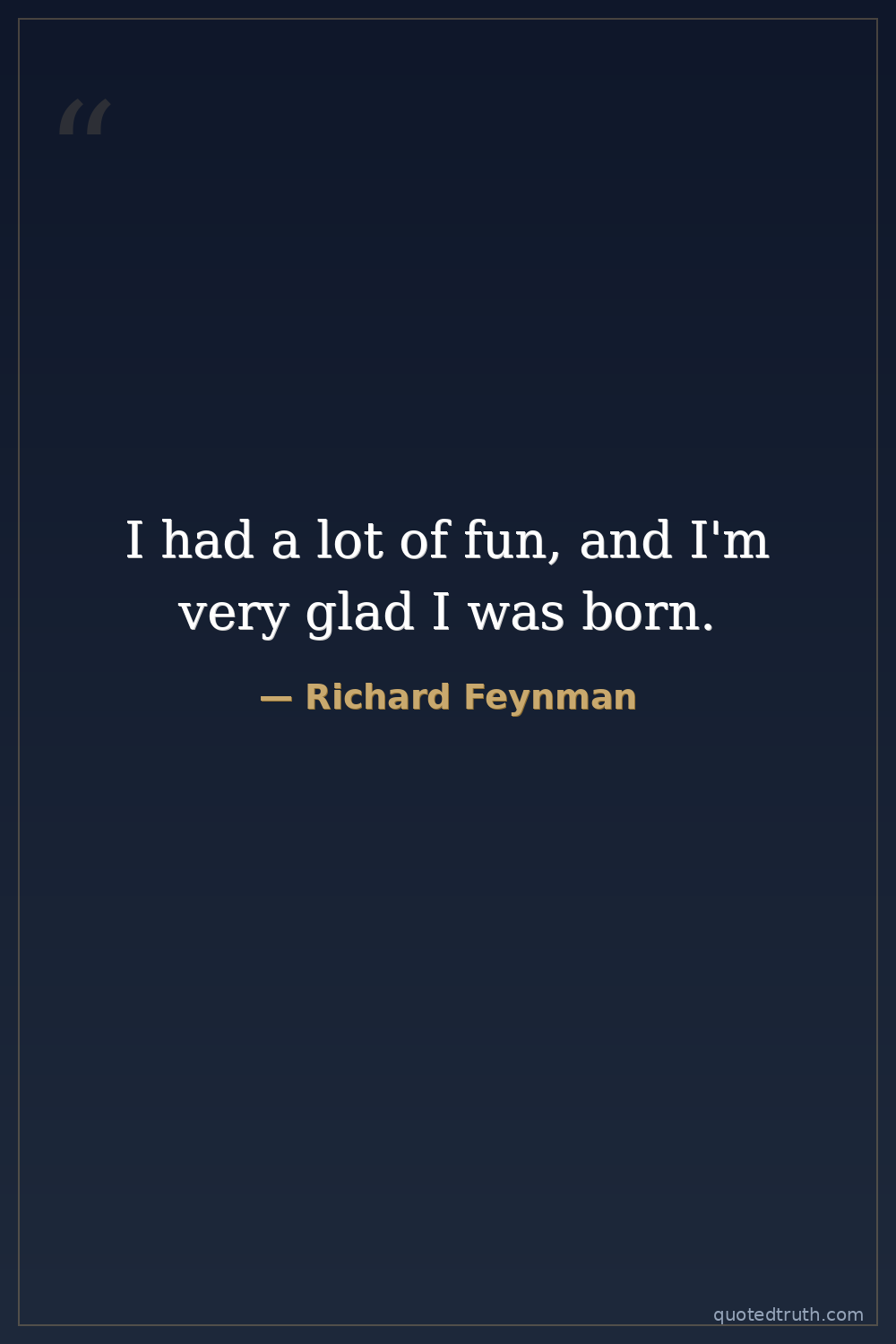
Richard Feynman — "I had a lot of fun, and I'm very glad I was born."
I had a lot of fun, and I'm very glad I was born.
I had a lot of fun, and I'm very glad I was born.
Click any product to generate a realistic preview. Up to 3 at a time.
* Initial load can take up to 90 seconds — revising the preview in another color is nearly instant.
"I don't believe in miracles, because I believe in science."
"I don't think I'm a very good teacher. I just try to explain things clearly."
"I have often thought that if there is any hell, it must be the place where there are no questions, only answers."
"I don't have to be consistent."
"I took the wavicles—the little particles of waves—and put them in a box."
American theoretical physicist who shared the 1965 Nobel for QED, developed Feynman diagrams, and wrote the Feynman Lectures on Physics. Closely associated with Julian Schwinger (co-Nobelist for QED) and Murray Gell-Mann (Caltech rival and Eightfold-Way physicist). For an intellectual contrast, see Deepak Chopra, physician and quantum-mysticism author — Feynman's Caltech 'cargo cult science' commencement address is the precise template for what he saw as misuse of physics terminology — Chopra-style appropriation of quantum vocabulary for metaphysical claims is the canonical example of what Feynman called 'fooling yourself'.
Found in 1 providers: grok
1 source checked
Life is worth living simply because it was enjoyable. Not because of achievements, legacy, or meaning — just that the experience itself brought genuine pleasure. It's a declaration that joy is a sufficient justification for existence. Looking back at a full life, the speaker doesn't reach for grand conclusions or lessons learned; they land on something simpler and more honest: it was fun, and that was enough.
Feynman approached physics as play — cracking safes at Los Alamos, drumming in samba bands, drawing in strip clubs, picking locks for fun. He built his identity around curiosity and delight rather than prestige. He famously declared the pleasure of finding things out was reward enough. Reportedly said near death while facing kidney failure, this quote is entirely consistent: even confronting mortality, Feynman's accounting of his life came back to enjoyment, not gravity.
Feynman lived through the Manhattan Project, Cold War nuclear paranoia, McCarthyism, and the Vietnam era — a period saturated with existential dread and ideological weight. Many of his physicist peers wrestled publicly with guilt over atomic weapons. Against that backdrop, his cheerful refusal to frame life in tragic or morally heavy terms was almost defiant. His era demanded gravity from scientists; Feynman consistently answered with mischief, wonder, and this kind of uncomplicated gratitude.
AI-generated insights based on extensive research and information for context. Factual errors? Email [email protected].
Your cart is empty