Richard Feynman — "The thing about science is that it's all about discovery. It's all about trying …"
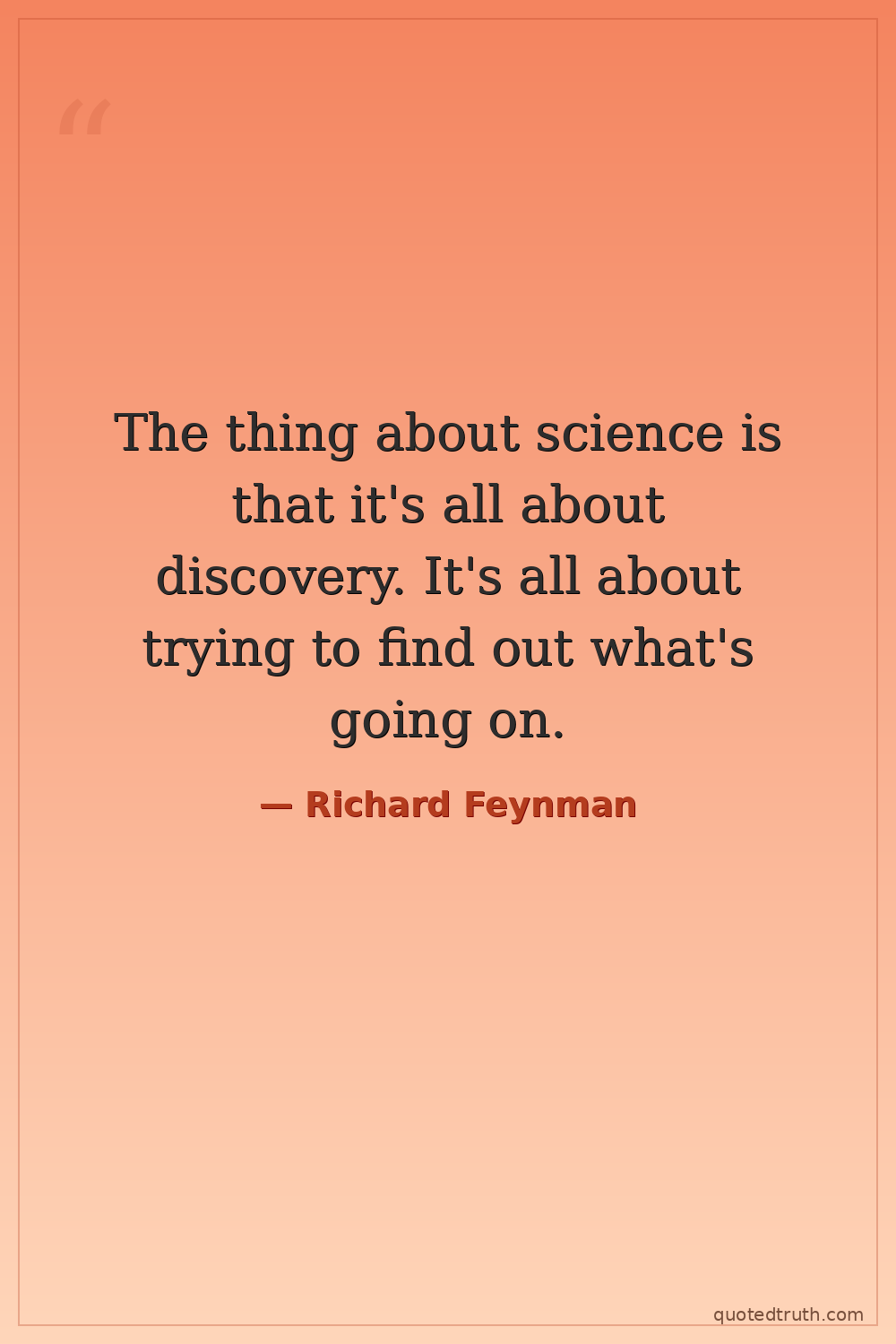
The thing about science is that it's all about discovery. It's all about trying to find out what's going on.
The thing about science is that it's all about discovery. It's all about trying to find out what's going on.
Click any product to generate a realistic preview. Up to 3 at a time.
* Initial load can take up to 90 seconds — revising the preview in another color is nearly instant.
"There are no rules in science, only facts."
"I would rather have questions that can't be answered than answers that can't be questioned."
"I don't have to be a gentleman."
"I have a theory that the universe is a great big safe, and that there's a combination to open it. But the combination is locked up in the safe."
"Nature uses only the longest threads to weave her patterns, so each small piece of her fabric reveals the organization of the entire tapestry."
American theoretical physicist who shared the 1965 Nobel for QED, developed Feynman diagrams, and wrote the Feynman Lectures on Physics. Closely associated with Julian Schwinger (co-Nobelist for QED) and Murray Gell-Mann (Caltech rival and Eightfold-Way physicist). For an intellectual contrast, see Deepak Chopra, physician and quantum-mysticism author — Feynman's Caltech 'cargo cult science' commencement address is the precise template for what he saw as misuse of physics terminology — Chopra-style appropriation of quantum vocabulary for metaphysical claims is the canonical example of what Feynman called 'fooling yourself'.
Found in 1 providers: grok
1 source checked
Science is fundamentally an act of exploration rather than confirmation. It means approaching the universe with genuine curiosity, following evidence wherever it leads, and accepting that you don't yet know the answer. The goal isn't to prove what you already believe but to uncover how things actually work, even when the truth is strange or uncomfortable.
Feynman embodied this relentlessly. His Nobel Prize-winning work in quantum electrodynamics emerged from playing with spinning plates and following curiosity without a fixed destination. He taught physics through raw wonder, not rote formulas, famously saying he'd rather have questions than answers. His Challenger investigation, his bongo drumming, his safe-cracking—all reflected a man compelled to find out how things work.
Feynman worked through the Cold War and post-WWII scientific boom, when science was simultaneously celebrated and weaponized. The Manhattan Project showed science could destroy cities; Sputnik made discovery a geopolitical race. Against this backdrop of politicized science, Feynman insisted discovery must remain pure—driven by curiosity, not ideology or national interest—a stance that felt radical when governments funded science to win wars.
AI-generated insights based on extensive research and information for context. Factual errors? Email [email protected].
Your cart is empty