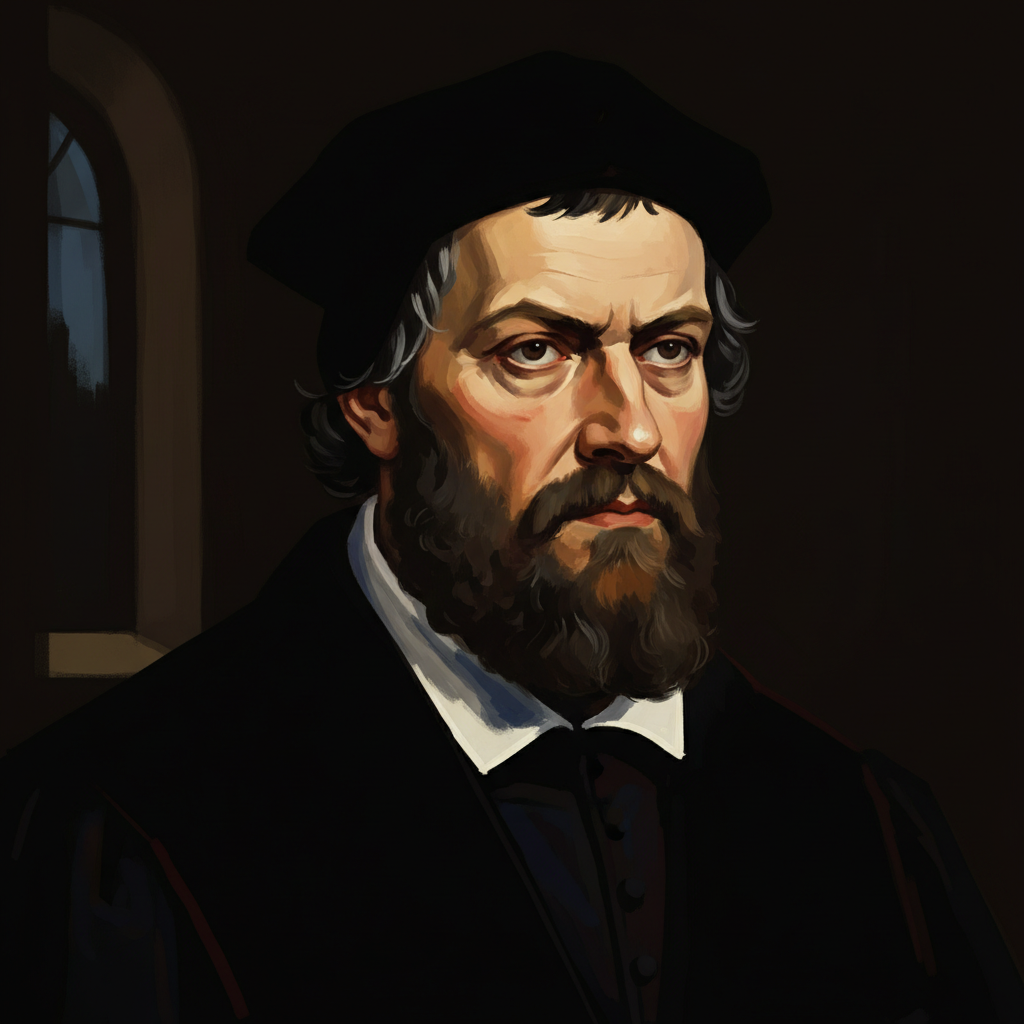
Martin Luther — "I had no other intention than to purge the Lord's house of abominations."
I had no other intention than to purge the Lord's house of abominations.
I had no other intention than to purge the Lord's house of abominations.
Click any product to generate a realistic preview. Up to 3 at a time.
* Initial load can take up to 90 seconds — revising the preview in another color is nearly instant.
"He who lets himself be led by reason will never escape sin."
"A Christian is a perfectly free lord of all, subject to none. A Christian is a perfectly dutiful servant of all, subject to all."
"God foreknows nothing by contingency, but that He foresees, purposes, and does all things according to His immutable, eternal, and infallible will. By this thunderbolt, 'Free-will' is thrown prostrate…"
"I would rather have my tongue cut out than retract a single syllable."
"My conscience is captive to the Word of God. I cannot and I will not recant anything, for to go against conscience is neither right nor safe. Here I stand, I can do no other. God help me. Amen."
German theologian whose 95 Theses (1517) launched the Protestant Reformation and broke the Catholic Church's monopoly on Western Christianity. Closely associated with Philipp Melanchthon (Lutheran systematizer) and John Calvin (later Reformer who built on Luther's break). For an intellectual contrast, see Pope Leo X, Renaissance pope (1513-1521) — Leo X's indulgence sales triggered Luther's break and Leo excommunicated him in 1521 — Luther's entire Reformation is structured as a direct answer to the indulgence-funded Vatican Leo represented.
Found in 1 providers: grok
1 source checked
Luther is defending his actions by insisting his goal was never rebellion or personal ambition. He simply wanted to clean up corruption and false practices within the Christian church, which he saw as God's house. In plain terms: I was not trying to start a fight or tear anything down. I only wanted to remove the rotten, harmful things that had crept into an institution that was supposed to be holy.
This captures Luther exactly. A monk and theology professor, he nailed his 95 Theses to the Wittenberg church door in 1517 to protest indulgences, not to split Christianity. He always framed himself as a reformer, not a revolutionary, attacking practices he considered abominations: indulgence sales, clerical corruption, and doctrines he believed contradicted Scripture. His self-image as a cleanser, not a destroyer, shaped his entire public defense.
In early modern Europe, the Catholic Church dominated spiritual and political life, and Pope Leo X was selling indulgences to fund St. Peter's Basilica. Johann Tetzel's aggressive sales tactics in Germany outraged clergy and laity. The printing press let Luther's critiques spread across Europe within weeks. Emperors, princes, and bishops were entangled in church finances, so calling for purification was inseparable from challenging political power, which is why his reform ignited the Reformation.
AI-generated insights based on extensive research and information for context. Factual errors? Email [email protected].
Your cart is empty