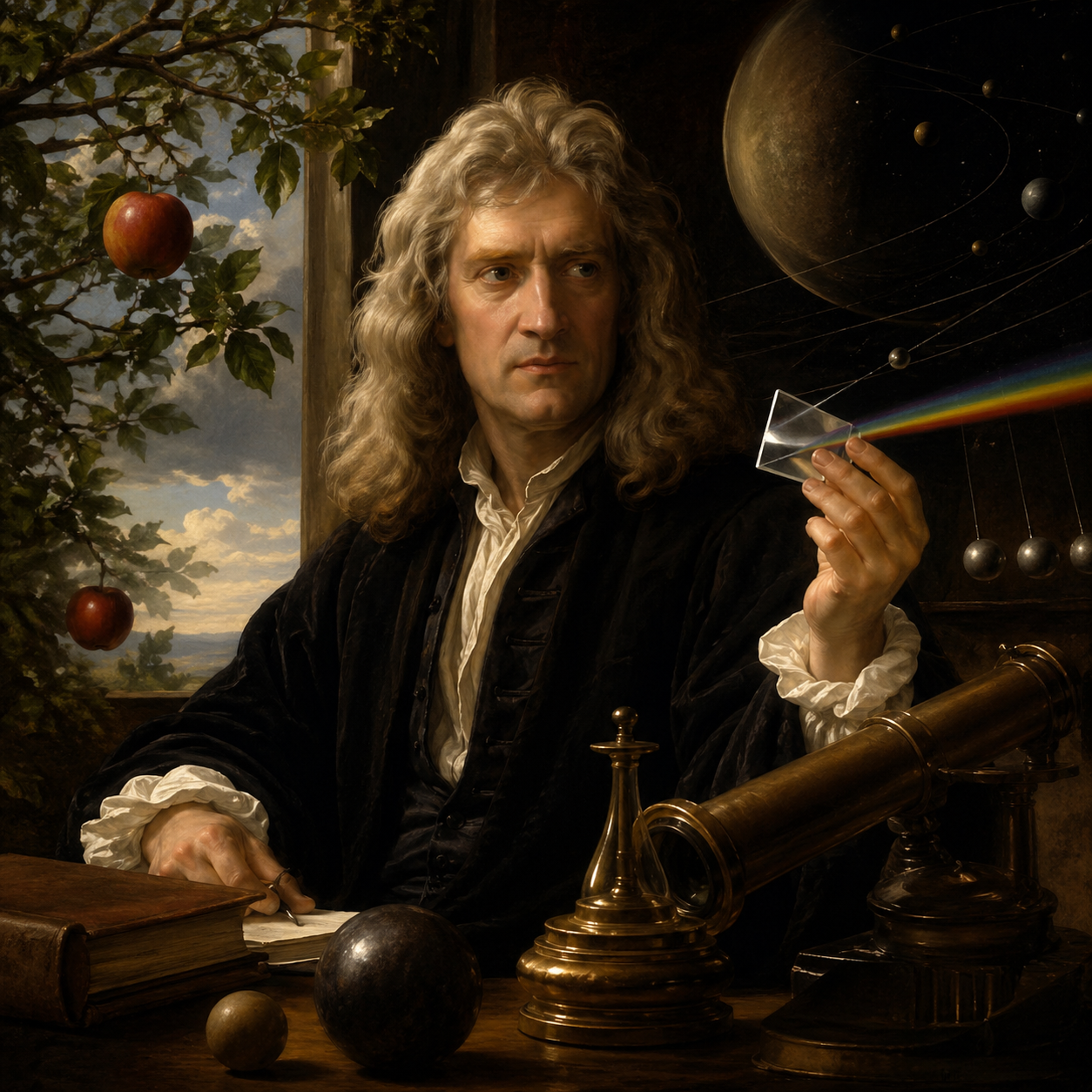
Isaac Newton — "I have a fundamental belief in the Bible as the Word of God, written by those wh…"
I have a fundamental belief in the Bible as the Word of God, written by those who were inspired. I study the Bible daily.
I have a fundamental belief in the Bible as the Word of God, written by those who were inspired. I study the Bible daily.
Click any product to generate a realistic preview. Up to 3 at a time.
* Initial load can take up to 90 seconds — revising the preview in another color is nearly instant.
"If I have done the public any service, it is due to my patient thought."
"What is there in places almost empty of air (such as the space between the planets) to hinder the free motion of bodies?"
"I do not know what I may appear to the world, but to myself I seem to have been only like a boy playing on the seashore, and diverting myself in now and then finding a smoother pebble or a prettier sh…"
"Nature is pleased with simplicity, and affects not the pomp of superfluous causes."
"The particles of light are exceedingly small, and move with exceeding swiftness."
Found in 1 providers: gemini
1 source checked
The speaker declares total conviction that the Bible originates from divine inspiration rather than mere human authorship. Daily reading is not obligation but personal discipline — a commitment to treat sacred text as a living source of truth, returning to it every day rather than relying on secondhand interpretation. In modern terms, this is someone whose worldview is anchored in scripture, actively studied rather than passively inherited as cultural background.
Newton devoted as much energy to theology as to physics — his unpublished theological manuscripts exceed one million words. He analyzed prophecy in Daniel and Revelation, wrote extensively on biblical chronology, and privately held Arian beliefs, rejecting the Trinity. Far from casual faith, he viewed natural philosophy as revealing God's design. The Bible was his intellectual foundation alongside mathematics — this quote reflects that his science and scripture were inseparable pursuits, not competing ones.
Newton lived through England's turbulent 17th century — Civil War, regicide, Restoration, and the Glorious Revolution all fell within his lifetime. The Protestant Reformation had made personal Bible reading central to faith, while fierce debates raged over scripture's authority versus Church tradition. Natural philosophers widely believed studying creation revealed the Creator, so scientific inquiry and biblical devotion were complementary. Separating rigorous scholarship from religious conviction would have been culturally unthinkable in Newton's world.
AI-generated insights based on extensive research and information for context. Factual errors? Email [email protected].
Your cart is empty