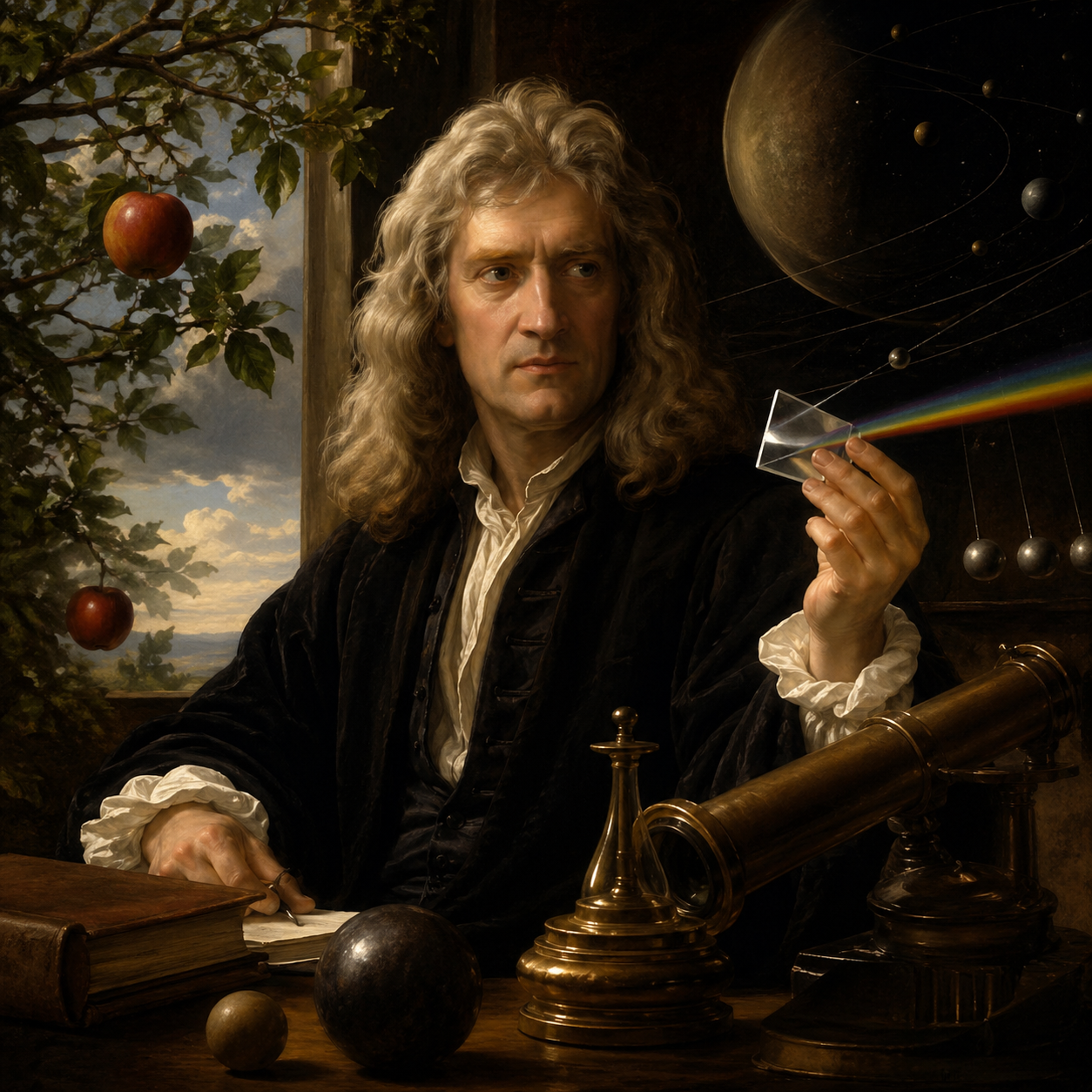
Isaac Newton — "What is there in places almost empty of air (such as the space between the plane…"
What is there in places almost empty of air (such as the space between the planets) to hinder the free motion of bodies?
What is there in places almost empty of air (such as the space between the planets) to hinder the free motion of bodies?
Click any product to generate a realistic preview. Up to 3 at a time.
* Initial load can take up to 90 seconds — revising the preview in another color is nearly instant.
"A man may imagine things that are false, but he can only understand things that are true, for if the things be false, the apprehension of them is not understanding."
"Gravity must be caused by some agent acting constantly according to certain laws; but whether this agent be material or immaterial, I have left to the consideration of my readers."
"The causes of gravity are not yet discovered. It is by experiments and observations that we are to know them."
"Can it be by accident that all birds beasts and men have their right side and left side alike shaped (except in their bowels) and just two eyes and no more on either side the face & just two ears on e…"
"The parts of all homogeneal hard bodies which fully touch one another, stick together with a very strong attraction."
Found in 1 providers: grok
1 source checked
Newton is asking: if the space between planets is nearly empty of any resisting substance, what could possibly slow a moving body down? Nothing. This is a rhetorical challenge to anyone insisting space must be filled with something. In plain terms, empty space offers no friction, so objects keep moving freely — a foundational insight explaining why planets orbit indefinitely without losing speed.
This sits at the core of Newton's Principia Mathematica (1687) and his First Law of Motion: objects in motion stay in motion unless a force acts on them. Newton was actively dismantling Descartes' ether theory, which held that swirling fluid filled interplanetary space and drove planetary orbits. By pointing to near-vacuum conditions, he justified why planets orbit perpetually without a continuous push — the central problem his career solved.
In the 1680s, René Descartes' vortex theory dominated natural philosophy — space was considered a plenum of swirling ethereal fluid carrying planets along their paths. True vacuum was philosophically suspect; Aristotle had declared nature abhors it, and the Church tied cosmic order to a filled, purposeful universe. Newton's pointed question attacked the ether concept directly, clearing the way for a universe governed purely by gravity acting across genuinely empty space.
AI-generated insights based on extensive research and information for context. Factual errors? Email [email protected].
Your cart is empty