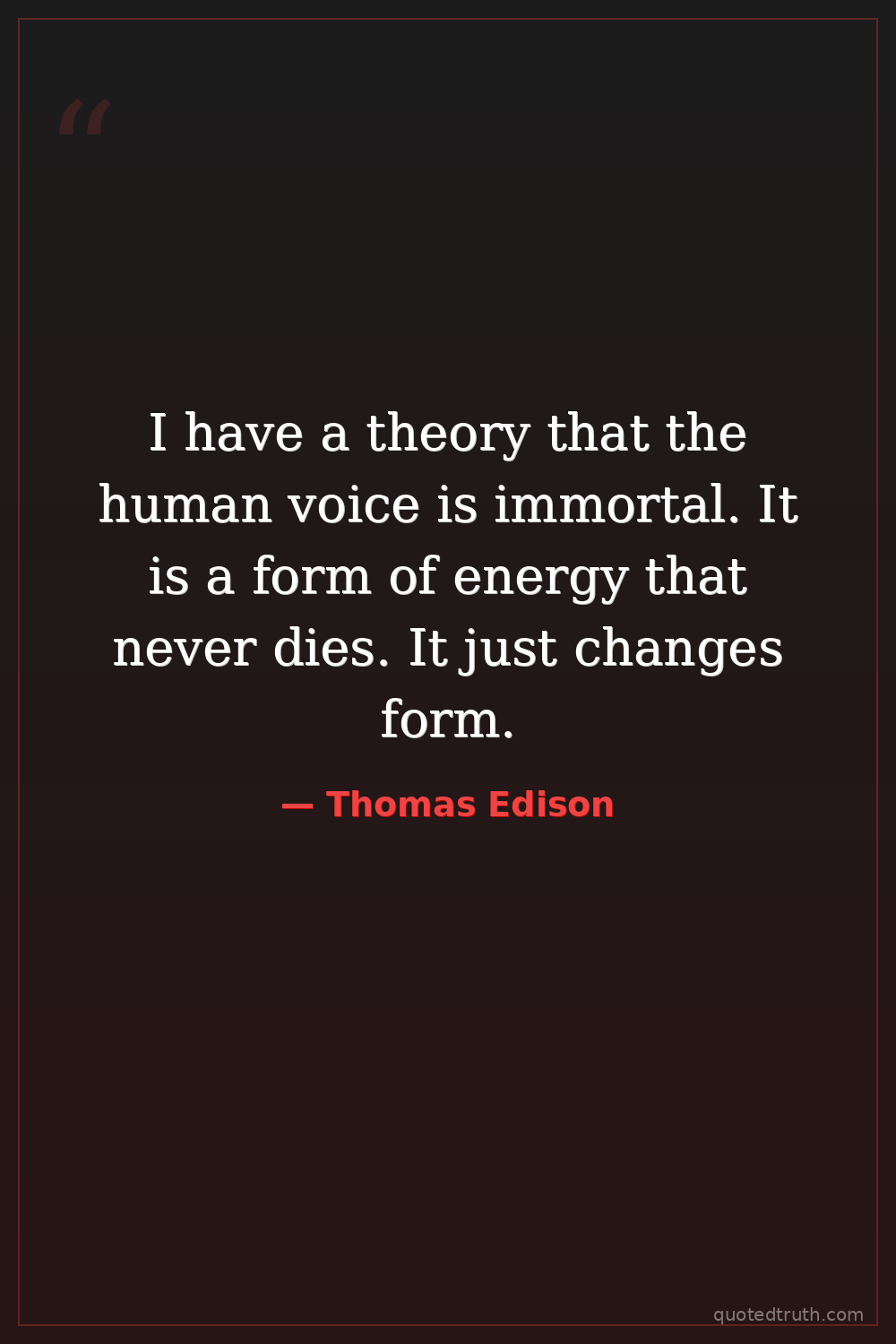
Thomas Edison — "I have a theory that the human voice is immortal. It is a form of energy that ne…"
I have a theory that the human voice is immortal. It is a form of energy that never dies. It just changes form.
I have a theory that the human voice is immortal. It is a form of energy that never dies. It just changes form.
Click any product to generate a realistic preview. Up to 3 at a time.
* Initial load can take up to 90 seconds — revising the preview in another color is nearly instant.
"Non-violence leads to the highest ethics, which is the goal of all evolution."
"The mind can do anything it wants to do."
"I told [John Kruesi] I was going to record talking, and then have the machine talk back. He thought it absurd. However, it was finished, the foil was put on; I then shouted 'Mary had a little lamb', e…"
"Restlessness is discontent and discontent is the first necessity of progress. Show me a thoroughly satisfied man and I will show you a failure."
"I have never seen a man who was afraid of a woman. I have seen men who were afraid of women's tongues. I have seen men who were afraid of women's brains. I have seen men who were afraid of women's str…"
Found in 1 providers: grok
1 source checked
The idea here is that sound, once produced, doesn't simply vanish. Because it is a form of energy, it transforms into other states rather than ceasing to exist. Every word spoken continues on in some altered form, potentially recoverable or at least preserved in the fabric of the physical world. It reframes speaking as something permanent, not fleeting, and suggests the act of vocalizing leaves a lasting imprint.
Edison built the first device to capture and replay the human voice, the phonograph, in 1877. That invention proved voices could outlive the moment they were spoken, which clearly shaped how he thought about sound. He spent decades refining audio recording and even pursued a 'spirit phone' intended to detect voices beyond death. The quote reflects both his scientific grounding in energy conservation and his lifelong fascination with making ephemeral sound permanent.
Edison worked from the 1870s into the 1930s, an age when electricity, recorded sound, and motion pictures were reshaping daily life. The law of conservation of energy had recently been formalized, inspiring speculation that no energy, including vocal vibration, truly disappeared. Spiritualism was also popular, and many inventors blended physics with metaphysical curiosity. Capturing voices on wax cylinders seemed almost supernatural, making immortality-through-sound a plausible frontier rather than poetic exaggeration.
AI-generated insights based on extensive research and information for context. Factual errors? Email [email protected].
Your cart is empty