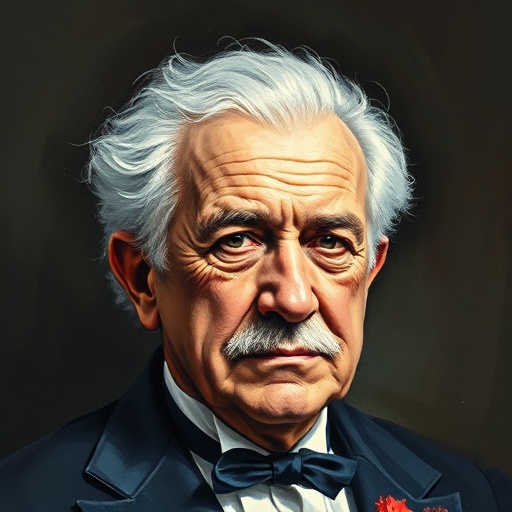
Thomas Edison — "To invent, you need a good imagination and a pile of junk."
To invent, you need a good imagination and a pile of junk.
To invent, you need a good imagination and a pile of junk.
Click any product to generate a realistic preview. Up to 3 at a time.
* Initial load can take up to 90 seconds — revising the preview in another color is nearly instant.
"The first thing is to find out what the world needs; then proceed to invent it."
"Anything that won't sell, I don't want to invent."
"I owe my success to the fact that I never had a watch. I never knew what time it was, so I never stopped working."
"Just because something doesn't do what you planned it to do doesn't mean it's useless."
"The value of an idea lies in the using of it."
Found in 2 providers: grok,gemini
2 sources checked
Invention requires two ingredients working together: creative vision to see possibilities others miss, and a stockpile of raw materials, spare parts, and failed experiments to test those ideas physically. Imagination without materials stays theoretical, while materials without imagination remain scrap. Real breakthroughs come from tinkering, combining odd components in new ways, and learning through hands-on experimentation rather than pure thought alone.
Edison famously worked at Menlo Park, nicknamed the Invention Factory, surrounded by shelves of wire, chemicals, filaments, and cast-off components. He tested thousands of materials searching for a workable light bulb filament and kept meticulous notebooks of failures. His process was relentlessly empirical, combining wild ideas with physical trial and error. With 1,093 patents, he embodied the marriage of imaginative leaps and the literal junk pile that made them testable.
Edison worked during the late 19th-century Second Industrial Revolution, when electricity, telegraphy, and mechanical innovation were transforming daily life. Lone tinkerers and small workshops competed to commercialize breakthroughs before corporate R&D labs dominated. Raw materials and surplus parts were abundant and cheap, enabling hands-on experimentation. Patent filings exploded, and inventors like Edison, Tesla, and Bell became cultural heroes. The era rewarded those who could combine vision with stubborn, material-heavy experimentation over formal theory.
AI-generated insights based on extensive research and information for context. Factual errors? Email [email protected].
Your cart is empty