William Harvey — "I have always preferred to learn and teach anatomy from actual dissection and no…"
I have always preferred to learn and teach anatomy from actual dissection and not from books.
I have always preferred to learn and teach anatomy from actual dissection and not from books.
Click any product to generate a realistic preview. Up to 3 at a time.
* Initial load can take up to 90 seconds — revising the preview in another color is nearly instant.
"The blood in the veins moves towards the heart, not away from it."
"The study of anatomy is the study of God's handiwork."
"Nature is the best teacher."
"The heart does not draw the blood, but propels it."
"The more accurately and industriously I have examined the matter, the more clearly have I perceived the truth."
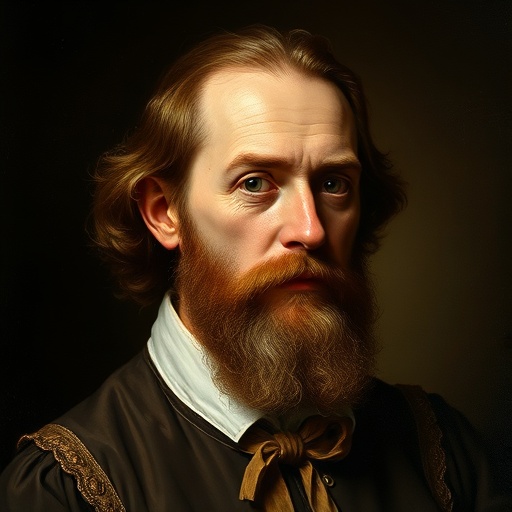
English physician whose On the Motion of the Heart and Blood in Animals (1628) demonstrated blood circulation, overturning 1,400 years of Galenic medicine. Closely associated with Francis Bacon (his contemporary in the new English empiricism). For an intellectual contrast, see Galenic medicine, the 2nd-century Greek medical tradition (humors, blood-as-consumed-fuel) — Harvey calculated that the heart pumps more blood per hour than the body could possibly produce as fuel — a single quantitative observation that demolished the entire Galenic-Aristotelian medical worldview. The cleanest example in medical history of arithmetic disproving 14 centuries of authority.
Found in 1 providers: grok
1 source checked
Direct observation beats inherited wisdom. Harvey argues that genuine anatomical knowledge comes from cutting open and examining actual bodies — seeing how parts connect, move, and function — not from studying what ancient scholars wrote. Firsthand experience with real specimens corrects errors that persist through centuries of recopied text. Only by touching, tracing vessels, and watching organs in action can a physician or student truly understand how the body works.
Harvey's entire career embodied this principle. His discovery of blood circulation came from dissecting dozens of animal species, watching hearts pump, and measuring blood volume — not from Galen's texts, which he found factually wrong. As physician to King James I and Charles I, he performed human autopsies and lectured using cadavers. His landmark 1628 work De Motu Cordis was built entirely on experimental evidence, making him a founding figure of modern empirical medicine.
In early modern Europe, medical education meant memorizing Galen's second-century Greek texts, still treated as sacred authority in universities. Vesalius had shaken this in 1543 by demonstrating Galenic errors through cadaver dissection, but reverence for books persisted. The broader Scientific Revolution — Bacon's empiricism, Galileo's experiments — was pushing Europe toward observation-based knowledge. Harvey worked in this transitional moment, when challenging ancient written authority through direct physical evidence was both intellectually bold and culturally contested.
AI-generated insights based on extensive research and information for context. Factual errors? Email [email protected].
Your cart is empty