William Harvey — "The circulation of the blood is a new doctrine, and I doubt not but it will meet…"
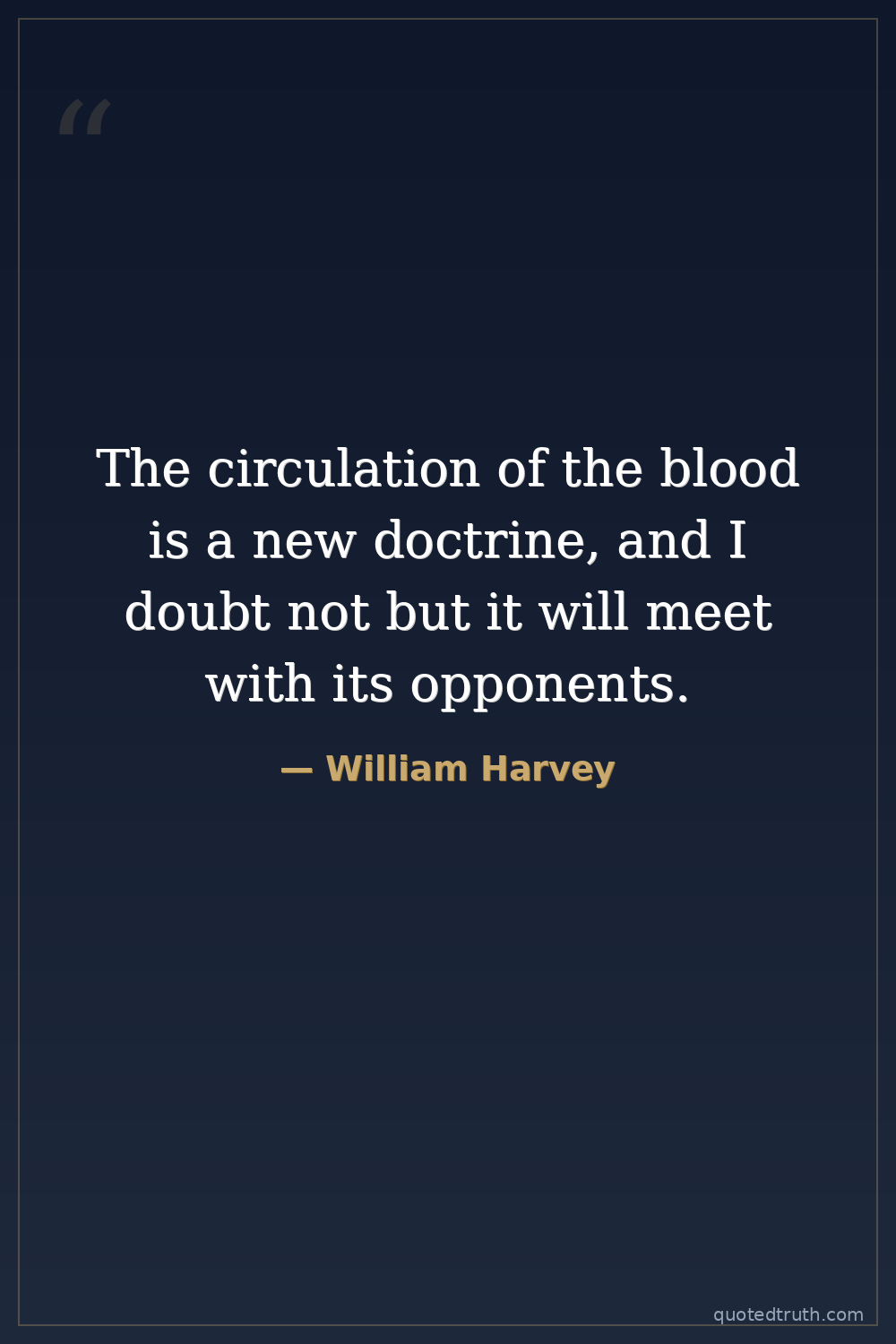
The circulation of the blood is a new doctrine, and I doubt not but it will meet with its opponents.
The circulation of the blood is a new doctrine, and I doubt not but it will meet with its opponents.
Click any product to generate a realistic preview. Up to 3 at a time.
* Initial load can take up to 90 seconds — revising the preview in another color is nearly instant.
"The heart is the beginning of life; the sun of the microcosm, even as the sun in his turn might well be designated the heart of the world; for it is the heart by whose virtue and pulse the blood is mo…"
"The greatest happiness is to be able to understand the works of God."
"Truth is the daughter of time, not of authority."
"I have been accused by some of daring to depart from the opinions of the ancients."
"The blood is the life."
English physician whose On the Motion of the Heart and Blood in Animals (1628) demonstrated blood circulation, overturning 1,400 years of Galenic medicine. Closely associated with Francis Bacon (his contemporary in the new English empiricism). For an intellectual contrast, see Galenic medicine, the 2nd-century Greek medical tradition (humors, blood-as-consumed-fuel) — Harvey calculated that the heart pumps more blood per hour than the body could possibly produce as fuel — a single quantitative observation that demolished the entire Galenic-Aristotelian medical worldview. The cleanest example in medical history of arithmetic disproving 14 centuries of authority.
Found in 1 providers: grok
1 source checked
A new idea will always face resistance from those who benefited from or believed in the old way of thinking. Harvey acknowledges that challenging established knowledge invites pushback, but the truth of discovery doesn't depend on immediate acceptance. Progress requires courage to assert findings even when they contradict centuries of received wisdom that powerful institutions and respected authorities have built their reputations upon.
Harvey spent decades carefully experimenting before publishing De Motu Cordis in 1628, proving blood circulates continuously rather than being consumed by tissues as Galen taught. He personally endured ridicule from contemporaries, lost patients who distrusted his heterodox views, and watched colleagues dismiss quantitative anatomical evidence. His prediction proved accurate — fierce opposition lasted years before circulation became accepted medical fact.
Early 17th-century medicine was dominated by Galenic humoral theory, unchallenged for 1,400 years and institutionally enforced by universities and royal colleges. The Scientific Revolution was just gaining momentum — Galileo faced the Inquisition, Vesalius had already challenged anatomy orthodoxy and paid professionally. Questioning ancient authorities was culturally dangerous, making Harvey's calm, evidence-based defiance of Galen an act of considerable intellectual and professional courage.
AI-generated insights based on extensive research and information for context. Factual errors? Email [email protected].
Your cart is empty