Saint Paul — "I have become all things to all people so that by all possible means I might sav…"
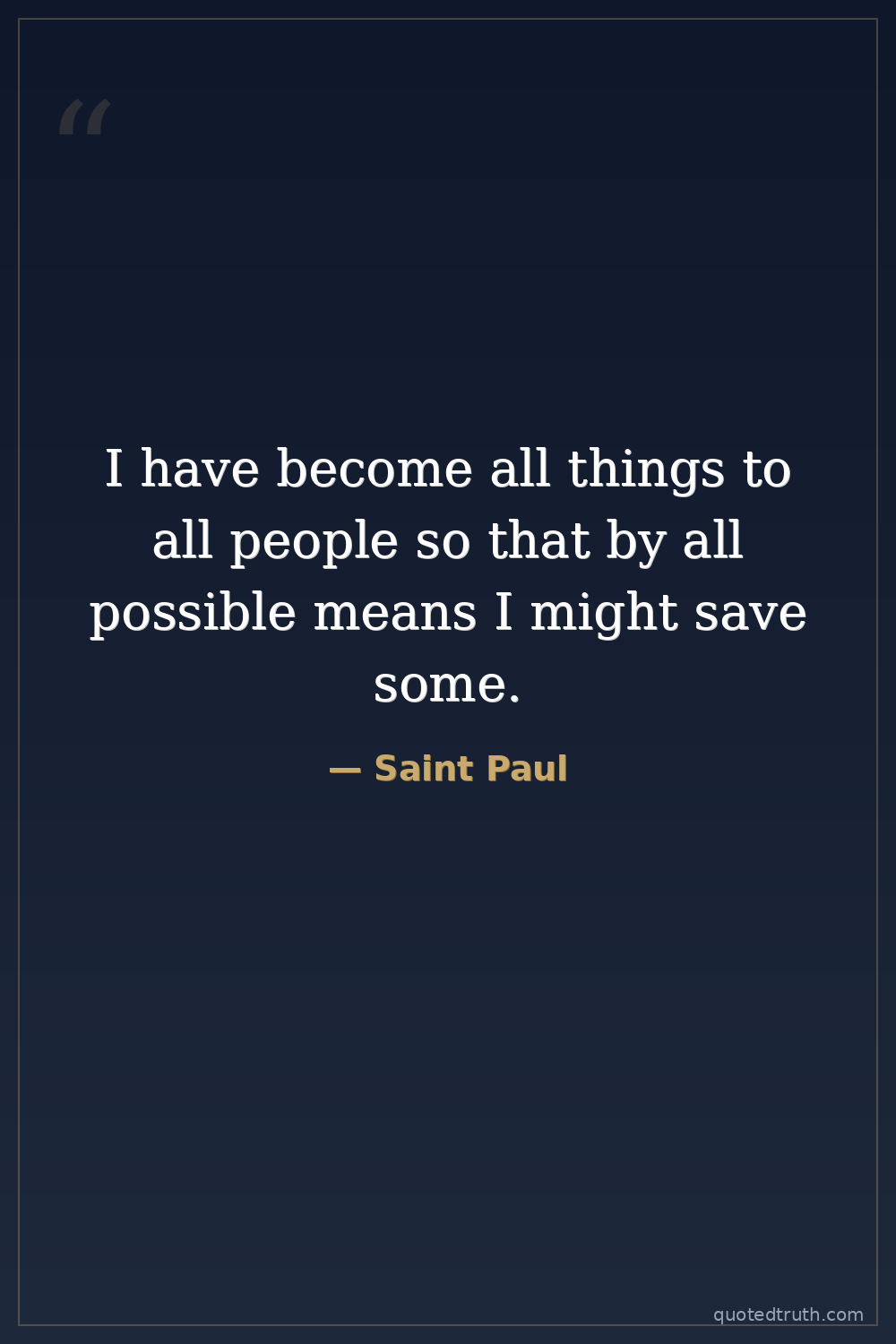
I have become all things to all people so that by all possible means I might save some.
I have become all things to all people so that by all possible means I might save some.
Click any product to generate a realistic preview. Up to 3 at a time.
* Initial load can take up to 90 seconds — revising the preview in another color is nearly instant.
"Is any man called being circumcised? let him not become uncircumcised. Is any called in uncircumcision? let him not be circumcised."
"But I would have you know, that the head of every man is Christ; and the head of the woman is the man; and the head of Christ is God."
"If I must needs glory, I will glory of the things which concern mine infirmities."
"I am made all things to all men, that I might by all means save some."
"For I could wish that I myself were accursed from Christ for my brethren, my kinsmen according to the flesh."
Found in 3 providers: deepseek,grok,gemini
3 sources checked
Paul is saying he adapts his approach, language, and customs to match whoever he is talking to, meeting people where they are rather than demanding they conform to him first. The goal is persuasion and rescue, not personal comfort or consistency. He flexes on style and surface habits while keeping his core message fixed, because reaching even a few souls justifies the effort of bending himself to their world.
Paul lived this literally. A Roman-citizen Pharisee trained under Gamaliel, he quoted Greek poets to Athenians, kept kosher around Jewish audiences, and dropped the Law for Gentiles. As a tentmaker who funded his own travel across Asia Minor, Greece, and Rome, he constantly switched cultural registers. His letters show a man obsessed with results: planting churches in dozens of cities meant becoming Greek to Greeks and Jewish to Jews.
The first-century Mediterranean was a polyglot patchwork of Jewish synagogues, Greek philosophical schools, Roman civic cults, and mystery religions, all under imperial rule. Christianity was a tiny Jewish offshoot deciding whether Gentiles needed circumcision and dietary law to join. Paul's missionary journeys (roughly 47-60 CE) collided with this fault line, and his willingness to drop Jewish boundary markers for Gentile converts was the controversial strategy that let the movement escape Judea and become a Roman-empire-wide religion.
AI-generated insights based on extensive research and information for context. Factual errors? Email [email protected].
Your cart is empty