Carl Linnaeus — "I have been as happy as a king, and happier."
I have been as happy as a king, and happier.
I have been as happy as a king, and happier.
Click any product to generate a realistic preview. Up to 3 at a time.
* Initial load can take up to 90 seconds — revising the preview in another color is nearly instant.
"I have spent my life in the company of plants, and they have taught me more than men."
"If you want to know yourself, study nature."
"The more hidden the flower, the sweeter the scent."
"It is the genus that gives the characters, and not the characters that make the genus."
"The greatest joy is to be useful to one's fellow men."
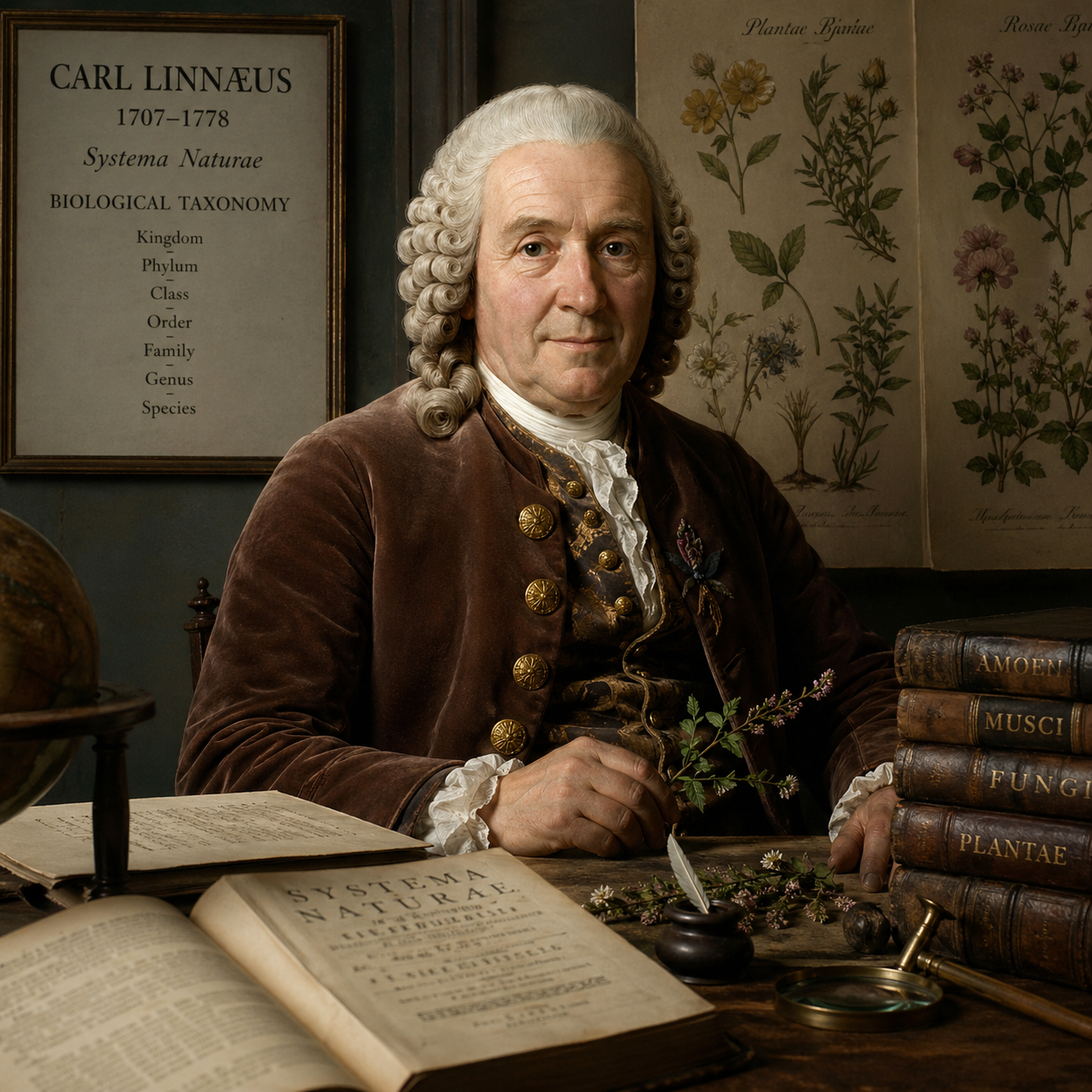
Swedish botanist and the father of modern taxonomy whose Systema Naturae (1735) introduced binomial nomenclature for naming all species. Closely associated with Joseph Banks (British naturalist who carried Linnaean classification on Cook's voyages). For an intellectual contrast, see Comte de Buffon, French naturalist and Histoire Naturelle author (1749-1788) — Buffon explicitly attacked Linnaean fixed-categories taxonomy as artificial and rejected the binomial system; his gradualist, environment-shaped natural history was the explicit alternative. Anticipates the fixed-species-vs-evolution debate Darwin would later resolve.
Found in 1 providers: grok
1 source checked
Genuine happiness, Linnaeus argues, surpasses even what kings experience — that power, wealth, and a throne are no guarantee of joy. The comparison is deliberate: kings represent society's peak of privilege and comfort. Yet someone without a crown can be happier still. The claim is that fulfillment rooted in passion and purpose outstrips any external status, suggesting inner contentment beats every form of worldly power.
Linnaeus rose from a rural Swedish pastor's son to the most celebrated naturalist of his age, ennobled as Carl von Linné. He described over 12,000 species, created binomial nomenclature, and corresponded with monarchs — yet found his deepest joy in his garden at Uppsala and field expeditions like his Lapland journey. He genuinely loved nature with near-religious devotion, believing God's creation was best understood through careful observation, not courtly life.
In 18th-century Europe, monarchs embodied the pinnacle of happiness, power, and social order — absolute rulers controlled empires and set cultural standards. The Enlightenment, however, challenged this, promoting reason, nature, and human potential over hereditary privilege. For a scientist to claim surpassing royal happiness was culturally provocative: it aligned with Enlightenment values that intellect and pursuit of knowledge — not birth or title — could yield the most meaningful human life.
AI-generated insights based on extensive research and information for context. Factual errors? Email [email protected].
Your cart is empty