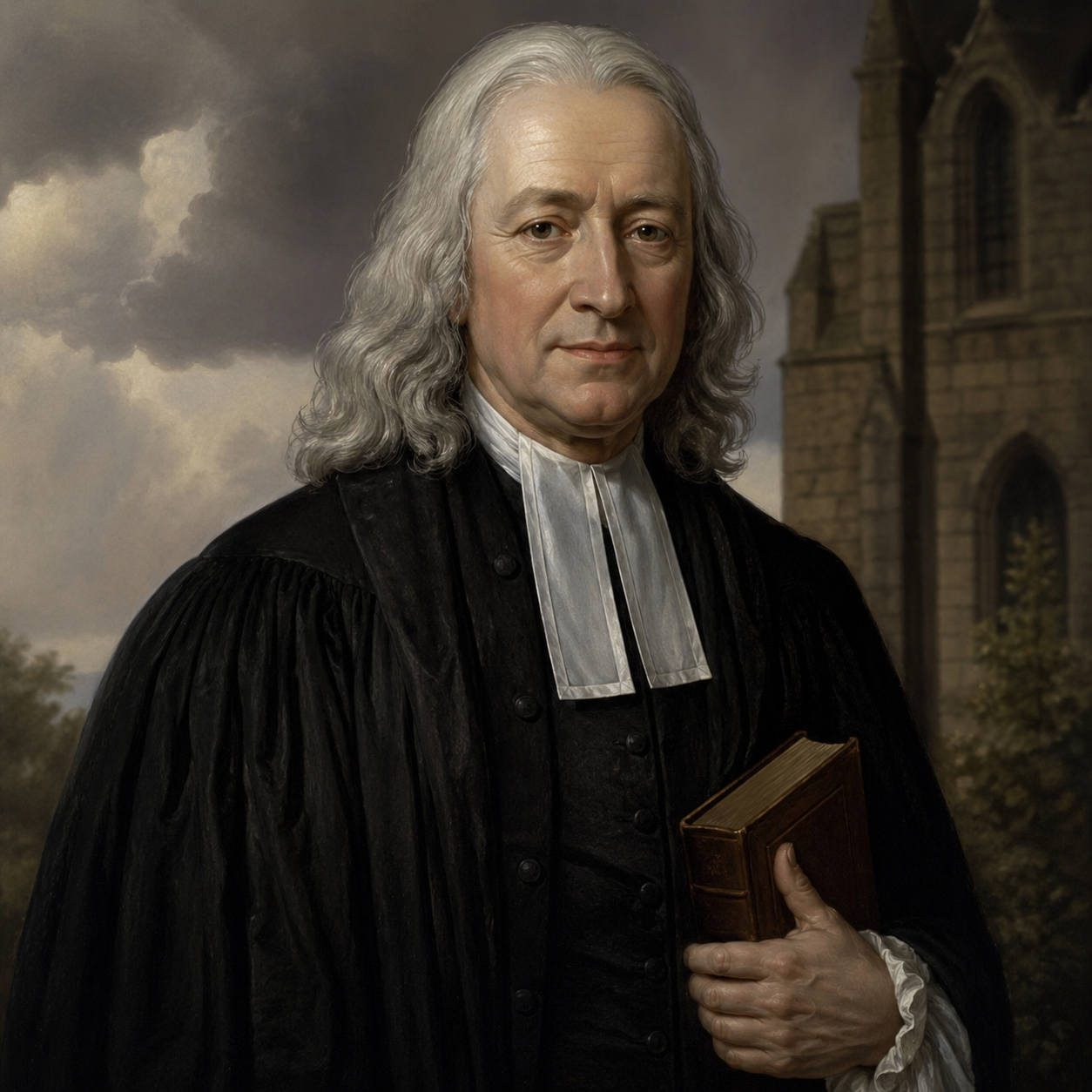
John Wesley — "I have but one point in view, to promote, as far as I am able, vital, practical …"
I have but one point in view, to promote, as far as I am able, vital, practical religion.
I have but one point in view, to promote, as far as I am able, vital, practical religion.
Click any product to generate a realistic preview. Up to 3 at a time.
* Initial load can take up to 90 seconds — revising the preview in another color is nearly instant.
"I have often thought, that if I were to choose a companion for life, it should be one who had as little money as myself."
"I am not afraid of dying. I have no more fear of death than I have of lying down to sleep."
"Sing lustily and with a good courage. Beware of singing as if you were half dead, or half asleep; but lift up your voice with strength."
"To candid, reasonable men, I am not afraid to lay open what has been the course of my life."
"Women's preaching is flatly contrary to the Bible."
English Anglican cleric and founder of Methodism, whose open-air preaching and class-meeting structure created the largest 18th-century evangelical revival. Closely associated with Charles Wesley (his hymn-writing brother) and George Whitefield (early co-revivalist, later doctrinal opponent). For an intellectual contrast, see George Whitefield, Calvinist evangelical revivalist — Whitefield's predestinarian Calvinism vs Wesley's free-grace Arminian theology split the early Methodist movement permanently in the 1739-41 break. The founding evangelical Calvinist-Arminian schism — the two parallel evangelical traditions American Christianity descends from.
Found in 1 providers: grok
1 source checked
Wesley had a single driving purpose: not religion as ritual, ceremony, or intellectual exercise, but faith that is alive and changes how people actually behave. 'Vital' means spiritually living, not dead formalism. 'Practical' means enacted in daily conduct—charity, discipline, service. He is saying everything he does, every sermon and society he builds, serves one end: making faith something that genuinely transforms a person's life from the inside out.
Wesley rode over 250,000 miles on horseback preaching to miners, factory workers, and the poor whom the established Church ignored. He founded Methodist societies built on structured discipline—prayer, scripture, visiting prisoners, feeding the hungry. His doctrine of sanctification insisted faith must produce visible moral transformation, not just assent. This quote is his lifelong mission statement, the animating principle behind 40 years of relentless field ministry and institutional reform.
The 18th-century Church of England was widely criticized as corrupt, complacent, and indifferent to the working poor multiplying under early industrialization. Religious formalism—attending services without inner renewal—was rampant among the gentry. Deism and Enlightenment skepticism eroded doctrinal authority among intellectuals. Wesley's insistence on 'vital, practical' religion was a direct counter to cold institutional Christianity, positioning personal holiness and active social care as inseparable, urgent responses to a society fracturing under rapid change.
AI-generated insights based on extensive research and information for context. Factual errors? Email [email protected].
Your cart is empty