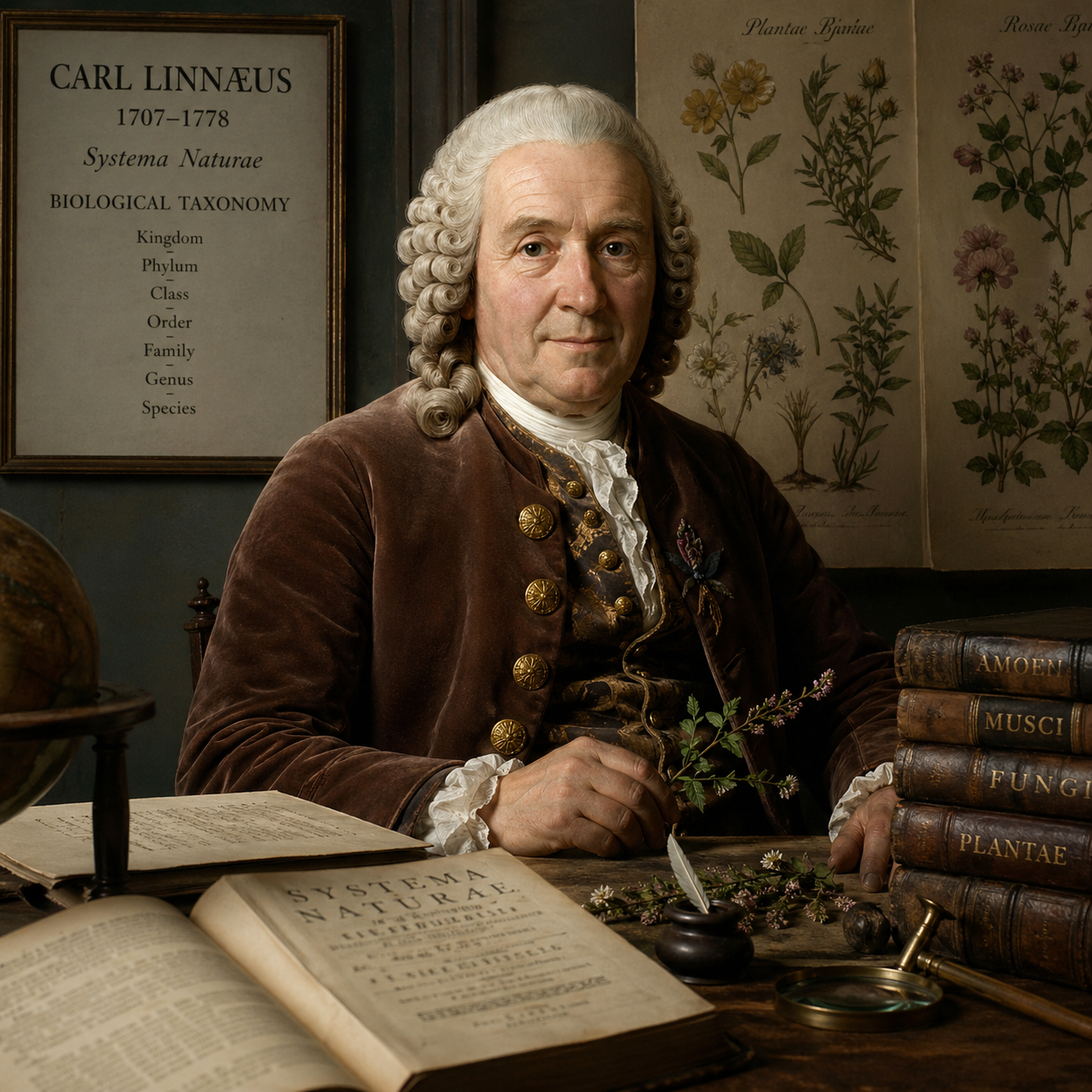
Carl Linnaeus — "I have established a new era in natural history."
I have established a new era in natural history.
I have established a new era in natural history.
Click any product to generate a realistic preview. Up to 3 at a time.
* Initial load can take up to 90 seconds — revising the preview in another color is nearly instant.
"I demand of you, and of the whole world, that you show me a generic character... by which to distinguish between Man and Ape. I myself most assuredly know of none. But perhaps I should still do it acc…"
"It is not the business of a botanist to know all the plants, but to know how to find out what they are."
"If a tree were to be a god, it would be a god of solitude."
"The European is inventive, governed by laws, and wears tight clothing."
"The world is a book, and those who do not travel read only one page."
Swedish botanist and the father of modern taxonomy whose Systema Naturae (1735) introduced binomial nomenclature for naming all species. Closely associated with Joseph Banks (British naturalist who carried Linnaean classification on Cook's voyages). For an intellectual contrast, see Comte de Buffon, French naturalist and Histoire Naturelle author (1749-1788) — Buffon explicitly attacked Linnaean fixed-categories taxonomy as artificial and rejected the binomial system; his gradualist, environment-shaped natural history was the explicit alternative. Anticipates the fixed-species-vs-evolution debate Darwin would later resolve.
Found in 1 providers: grok
1 source checked
A bold declaration of intellectual ownership over a scientific revolution: the claim that one person transformed how humanity catalogs all living things. Before this system, naturalists worldwide used inconsistent, unwieldy names for the same species. Binomial nomenclature and hierarchical classification gave science a universal language — a shared framework making knowledge cumulative, comparable, and transferable across cultures, nations, and languages for the first time.
Linnaeus wasn't being immodest without cause — his Systema Naturae (1735) and Species Plantarum (1753) genuinely overhauled biology. He personally named over 10,000 species using two-word Latin names still used today. Known for supreme self-confidence, he called himself 'the prince of botanists' and saw his work as fulfilling God's command to name creation. This declaration reflects his documented belief that his life's work was singular and world-altering.
The 18th-century Enlightenment prized rational order and systematic knowledge above all. European explorers were flooding back from the Americas, Asia, and Africa with thousands of previously unknown plants and animals, creating chaos — no shared naming system existed. Scientists believed nature had a divine rational structure waiting to be cataloged. Linnaeus arrived precisely when natural history needed universal organization most, making his claim of founding a new era historically credible.
AI-generated insights based on extensive research and information for context. Factual errors? Email [email protected].
Your cart is empty