Carl Linnaeus — "If I have been of any service to the world, it is due to my love of animals and …"
If I have been of any service to the world, it is due to my love of animals and plants.
If I have been of any service to the world, it is due to my love of animals and plants.
Click any product to generate a realistic preview. Up to 3 at a time.
* Initial load can take up to 90 seconds — revising the preview in another color is nearly instant.
"¿Qué tiene de extraño que yo no vea a Dios si no puedo ver siquiera al Yo que vive en mí?"
"The whole earth is a garden, and man is its gardener."
"I saw the infinite, all-knowing and all-powerful God from behind as he went away, and I grew dizzy. I followed his footsteps over nature's fields and saw everywhere an eternal wisdom and power, an ins…"
"I demand of you, and of the whole world, that you show me a generic character... by which to distinguish between Man and Ape. I myself most assuredly know of none. But perhaps I should still do it acc…"
"A natural arrangement is one which is based on all parts of the plant."
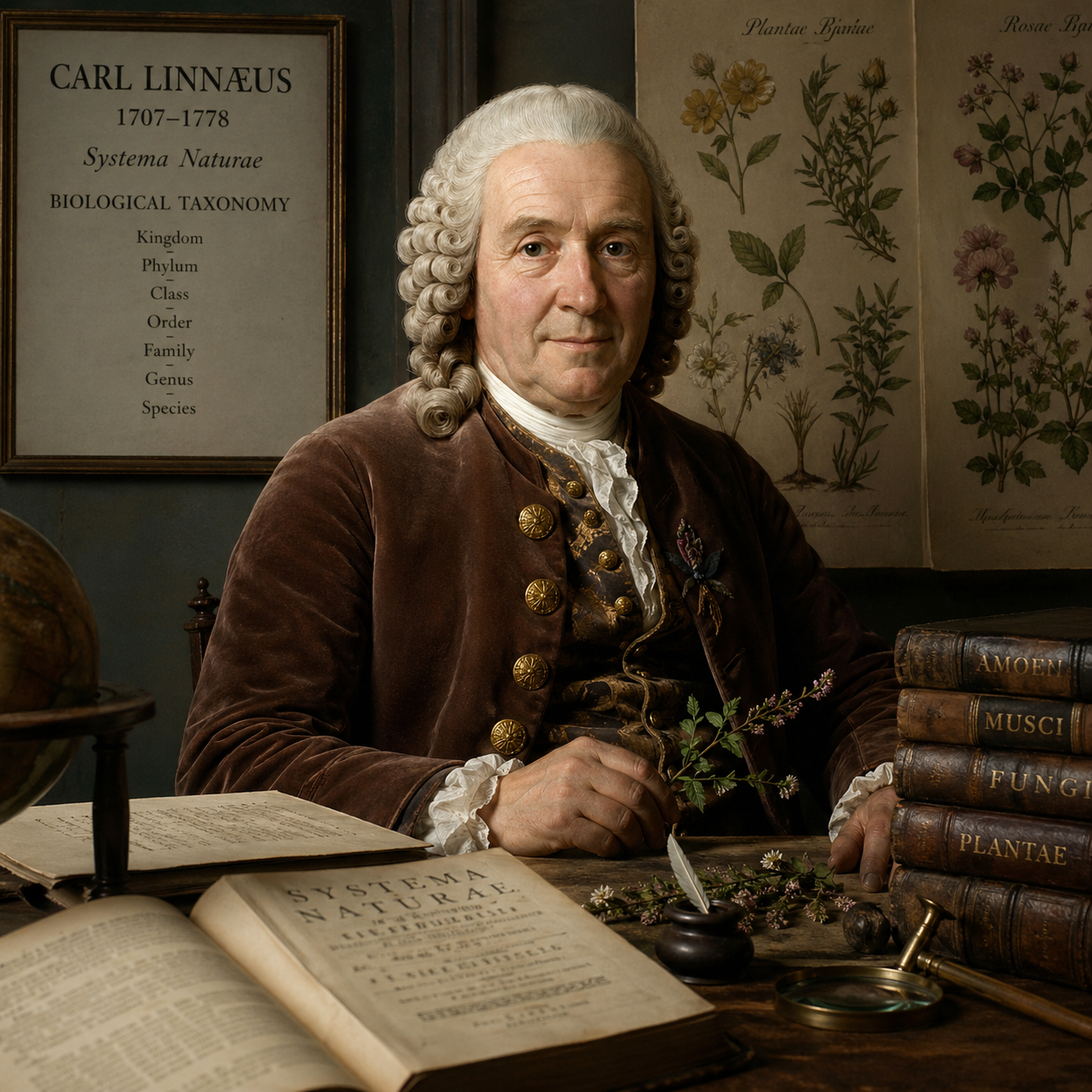
Swedish botanist and the father of modern taxonomy whose Systema Naturae (1735) introduced binomial nomenclature for naming all species. Closely associated with Joseph Banks (British naturalist who carried Linnaean classification on Cook's voyages). For an intellectual contrast, see Comte de Buffon, French naturalist and Histoire Naturelle author (1749-1788) — Buffon explicitly attacked Linnaean fixed-categories taxonomy as artificial and rejected the binomial system; his gradualist, environment-shaped natural history was the explicit alternative. Anticipates the fixed-species-vs-evolution debate Darwin would later resolve.
From his autobiography or letters, expressing his passion for natural history.
Date: c. 1770s
ShockingFound in 1 providers: grok
1 source checked
The speaker credits passionate devotion to living things, not raw intellect or ambition, as the source of whatever good they contributed. True service to humanity grows from genuine love of the natural world, not from career calculation or fame-seeking. If you care deeply about something, that care itself becomes productive and beneficial to others.
Linnaeus dedicated his life to cataloguing every known plant and animal, creating the binomial nomenclature system still used today. His fieldwork across Lapland and his Systema Naturae reflected obsessive curiosity about nature. Students called his Uppsala lectures transformative. His love for plants was literal, naming the Linnaean flower Linnaea borealis his personal favorite.
The early modern period saw Europe's scientific revolution maturing into systematic natural philosophy. Explorers were returning with exotic specimens from the Americas, Asia, and Africa, overwhelming scholars with undescribed life forms. There was no shared language to categorize or compare findings across nations. Linnaeus's taxonomic system emerged as an urgent practical solution to this explosion of biological discovery.
AI-generated insights based on extensive research and information for context. Factual errors? Email [email protected].
Your cart is empty