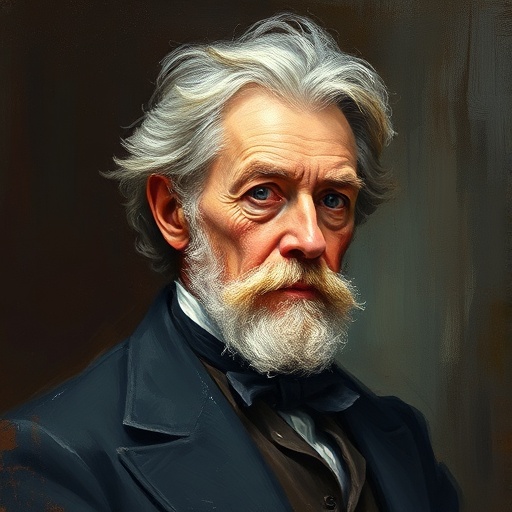
Michael Faraday — "I have far more confidence in the one man who works mentally and bodily at a mat…"
I have far more confidence in the one man who works mentally and bodily at a matter than in the six who merely talk about it.
I have far more confidence in the one man who works mentally and bodily at a matter than in the six who merely talk about it.
Click any product to generate a realistic preview. Up to 3 at a time.
* Initial load can take up to 90 seconds — revising the preview in another color is nearly instant.
"The important thing is to know how to take all things quietly."
"The true measure of a man is not what he has, but what he gives."
"A man who is certain he is right is almost sure to be wrong."
"The greatest enemy of knowledge is not ignorance, it is the illusion of knowledge."
"I am no poet, but if you think for yourselves, as I proceed, the facts will form a poem in your minds."
Found in 1 providers: deepseek
1 source checked
Someone who physically and mentally engages with a problem will produce more reliable results than a group that only discusses it. Real work requires hands-on effort combined with focused thinking, not committee chatter. One dedicated practitioner doing the work beats six theorists analyzing from a distance. Action and direct involvement produce truth; talk alone produces opinions. Trust the doer over the debater every time.
Faraday embodied this principle entirely. A self-taught bookbinder's apprentice with no formal math training, he discovered electromagnetic induction, diamagnetism, and the laws of electrolysis through relentless hands-on experimentation at the Royal Institution. He kept meticulous lab notebooks, ran thousands of experiments personally, and distrusted speculation unsupported by apparatus. While theoretical contemporaries debated, Faraday built coils, magnets, and rotating devices with his own hands, producing discoveries that powered the electrical age.
Faraday worked during the early-to-mid 1800s, when science was transitioning from gentleman-amateur speculation to rigorous experimental discipline. Learned societies were often dominated by theorists debating without laboratories. Meanwhile the Industrial Revolution rewarded practical tinkerers—Stephenson, Watt, Arkwright—whose machinery transformed Britain. Faraday's Royal Institution lectures popularized hands-on demonstration science. His remark reflects tension between aristocratic armchair philosophers and the emerging class of working experimentalists whose direct labor, not discourse, was rebuilding the modern world.
AI-generated insights based on extensive research and information for context. Factual errors? Email [email protected].
Your cart is empty