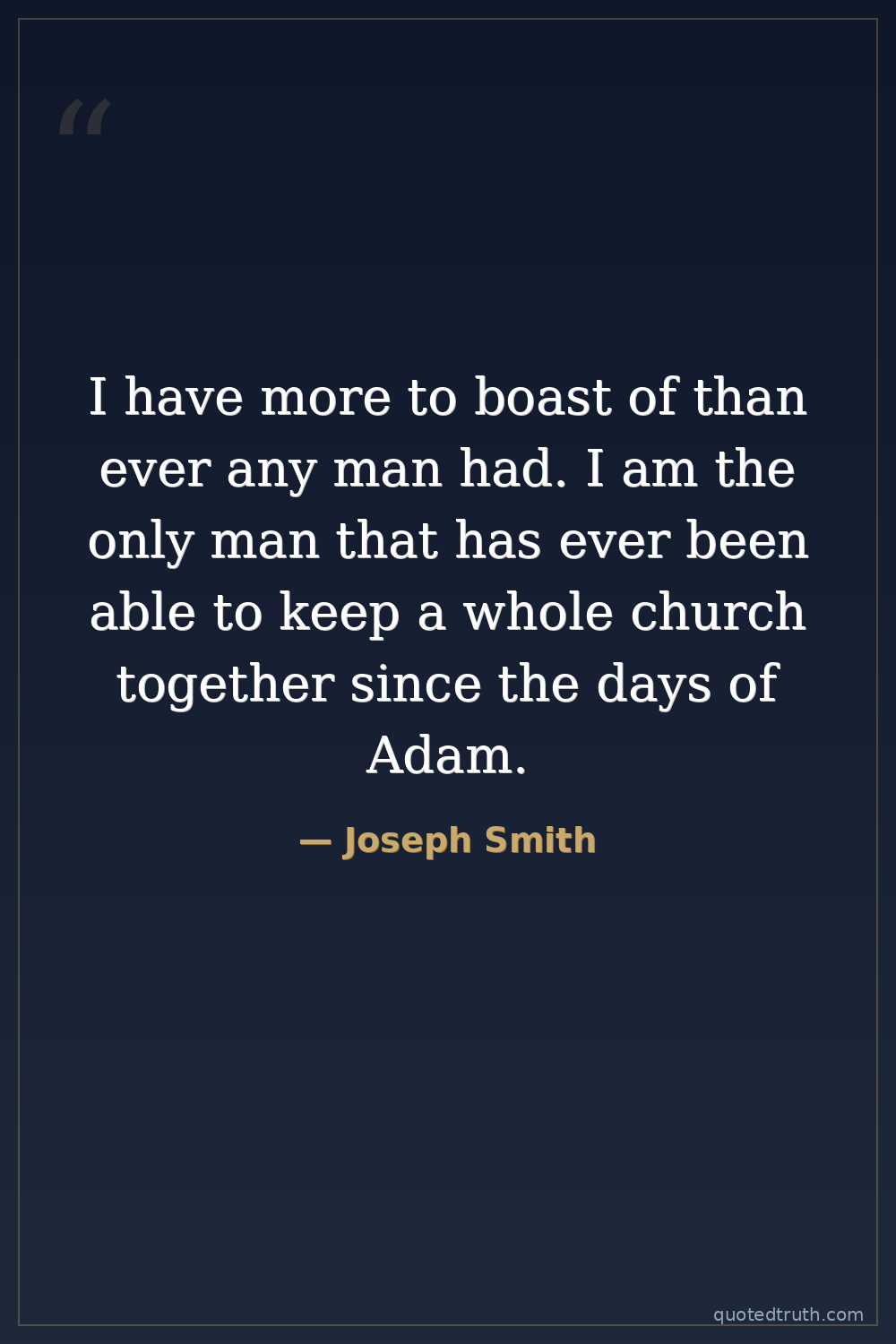
Joseph Smith — "I have more to boast of than ever any man had. I am the only man that has ever b…"
I have more to boast of than ever any man had. I am the only man that has ever been able to keep a whole church together since the days of Adam.
I have more to boast of than ever any man had. I am the only man that has ever been able to keep a whole church together since the days of Adam.
Click any product to generate a realistic preview. Up to 3 at a time.
* Initial load can take up to 90 seconds — revising the preview in another color is nearly instant.
"I never told you I was perfect; but there is no error in the revelations which I have taught."
"I am a servant of God, and I will serve him to the end."
"I defy all the world to find a passage in the Bible where the Lord says that He ever authorized a man to make a king, or a priest, or even a prophet, without first giving him a vision or by the minist…"
"I will not be bought, nor sold, nor flattered, nor threatened."
"For behold, the Lord shall curse the land with much heat, and the barrenness thereof shall go forth forever; and there was a blackness came upon all the children of Canaan, that they were despised amo…"
Found in 2 providers: deepseek,grok
2 sources checked
This quote expresses Smith's claim to unmatched religious leadership — that he alone, among all men since Adam, had successfully kept a unified church intact. It is a bold assertion of personal greatness and divine appointment, framing his organizational achievement as historically unprecedented. He is not merely claiming spiritual authority but institutional endurance: that despite persecution, schism, and opposition, his church had held together when all others had fractured.
Smith founded the LDS Church in 1830 and by 1844 had grown it to roughly 35,000 members while building Nauvoo into one of Illinois's largest cities. His entire life was defined by claiming exclusive divine authority and prophetic calling. This statement — delivered weeks before his assassination — reflects his unshakeable conviction in his own mission and his awareness of what he had built despite constant expulsions, mob violence, and internal defections.
Smith spoke these words in May 1844, weeks before his murder. The antebellum U.S. was churning with religious experimentation — the Second Great Awakening had spawned dozens of new movements, most of which quickly fragmented. Smith was simultaneously running for U.S. president while apostates had just published the Nauvoo Expositor exposing polygamy. His boast carried real weight in an era when new religious organizations routinely splintered within years of founding.
AI-generated insights based on extensive research and information for context. Factual errors? Email [email protected].
Your cart is empty