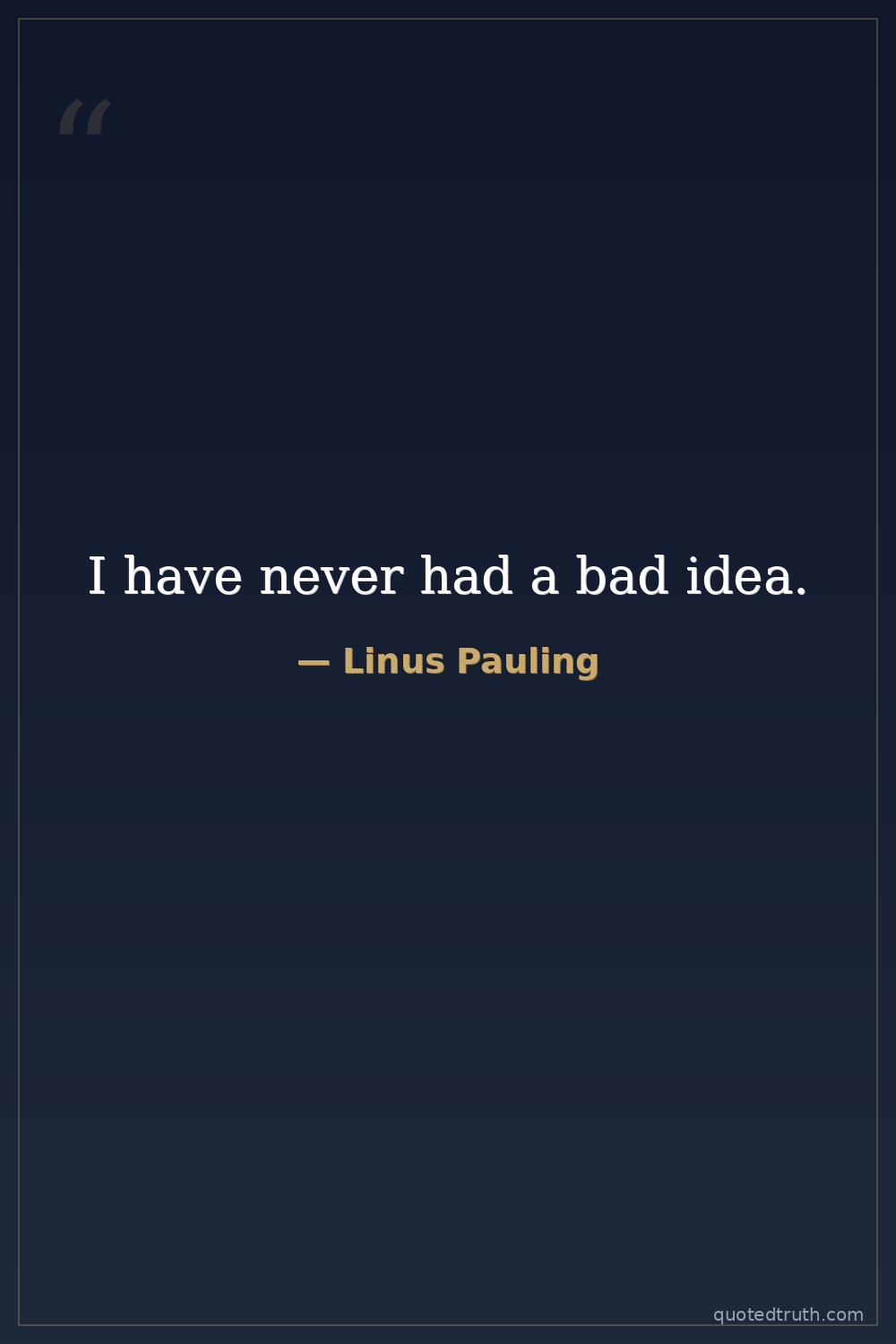
Linus Pauling — "I have never had a bad idea."
I have never had a bad idea.
I have never had a bad idea.
Click any product to generate a realistic preview. Up to 3 at a time.
* Initial load can take up to 90 seconds — revising the preview in another color is nearly instant.
"I think that the formation of [DNA's] structure by Watson and Crick may turn out to be the greatest developments in the field of molecular genetics in recent years."
"The only thing that stands between a man and what he wants from life is often merely the will to try it and the faith to believe that it is possible."
"I believe that the scientist has a special responsibility. He has a special responsibility to use his knowledge for the benefit of mankind."
"I have always believed that it is possible to achieve peace through understanding."
"Life... is a relationship between molecules."
A humorous or self-assured remark, often taken ironically given his 'throw bad ones away' philosophy.
Date: Unknown
WisdomFound in 1 providers: grok
1 source checked
The quote declares that generating ideas is always productive — no hypothesis is truly worthless because even flawed thinking advances understanding. It's a defense of intellectual fearlessness: propose boldly, test rigorously, and refuse to self-censor. The value lies not in every idea being correct, but in the habit of relentless inquiry. Being wrong is acceptable; refusing to think is not.
Pauling won two Nobel Prizes — Chemistry in 1954 for chemical bond theory and Peace in 1962 for anti-nuclear activism — making him history's most decorated individual scientist. His career was defined by audacious leaps: applying quantum mechanics to chemistry, predicting the alpha helix. Yet his late-career vitamin C megadosing advocacy showed the same confidence applied to thinner evidence. The quote captures both his genius and his blind spot.
The mid-20th century was science's heroic age — massive federal funding, the Manhattan Project's legacy, and public reverence for theorists who reshaped entire fields. Scientists like Pauling operated as public intellectuals whose sweeping ideas carried geopolitical weight during the Cold War. His era rewarded bold synthesis over cautious incrementalism, making confident claims a professional virtue rather than a liability.
AI-generated insights based on extensive research and information for context. Factual errors? Email [email protected].
Your cart is empty