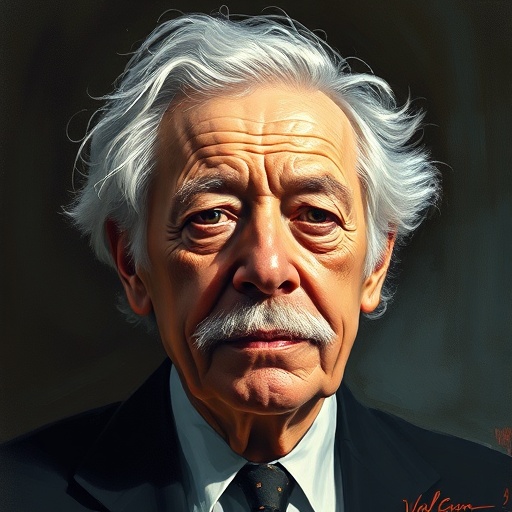
Linus Pauling — "I refuse to be intimidated by the word impossible."
I refuse to be intimidated by the word impossible.
I refuse to be intimidated by the word impossible.
Click any product to generate a realistic preview. Up to 3 at a time.
* Initial load can take up to 90 seconds — revising the preview in another color is nearly instant.
"Vitamin C is the most important of all vitamins."
"I like people. I like animals, too—whales and quail, dinosaurs and dodos. But I like human beings especially, and I am unhappy that the pool of human germ plasm, which determines the nature of the hum…"
"The problem of an atomic war must not be confused by minor problems such as Communism versus capitalism. An atomic war would kill everyone, left, right, or center."
"I am a scientist, and I believe in the scientific method. But I also believe that there are things that science cannot explain."
"The only limit to our realization of tomorrow will be our doubts of today."
Found in 1 providers: grok
1 source checked
The quote captures a defiant mindset that treats impossibility as invitation rather than barrier. When told something cannot be done, the impulse is to interrogate that claim rather than accept it. It reflects intellectual courage — refusing to let conventional wisdom or institutional consensus set the ceiling for what's worth attempting. Achievement often begins by challenging the assumptions embedded in the word 'impossible.'
Pauling achieved what many deemed impossible twice over: winning two unshared Nobel Prizes — Chemistry in 1954 for revolutionizing chemical bond theory using quantum mechanics, and Peace in 1962 for anti-nuclear activism. Applying wave mechanics to molecular structure was considered impractical by many peers. During McCarthyism, his peace campaigning cost him his passport; he persisted anyway, gathering over 11,000 scientist signatures opposing nuclear weapons testing.
Pauling's most active decades — the 1930s through 1960s — saw quantum mechanics upend classical physics, nuclear weapons emerge from once-'impossible' science, and Cold War ideology suppress dissent. Scientists were expected to serve national security, not oppose it. The atomic bomb proved unprecedented destruction was achievable; simultaneously, the peace movement argued nuclear disarmament — dismissed as naive idealism — was both necessary and possible. 'Impossible' carried genuine political weight.
AI-generated insights based on extensive research and information for context. Factual errors? Email [email protected].
Your cart is empty