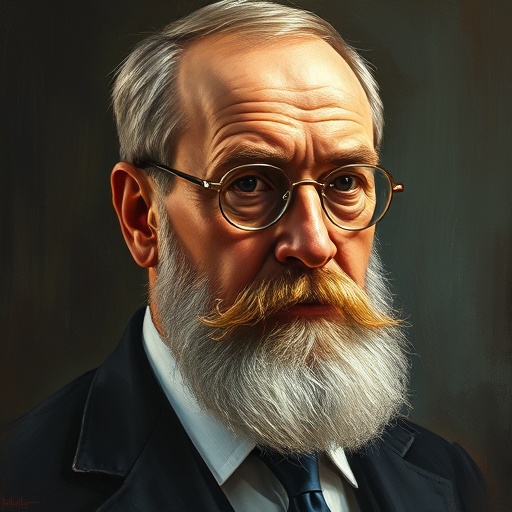
Robert Koch — "I have no other aim than to advance science and to contribute to the welfare of …"
I have no other aim than to advance science and to contribute to the welfare of mankind.
I have no other aim than to advance science and to contribute to the welfare of mankind.
Click any product to generate a realistic preview. Up to 3 at a time.
* Initial load can take up to 90 seconds — revising the preview in another color is nearly instant.
"I have often been misunderstood, but that has never deterred me from my path."
"The development of effective vaccines is a crucial step in controlling infectious diseases."
"The idea that diseases of humans and animals are fundamentally different is erroneous."
"The methods of bacteriological research are simple, but they require great patience and precision."
"The struggle against infectious diseases is one of the most important tasks of mankind."
Found in 1 providers: grok
1 source checked
The speaker renounces personal ambition, declaring that only two goals drive all their work: expanding what humanity collectively knows and reducing human suffering. There is no profit motive, no nationalism, no rivalry—just the pure pursuit of discovery and its practical benefit to people. It is a vow that scientific work must serve humanity rather than the scientist, placing the public good above individual recognition.
Koch spent years in underfunded rural labs before identifying the tuberculosis bacterium in 1882, when TB killed one in seven Europeans. He developed Koch's Postulates to put microbiology on rigorous logical footing, not to win arguments with Pasteur. Late in life he traveled to Africa studying sleeping sickness and cattle plague, long after achieving fame. His compulsive focus on pathogens over prizes makes this declaration wholly credible.
In the 1870s–1900s, tuberculosis, cholera, and typhoid killed millions annually in industrializing cities. Germ theory was still disputed—many physicians blamed miasma. Koch's era saw the first reliable bacterial culturing techniques, the emergence of antiseptic surgery, and vaccines beyond smallpox. Science was shifting from natural philosophy to laboratory medicine, and a researcher's stated motives mattered enormously for public trust in a deeply skeptical age.
AI-generated insights based on extensive research and information for context. Factual errors? Email [email protected].
Your cart is empty