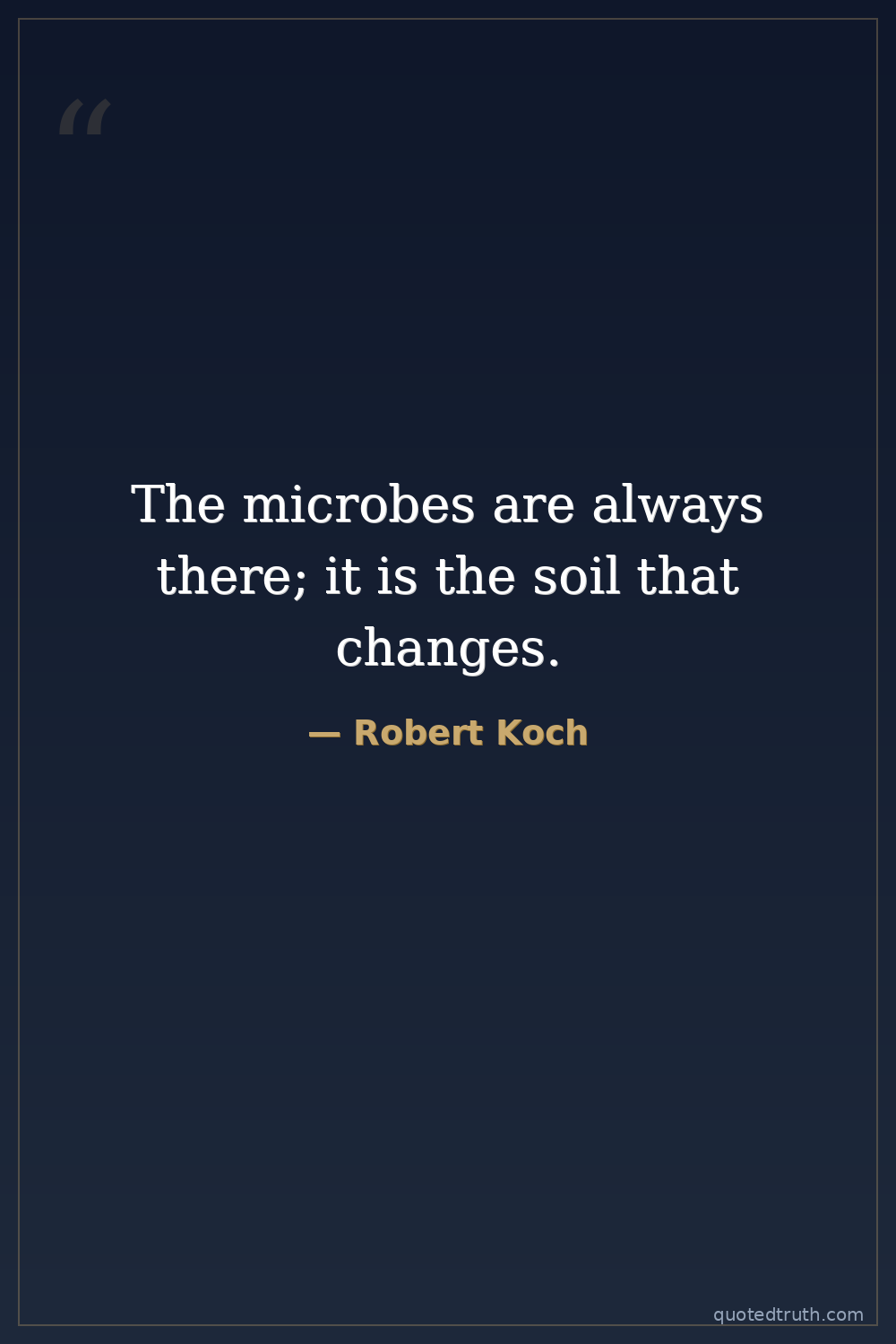
Robert Koch — "The microbes are always there; it is the soil that changes."
The microbes are always there; it is the soil that changes.
The microbes are always there; it is the soil that changes.
Click any product to generate a realistic preview. Up to 3 at a time.
* Initial load can take up to 90 seconds — revising the preview in another color is nearly instant.
"It is a great satisfaction to me to see that my work has been recognized and appreciated."
"The results of my investigations have been confirmed by many other workers."
"The greatest joy of a scientist is to make a new discovery."
"The fight against cholera is a fight against ignorance and prejudice."
"One must be prepared to make sacrifices for the sake of science."
Found in 1 providers: deepseek
1 source checked
Pathogens surround us constantly — the deciding factor in whether disease strikes isn't exposure alone, but the body's condition. "Soil" means the host: immune strength, nutrition, stress, underlying vulnerabilities. You can be surrounded by tuberculosis bacteria without falling ill if your body is resilient. Disease emerges when that internal environment shifts — weakened immunity, poverty, exhaustion — creating fertile ground for microbes already present to take hold.
Koch spent decades proving specific bacteria cause specific diseases — his postulates became microbiology's foundation. But fieldwork in Africa and India studying cholera and sleeping sickness confronted him with an inconvenient observation: many people exposed to deadly pathogens never sickened. Malnourished, exhausted, or immunocompromised individuals succumbed while others survived identical exposure. This nuanced the rigid germ-theory position he championed, acknowledging the host's vulnerability as a genuine co-factor alongside the microbe itself.
Koch worked as tuberculosis killed one in seven people across industrialized Europe. The industrial revolution packed workers into airless tenements, creating ideal conditions for airborne disease — yet exposure was near-universal while death remained selective. Urban poor died at catastrophic rates while wealthier citizens often survived. Public health reformers were discovering that nutrition, sanitation, and living conditions — the "soil" — determined outcomes as powerfully as the pathogen Koch himself had identified.
AI-generated insights based on extensive research and information for context. Factual errors? Email [email protected].
Your cart is empty