Richard Feynman — "I have often thought that if there is any hell, it must be the place where there…"
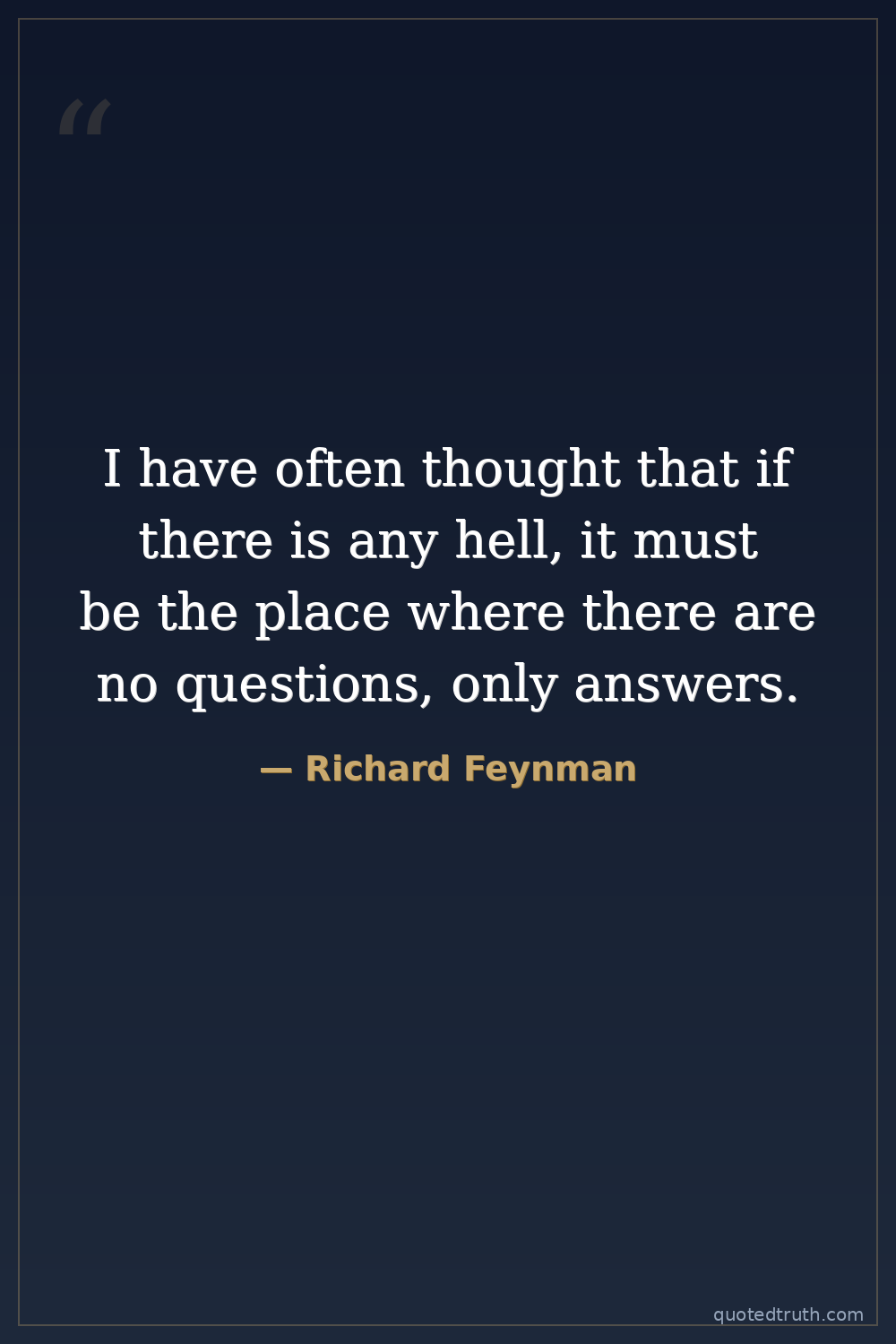
I have often thought that if there is any hell, it must be the place where there are no questions, only answers.
I have often thought that if there is any hell, it must be the place where there are no questions, only answers.
Click any product to generate a realistic preview. Up to 3 at a time.
* Initial load can take up to 90 seconds — revising the preview in another color is nearly instant.
"If you thought that science was certain — well, that is just an error on your part."
"I would like to add a third possibility, that it might be that, when we die, we just die, and that's the end of it."
"The only way to do great work is to love what you do."
"I can live with doubt and uncertainty and not knowing. I think it's much more interesting to live not knowing than to have answers which might be wrong."
"I learned very early the difference between knowing the name of something and knowing something."
American theoretical physicist who shared the 1965 Nobel for QED, developed Feynman diagrams, and wrote the Feynman Lectures on Physics. Closely associated with Julian Schwinger (co-Nobelist for QED) and Murray Gell-Mann (Caltech rival and Eightfold-Way physicist). For an intellectual contrast, see Deepak Chopra, physician and quantum-mysticism author — Feynman's Caltech 'cargo cult science' commencement address is the precise template for what he saw as misuse of physics terminology — Chopra-style appropriation of quantum vocabulary for metaphysical claims is the canonical example of what Feynman called 'fooling yourself'.
Found in 1 providers: grok
1 source checked
True intellectual torment isn't fire or punishment — it's a world of rigid, final answers with no room for curiosity, exploration, or discovery. Questions are what make existence meaningful and dynamic. A universe of only answers is one where learning has died, where wonder is forbidden, where the human drive to understand is permanently extinguished — that stasis is the real horror.
Feynman built his entire identity around insatiable curiosity. He revolutionized quantum electrodynamics not by accepting prior answers but by questioning everything, including his own theories. He famously said not knowing something was more honest than pretending certainty. His Caltech lectures, his safe-cracking hobby, his bongo drumming — all reflected a man who found joy in the question itself, not the destination.
Feynman worked through the Cold War era, when ideological certainty — communist vs. capitalist dogma — defined global politics. Scientific institutions sometimes rewarded conformity over questioning. Post-WWII, the Manhattan Project showed science's dangerous power when harnessed without moral questioning. Feynman's Challenger investigation (1986) exemplified his era's tension: institutional answers suppressing dangerous questions about O-ring failures.
AI-generated insights based on extensive research and information for context. Factual errors? Email [email protected].
Your cart is empty