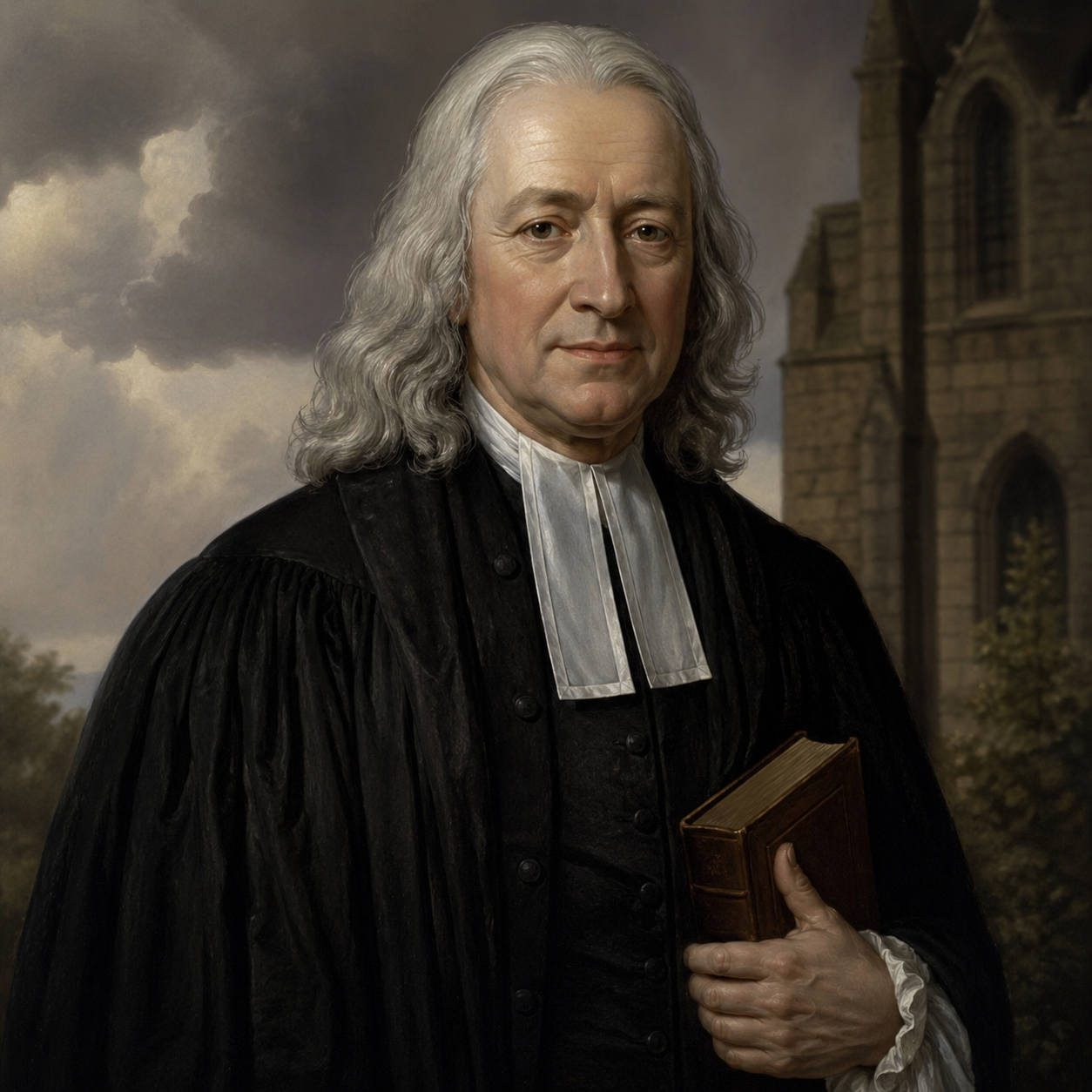
John Wesley — "I have often thought, that if I were to choose a place of abode, it should be in…"
I have often thought, that if I were to choose a place of abode, it should be in a country where there were no rich people.
I have often thought, that if I were to choose a place of abode, it should be in a country where there were no rich people.
Click any product to generate a realistic preview. Up to 3 at a time.
* Initial load can take up to 90 seconds — revising the preview in another color is nearly instant.
"Catch on fire with enthusiasm and people will come for miles to watch you burn."
"Satan has no objection to our being religious, provided we are not too religious."
"I am a creature of a day, passing through life as an arrow through the air. I am a spirit come from God, and returning to God; just hovering a few moments over a great gulf, till, on a sudden, I drop …"
"I have been writing a sermon on the use of money. Oh, what a flat, unprofitable subject it is!"
"I am not afraid of giving too much, but of giving too little."
English Anglican cleric and founder of Methodism, whose open-air preaching and class-meeting structure created the largest 18th-century evangelical revival. Closely associated with Charles Wesley (his hymn-writing brother) and George Whitefield (early co-revivalist, later doctrinal opponent). For an intellectual contrast, see George Whitefield, Calvinist evangelical revivalist — Whitefield's predestinarian Calvinism vs Wesley's free-grace Arminian theology split the early Methodist movement permanently in the 1739-41 break. The founding evangelical Calvinist-Arminian schism — the two parallel evangelical traditions American Christianity descends from.
Found in 1 providers: grok
1 source checked
The quote expresses a radical preference for living among the economically equal rather than the wealthy. Wesley is saying that the presence of rich people corrupts communities and creates spiritual danger. He would rather inhabit a place of shared poverty than one stratified by wealth. It is a statement about how inequality poisons social fabric and Christian community—wealth breeds pride, class division, and moral compromise Wesley found incompatible with genuine faith.
Wesley spent decades preaching in coal pits, jails, and slums to Britain's poorest—people ignored by the Anglican parish system. He warned repeatedly that wealth was religion's greatest enemy, writing that wherever riches increased, true piety decreased. He gave away nearly everything he earned, lived austerely, and believed Methodism's power came from its working-class roots. He genuinely feared wealthy patrons would corrupt the movement's soul, as he witnessed money destroy authentic faith repeatedly.
Eighteenth-century England was defined by brutal inequality. Enclosure Acts displaced thousands of rural poor into factories and slums; child labor in mines was normalized; debtors' prisons swallowed the desperate while aristocrats inherited vast estates. The established Anglican Church largely served wealthy landowners, leaving industrial laborers spiritually neglected. Wesley emerged precisely in this moral vacuum, building Methodism as a movement of the discarded. His hostility to the rich reflected the lived conditions of the millions he spent his life serving.
AI-generated insights based on extensive research and information for context. Factual errors? Email [email protected].
Your cart is empty