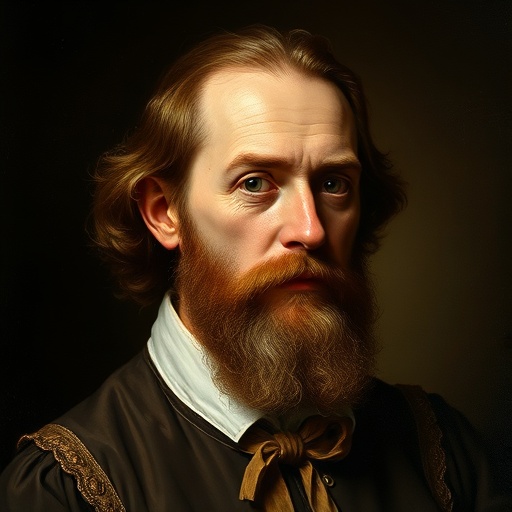
William Harvey — "I have seen, and by my own experiments, demonstrated the truth of what I assert."
I have seen, and by my own experiments, demonstrated the truth of what I assert.
I have seen, and by my own experiments, demonstrated the truth of what I assert.
Click any product to generate a realistic preview. Up to 3 at a time.
* Initial load can take up to 90 seconds — revising the preview in another color is nearly instant.
"The heart is the beginning of life, and the source of all motion."
"The heart of animals is the foundation of their life, the sovereign of everything within them, the sun of their microcosm, that upon which all growth depends, from which all power proceeds."
"The blood, in truth, is the fountain of life, the first to move and the last to rest."
"The circulation of the blood is the greatest discovery ever made in medicine."
"The physician must be a constant student."
English physician whose On the Motion of the Heart and Blood in Animals (1628) demonstrated blood circulation, overturning 1,400 years of Galenic medicine. Closely associated with Francis Bacon (his contemporary in the new English empiricism). For an intellectual contrast, see Galenic medicine, the 2nd-century Greek medical tradition (humors, blood-as-consumed-fuel) — Harvey calculated that the heart pumps more blood per hour than the body could possibly produce as fuel — a single quantitative observation that demolished the entire Galenic-Aristotelian medical worldview. The cleanest example in medical history of arithmetic disproving 14 centuries of authority.
Found in 1 providers: grok
1 source checked
Knowledge requires direct personal observation and repeatable experiment, not inherited authority or ancient texts. Harvey insists on firsthand evidence—he watched it happen and tested it himself—as the only valid foundation for truth. Confidence here comes not from scholarly credentials or classical citation but from what a person can physically witness and demonstrate with their own hands.
Harvey spent decades performing dissections and vivisections on living animals to map blood's movement through the body. He rejected the 1,400-year-old Galenic model not through argument but through direct measurement—calculating that the heart's hourly output far exceeded total blood volume, making Galen's scheme impossible. His De Motu Cordis (1628) was built entirely on hands-on experimental proof, making this declaration his professional creed.
In the early 17th century, European medicine was still grounded in Galen's ancient texts, accepted as infallible for over a millennium. The Scientific Revolution was underway—Galileo, Bacon, and Kepler were replacing authority with observation and mathematics—but medicine lagged behind. Harvey worked inside that tension, insisting no ancient source outweighed what dissection revealed. His claim to personal demonstration was a direct challenge to scholastic tradition still dominating university medicine across Europe.
AI-generated insights based on extensive research and information for context. Factual errors? Email [email protected].
Your cart is empty