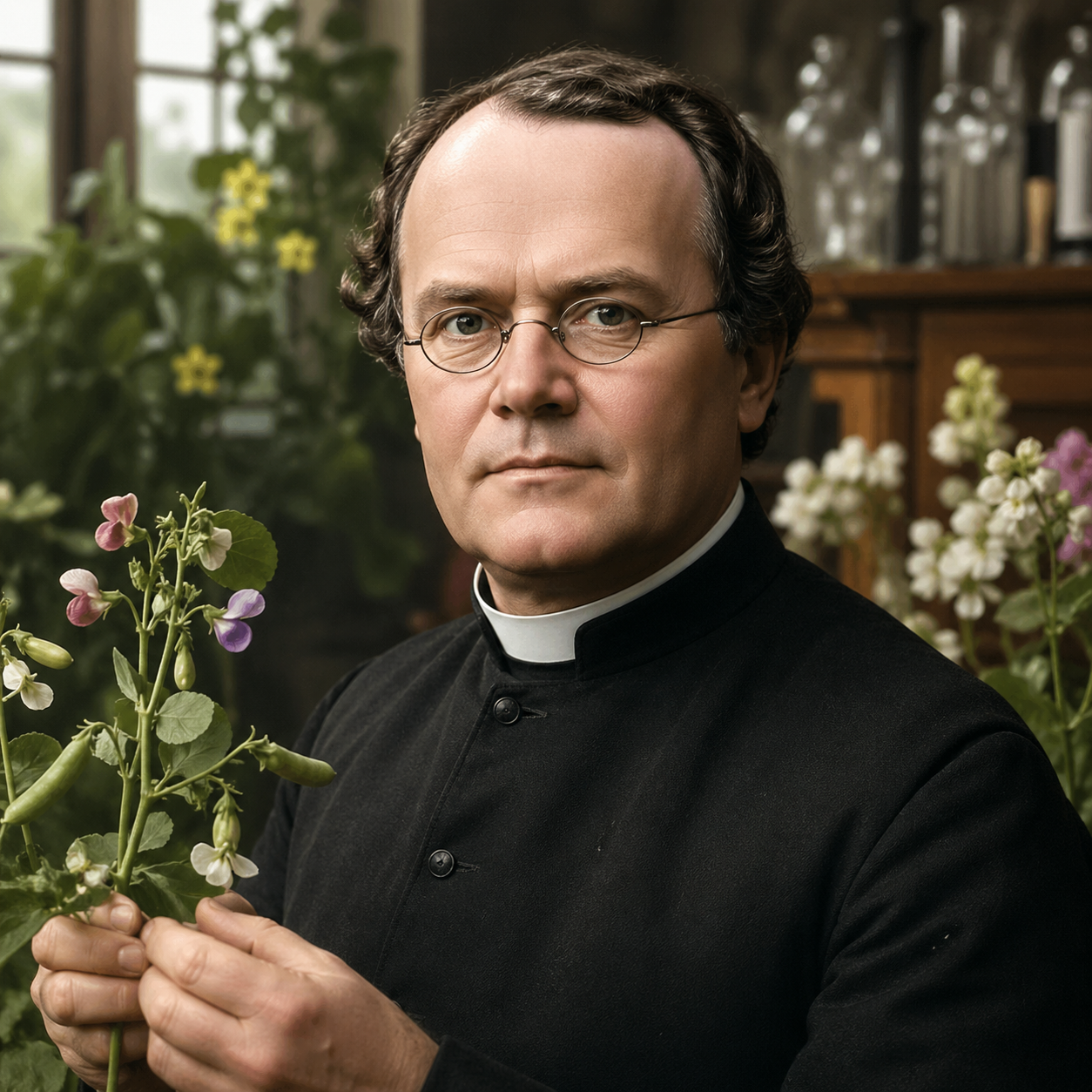
Gregor Mendel — "I have spent more time with peas than with people."
I have spent more time with peas than with people.
I have spent more time with peas than with people.
Click any product to generate a realistic preview. Up to 3 at a time.
* Initial load can take up to 90 seconds — revising the preview in another color is nearly instant.
"The future will judge my work more fairly than the present."
"I have seen the future of biology, and it is in the numbers."
"The development of every living thing is based on a preordained plan."
"The pea hybrids form eggs and pollen cells which, in their constitution, represent in equal numbers all constant forms resulting from the combination of traits united through fertilization."
"The experiments described were begun in 1856. The plants were grown in the garden of the monastery."
Found in 1 providers: deepseek
1 source checked
A candid confession of all-consuming obsession with one's work. The speaker acknowledges trading human companionship for close, repetitive study of something seemingly mundane. It captures the isolation that deep scientific focus demands — countless hours tracking, measuring, recording — while carrying wry self-awareness. The peas are not incidental; they are the entire world. Most readers recognize the tradeoff between profound passion and ordinary human connection.
Mendel spent over a decade — roughly 1856 to 1863 — cultivating approximately 29,000 pea plants in the monastery garden in Brno, Austria. An Augustinian friar working largely alone, he meticulously recorded trait inheritance across generations. His findings, published in 1866, were ignored for 34 years. His life was genuinely defined by those plants far more than by colleagues, recognition, or any lasting human relationship.
The 1850s–1860s were the height of natural history science. Darwin's On the Origin of Species appeared in 1859, sparking fierce debate about heredity with no mechanism to explain it. Scientific work was solitary, institutional funding scarce, and peer collaboration rare — especially for a monk in provincial Moravia. Mendel's statistical approach to biology was decades ahead of convention, leaving him invisible to contemporaries who lacked the framework to understand him.
AI-generated insights based on extensive research and information for context. Factual errors? Email [email protected].
Your cart is empty