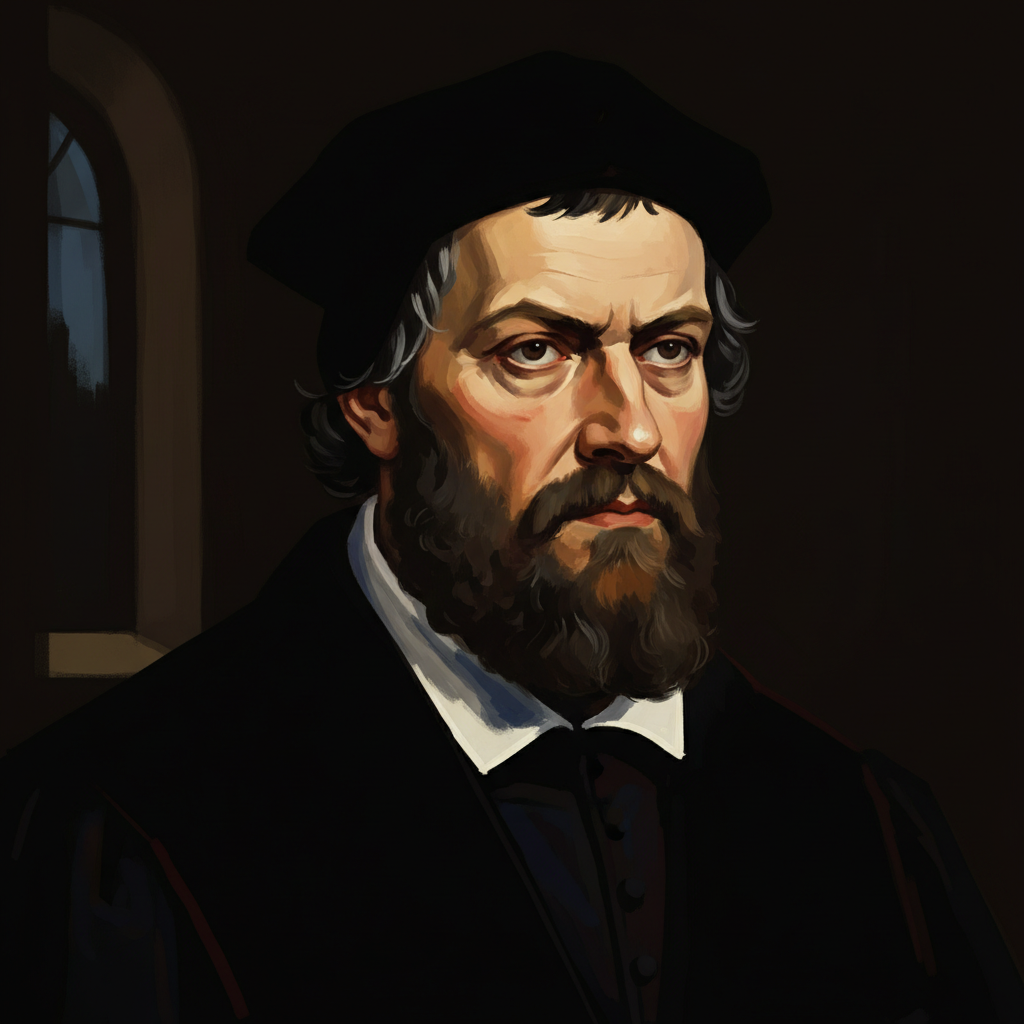
Martin Luther — "I have to confess that I have no desire to be a martyr."
I have to confess that I have no desire to be a martyr.
I have to confess that I have no desire to be a martyr.
Click any product to generate a realistic preview. Up to 3 at a time.
* Initial load can take up to 90 seconds — revising the preview in another color is nearly instant.
"If you wish to make a good prayer, go into your closet, lock the door, and throw the key out the window."
"My conscience is captive to the Word of God. I cannot and I will not recant anything, for to go against conscience is neither right nor safe. Here I stand, I can do no other. God help me. Amen."
"You owe nothing to God except faith and confession. In all other things He lets you do whatever you like. You may do as you please, without any danger of conscience whatsoever."
"In lying fashion you ignore what even children know."
"Heretics are not to be disputed with, but to be condemned unheard, and whilst they perish by fire, the faithful ought to pursue the evil to its source, and bathe their heads in the blood of the Cathol…"
German theologian whose 95 Theses (1517) launched the Protestant Reformation and broke the Catholic Church's monopoly on Western Christianity. Closely associated with Philipp Melanchthon (Lutheran systematizer) and John Calvin (later Reformer who built on Luther's break). For an intellectual contrast, see Pope Leo X, Renaissance pope (1513-1521) — Leo X's indulgence sales triggered Luther's break and Leo excommunicated him in 1521 — Luther's entire Reformation is structured as a direct answer to the indulgence-funded Vatican Leo represented.
Found in 1 providers: grok
1 source checked
Luther admits he doesn't want to die for his beliefs, even though he's willing to stand by them. He's being honest about a very human fear—he'd rather live and keep working than be killed and celebrated afterward. It's a candid acknowledgment that courage isn't the same as wanting to suffer, and that dying for a cause holds no appeal no matter how deeply he believes in it.
Luther faced real execution risk after challenging the Catholic Church with his 95 Theses in 1517. Declared an outlaw at the Diet of Worms in 1521, he could have been killed like Jan Hus before him. Yet despite his defiance, Luther was a pragmatic monk and professor who preferred writing, preaching, and teaching over dramatic self-sacrifice. This honesty reflects his earthy, plainspoken character—never pretending to be braver than he was.
Early modern Europe treated heresy as a capital crime; reformers before Luther, like Jan Hus, were burned at the stake. The Catholic Church wielded both spiritual and political power, and questioning it invited death. Luther spoke during an era when martyrdom was glorified as ultimate devotion, yet also genuinely terrifying. Protected by Frederick the Wise of Saxony and hidden at Wartburg Castle after Worms, Luther survived through strategic concealment rather than courtroom heroics—pragmatism over martyrdom defined the early Reformation.
AI-generated insights based on extensive research and information for context. Factual errors? Email [email protected].
Your cart is empty