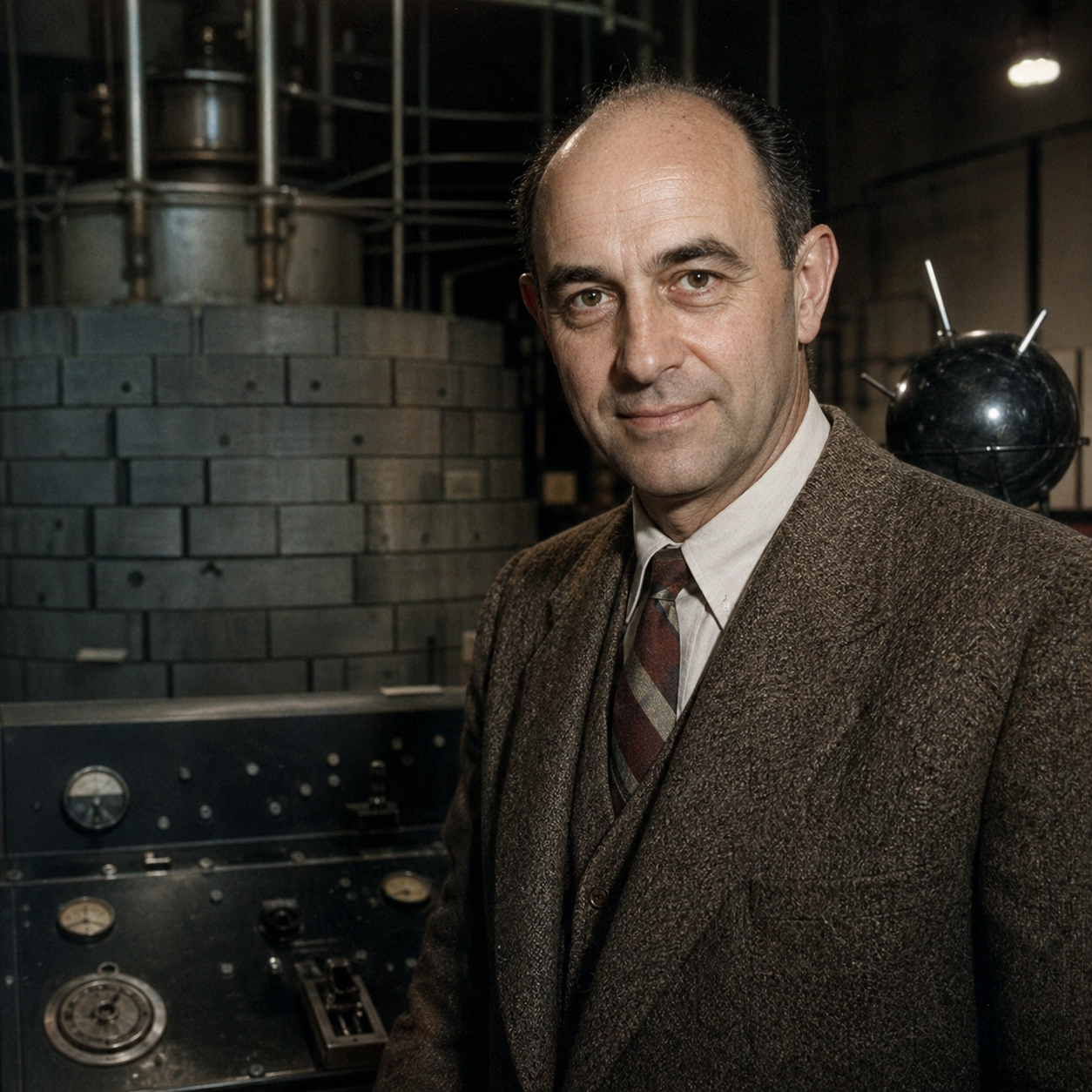
Enrico Fermi — "I hope it works."
I hope it works.
I hope it works.
Click any product to generate a realistic preview. Up to 3 at a time.
* Initial load can take up to 90 seconds — revising the preview in another color is nearly instant.
"Where is everybody? Humans could theoretically colonize the galaxy in a million years or so, and if they could, astronauts from older civilizations could do the same. So why haven't They come to Earth…"
"The greatest discovery yet to be made is the discovery of what we do not know."
"Never underestimate the power of a good approximation."
"The future of science depends on the education of young people."
"Physics is like sex: sure, it may give some practical results, but that's not why we do it."
Said to Leo Szilard just before the Chicago Pile-1 went critical, referring to the nuclear chain reaction.
Date: 1942
ShockingFound in 1 providers: grok
1 source checked
Even the most prepared person faces a moment where calculation ends and reality begins. This phrase captures the honest uncertainty between theory and outcome—acknowledging that effort and expertise don't guarantee results. It's not defeatism; it's intellectual honesty. The speaker has done everything possible and now surrenders to the test itself. Hope here isn't wishful thinking—it's the last honest word before the unknown answers back.
Fermi built Chicago Pile-1 beneath the University of Chicago's Stagg Field stands in December 1942—the first human-made self-sustaining nuclear chain reaction. Despite being arguably the era's greatest experimental physicist, no one had ever done this before. Fermi's entire career balanced rigorous mathematics with hands-on experiment. This quote perfectly reflects his empiricist core: you calculate everything, then you find out if reality agrees.
December 1942, mid-World War II: Fermi's team achieved the first controlled nuclear fission chain reaction while Nazi Germany raced toward the same goal. The Manhattan Project was accelerating, the atomic bomb was theoretical, and the geopolitical stakes were civilization-scale. Scientific success here wasn't abstract—it would reshape warfare, international power, and human existence permanently. The gap between 'we think it works' and 'it works' had never carried higher consequences.
AI-generated insights based on extensive research and information for context. Factual errors? Email [email protected].
Your cart is empty