John Wesley — "I look upon all the world as my parish."
I look upon all the world as my parish.
I look upon all the world as my parish.
Click any product to generate a realistic preview. Up to 3 at a time.
* Initial load can take up to 90 seconds — revising the preview in another color is nearly instant.
"I believe that all true Christians are brothers and sisters, whatever their denomination."
"I am not afraid of dying. I have no fear of death."
"It is a melancholy proof of the blindness and ignorance of mankind, that they are not aware of the evil of sin."
"I am not afraid that the people called Methodists should ever cease to exist either in Europe or America. But I am afraid lest they should only exist as a dead sect, having the form of religion withou…"
"I still find, and find it to my comfort, that I am not in the number of the rich. If I am not, I am not in the number of them that are in danger of falling into temptation and a snare, and into many f…"
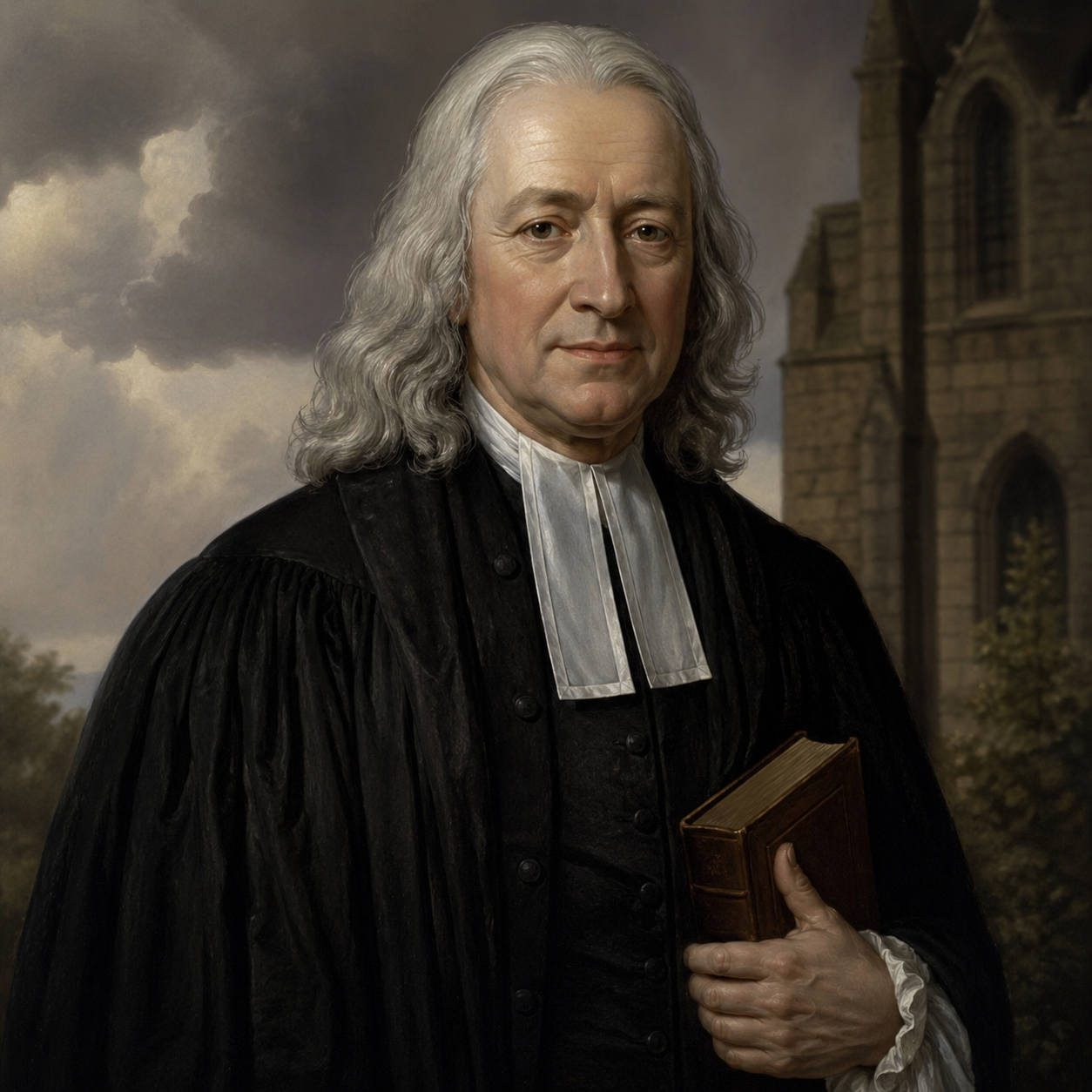
English Anglican cleric and founder of Methodism, whose open-air preaching and class-meeting structure created the largest 18th-century evangelical revival. Closely associated with Charles Wesley (his hymn-writing brother) and George Whitefield (early co-revivalist, later doctrinal opponent). For an intellectual contrast, see George Whitefield, Calvinist evangelical revivalist — Whitefield's predestinarian Calvinism vs Wesley's free-grace Arminian theology split the early Methodist movement permanently in the 1739-41 break. The founding evangelical Calvinist-Arminian schism — the two parallel evangelical traditions American Christianity descends from.
Found in 2 providers: deepseek,grok
2 sources checked
Wesley declares that spiritual duty has no geographic or institutional ceiling. Rather than confining his work to a single assigned church territory, he claimed responsibility for every human soul everywhere. It rejects the idea that ministry is a local job with fixed borders, asserting instead that authentic Christian service demands going wherever people are—field, coal mine, or city street—without waiting for formal permission or assignment.
Wesley traveled roughly 250,000 miles on horseback across Britain and Ireland, preaching to coal miners, factory workers, and the urban poor in open fields and market squares—often after Anglican churches barred him entry. He organized Methodist societies from Cornwall to Newcastle. This quote directly mirrors his life: he never waited for a pulpit invitation, treating every crowd of neglected working-class souls as his congregation.
Eighteenth-century Britain ran on a rigid Anglican parish system—each priest served only his assigned territory, leaving industrial towns and rural poor chronically under-served. The early Industrial Revolution was pulling thousands into mines and mills with no spiritual care. Wesley's itinerant preaching directly challenged Church of England territorial authority, arriving precisely when Britain's social fabric was fracturing and the established church's parish grid was visibly failing its people.
AI-generated insights based on extensive research and information for context. Factual errors? Email [email protected].
Your cart is empty