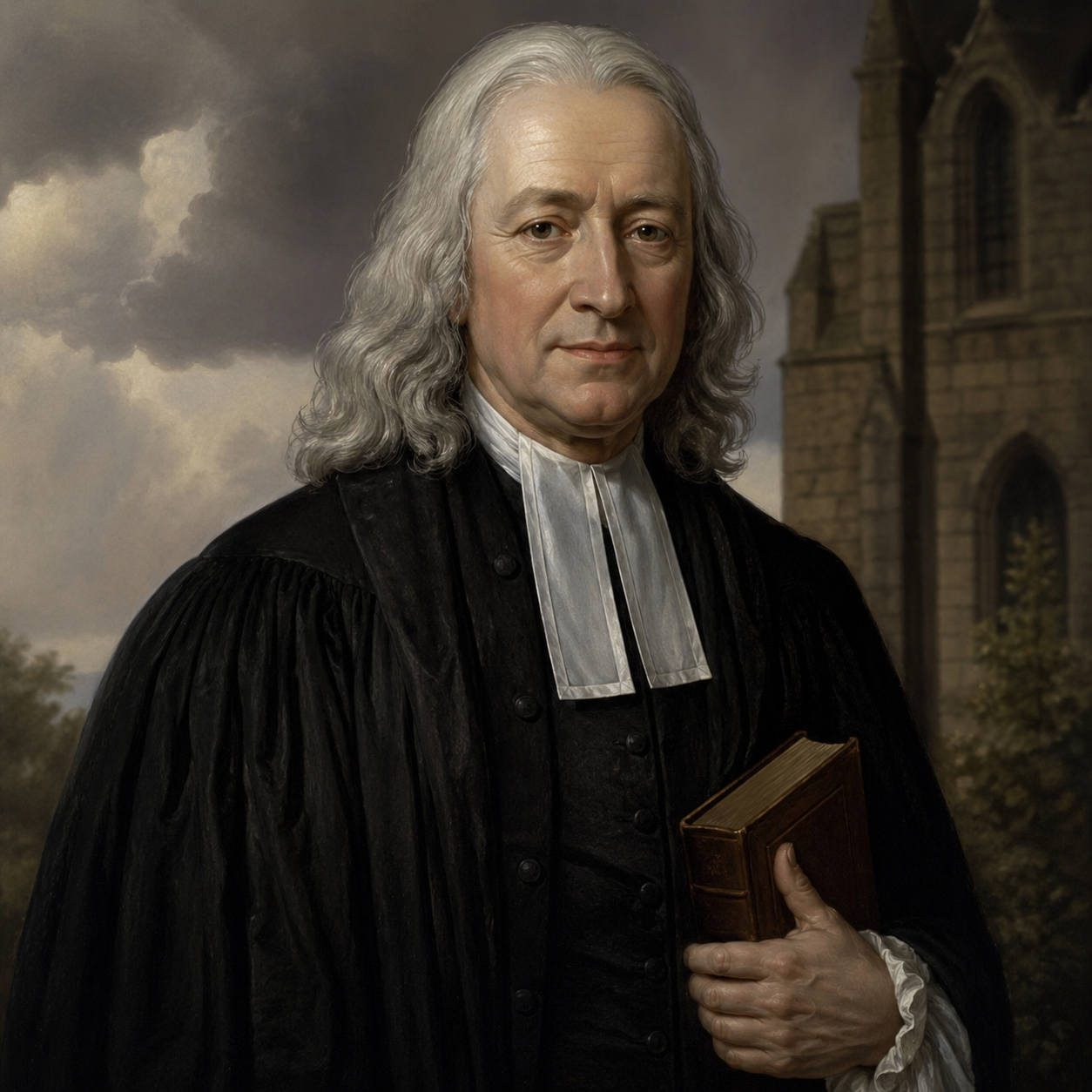
John Wesley — "It is a poor religion that consists in negatives only."
It is a poor religion that consists in negatives only.
It is a poor religion that consists in negatives only.
Click any product to generate a realistic preview. Up to 3 at a time.
* Initial load can take up to 90 seconds — revising the preview in another color is nearly instant.
"When I have money, I get rid of it quickly, lest it find a way into my heart."
"It is not the being in a place, but the being in a state, that makes us happy."
"I still find, and find it to my comfort, that I am not in the number of the rich. If I am not, I am not in the number of them that are in danger of falling into temptation and a snare, and into many f…"
"Beware you be not swallowed up in books! An ounce of love is worth a pound of knowledge."
"I am as much a High-Churchman as ever I was. And I hope to live and die so."
English Anglican cleric and founder of Methodism, whose open-air preaching and class-meeting structure created the largest 18th-century evangelical revival. Closely associated with Charles Wesley (his hymn-writing brother) and George Whitefield (early co-revivalist, later doctrinal opponent). For an intellectual contrast, see George Whitefield, Calvinist evangelical revivalist — Whitefield's predestinarian Calvinism vs Wesley's free-grace Arminian theology split the early Methodist movement permanently in the 1739-41 break. The founding evangelical Calvinist-Arminian schism — the two parallel evangelical traditions American Christianity descends from.
Found in 1 providers: grok
1 source checked
A faith built only on prohibitions—what one must not do, touch, or say—is hollow. Genuine religion demands positive action: loving neighbors, serving the poor, pursuing justice. Defining belief as a list of avoidances strips it of vitality and purpose. Real spiritual life expresses itself outwardly through what a person actively does, not merely through what they refuse. Negatives alone cannot animate a living, transforming faith.
Wesley embodied active faith throughout his life, riding over 250,000 miles on horseback to preach to miners, prisoners, and the impoverished. He founded schools, dispensaries, and loan societies alongside his preaching. His doctrine of entire sanctification called believers toward perfect love, not mere rule-following. Methodism's core disciplines—visiting the sick, feeding the hungry, reforming prisons—directly reflected his conviction that true holiness must show itself in ceaseless, outward, positive works.
Eighteenth-century Britain's dominant religious culture often equated godliness with respectability: avoiding drink, gambling, and vice. High Calvinism stressed predestination and doctrinal purity over active charity, while the established Church of England was widely criticized as complacent. As industrialization uprooted rural communities and created urban poverty, Wesley's demand for activist religion challenged a church perceived as defining faith through abstention rather than through transforming engagement with suffering people.
AI-generated insights based on extensive research and information for context. Factual errors? Email [email protected].
Your cart is empty