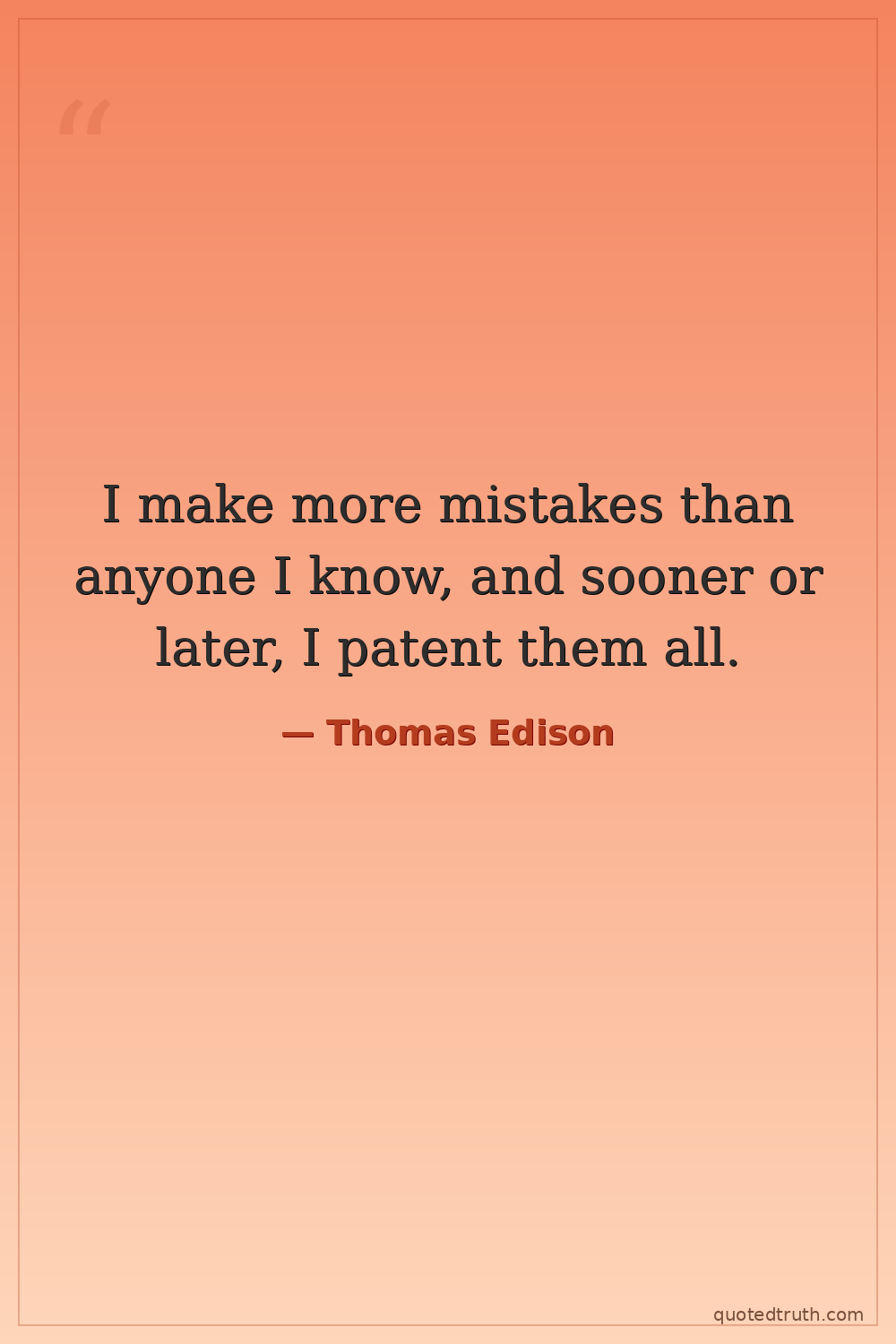
Thomas Edison — "I make more mistakes than anyone I know, and sooner or later, I patent them all."
I make more mistakes than anyone I know, and sooner or later, I patent them all.
I make more mistakes than anyone I know, and sooner or later, I patent them all.
Click any product to generate a realistic preview. Up to 3 at a time.
* Initial load can take up to 90 seconds — revising the preview in another color is nearly instant.
"I never had a policy; I have just tried to do my very best each and every day."
"There will be more women than men inventors in the future."
"There's a way to do it better - find it."
"The greatest invention of all time is the human mind."
"I am long on ideas, but short on time. I expect to live to be only about a hundred."
Found in 1 providers: grok
1 source checked
Edison is saying that failure is not something to hide but something to harvest. He makes a huge number of errors, yet treats each one as raw material. Given enough time, even the botched attempts turn into something worth owning and protecting. The point is that quantity of attempts, combined with the willingness to keep what the mistakes teach, eventually produces results valuable enough to claim as your own.
Edison famously ran thousands of failed filament tests before landing on a workable light bulb, and held 1,093 U.S. patents by his death in 1931. He ran Menlo Park as an invention factory built on iteration, not inspiration. The remark fits a man who publicly reframed failure as data, insisted genius was mostly perspiration, and turned experimental dead-ends into phonographs, batteries, and cement formulas he could legally monetize.
Edison worked from the 1870s through the 1920s, the heart of America's Second Industrial Revolution, when the U.S. Patent Office was the gateway to fortune and electricity, telegraphy, and recorded sound were being invented in real time. Patents had just become the backbone of industrial competition, with Bell, Westinghouse, and Tesla racing alongside him. Owning an idea on paper mattered as much as building it, and Edison mastered that system.
AI-generated insights based on extensive research and information for context. Factual errors? Email [email protected].
Your cart is empty