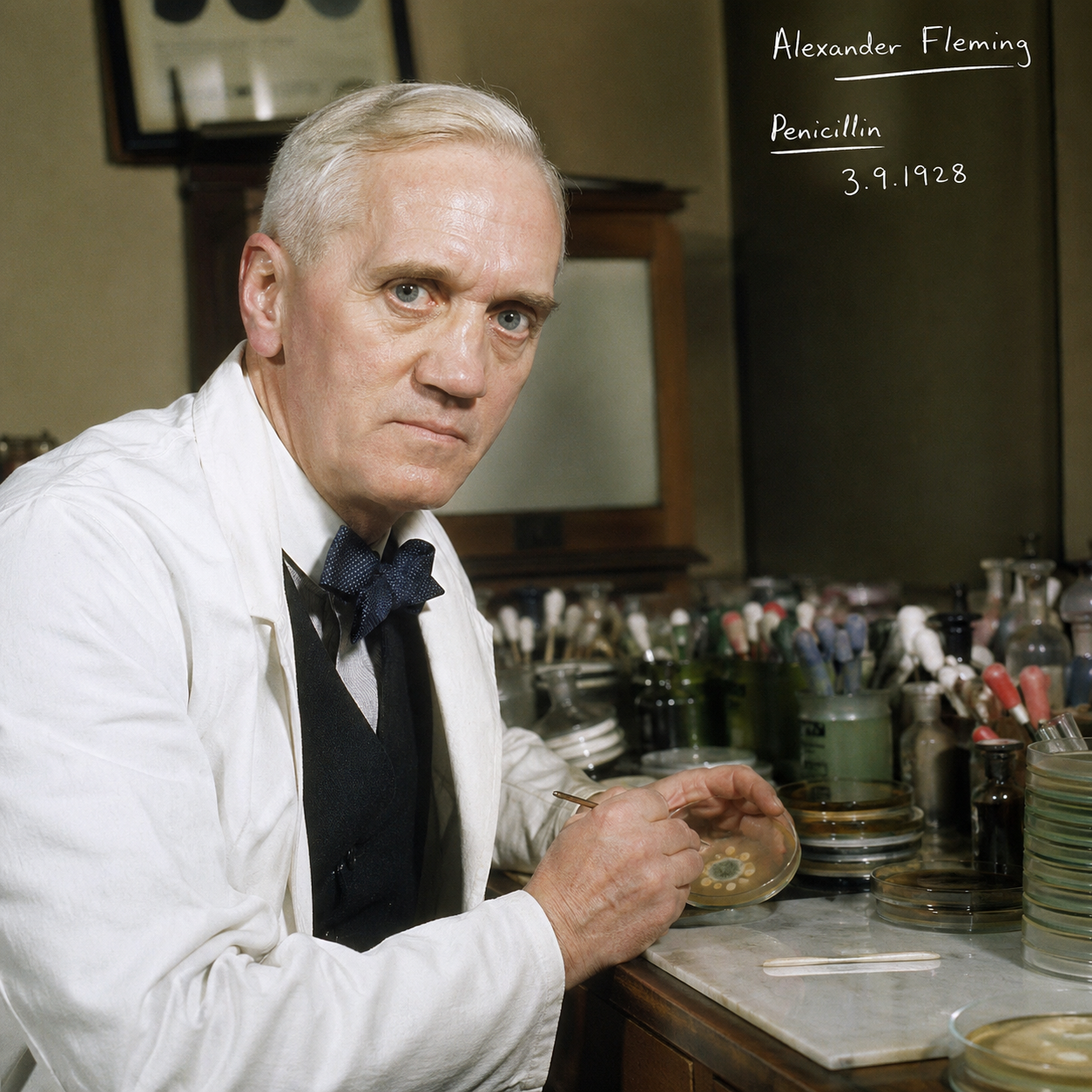
Alexander Fleming — "I never thought of myself as a genius. I just kept looking."
I never thought of myself as a genius. I just kept looking.
I never thought of myself as a genius. I just kept looking.
Click any product to generate a realistic preview. Up to 3 at a time.
* Initial load can take up to 90 seconds — revising the preview in another color is nearly instant.
"It is the lone worker who makes the first advance in a subject; the details may be worked out by a team, but the prime idea is due to enterprise, thought, and perception of an individual."
"I can only warn. It is up to others to heed the warning."
"I am often asked if I foresaw the impact of penicillin. My honest answer is no."
"The future of chemotherapy lies in the intelligent use of these new antibacterial agents."
"I was not a great scientist, but I was a careful observer."
Found in 1 providers: grok
1 source checked
The speaker rejects the idea that breakthrough achievements come from innate brilliance. Instead, success is framed as the result of persistent attention and continued investigation. The message is that ordinary people who refuse to stop observing, questioning, and examining their surroundings are the ones who eventually find what others miss. Discovery belongs to the patient and curious, not to those waiting for a flash of inspiration.
Fleming famously discovered penicillin in 1928 after noticing a mold contaminating a forgotten Petri dish of staphylococci, an observation many researchers would have discarded. His career as a Scottish bacteriologist at St. Mary's Hospital was built on careful, patient lab work, not theoretical leaps. He often credited luck and noticing, downplaying his own intellect. The quote captures his self-effacing realism and the methodical curiosity that turned a contaminated culture plate into modern antibiotics.
Fleming worked in early-twentieth-century Britain, scarred by World War I infections that killed more soldiers than bullets. Bacterial diseases like pneumonia, sepsis, and tuberculosis were routinely fatal, and medicine had no reliable cure. The interwar laboratories of the 1920s were modest, underfunded, and observational. Penicillin's true mass production only arrived during World War II under Allied wartime urgency. His humility reflects an era when single careful observers, not big-budget teams, still moved science forward.
AI-generated insights based on extensive research and information for context. Factual errors? Email [email protected].
Your cart is empty