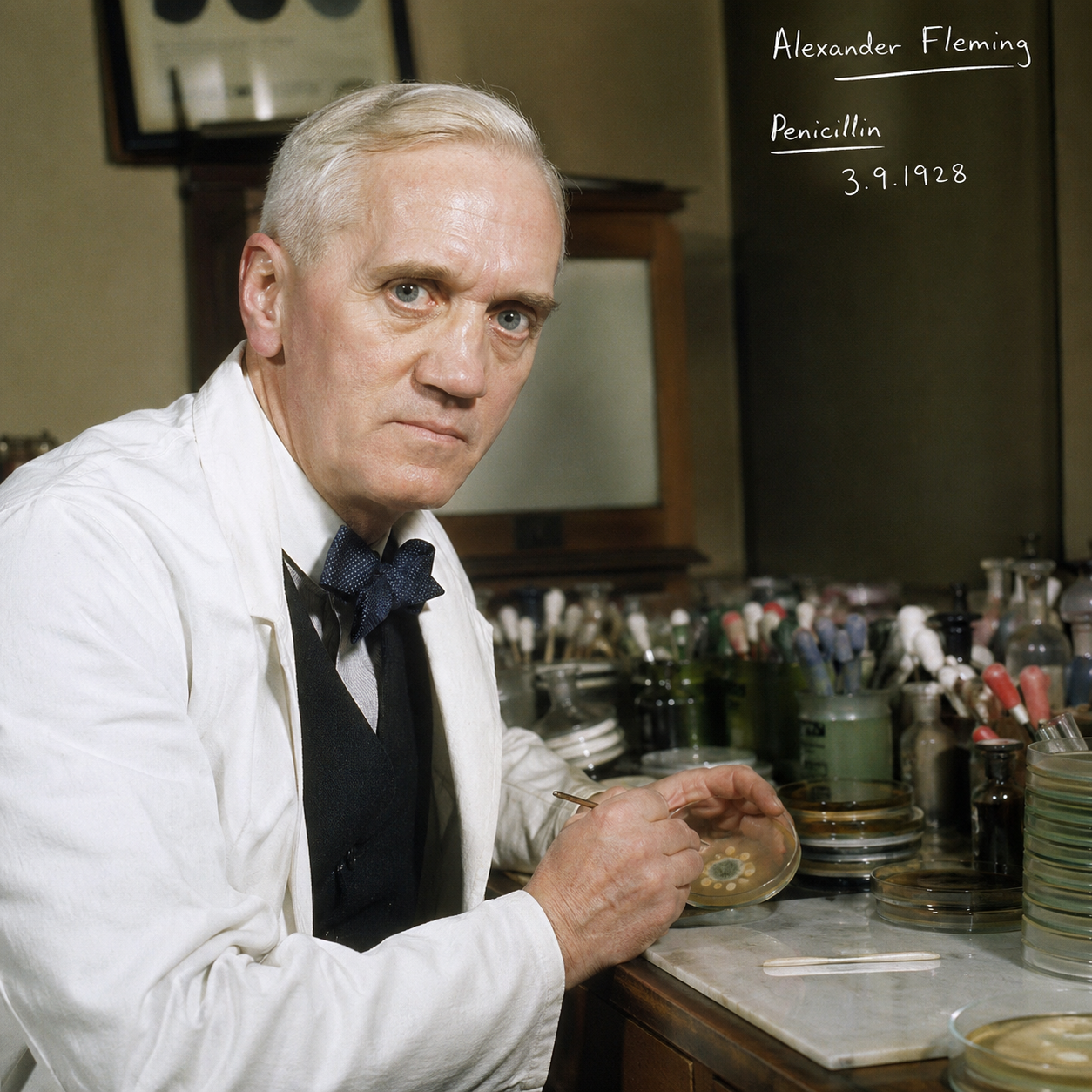
Alexander Fleming — "The mold was a lucky accident, but the observation was not."
The mold was a lucky accident, but the observation was not.
The mold was a lucky accident, but the observation was not.
Click any product to generate a realistic preview. Up to 3 at a time.
* Initial load can take up to 90 seconds — revising the preview in another color is nearly instant.
"My laboratory was always a bit chaotic, but I knew where everything was."
"I am sometimes asked what I think of the future of penicillin. I think it has a great future, but it must be used wisely."
"I can only warn. It is up to others to heed the warning."
"I had no idea at the time that I was making a discovery that would change the course of medicine."
"It is not the man who first sees a thing who is the discoverer, but he who sees into a thing."
Found in 1 providers: grok
1 source checked
Chance creates openings, but discovery requires a prepared and attentive mind to act on them. The quote separates the random event from the deliberate recognition of its importance. Most accidents go unnoticed because nobody stops to ask why they happened. Real breakthroughs come from the discipline of paying attention—of seeing an anomaly and pursuing it rather than dismissing it as contamination or noise.
In September 1928, Fleming returned from vacation to find a Penicillium mold had killed Staphylococcus colonies on a discarded petri dish. A less curious scientist would have thrown it away. His WWI experience treating infected battlefield wounds had trained him to watch bacterial behavior obsessively. That prior discipline—not the mold's arrival—was the actual discovery. Fleming spent his career insisting observation, not inspiration, was the engine of science.
In the 1920s and 1930s, bacterial infections—sepsis, pneumonia, infected wounds—were among the leading causes of death worldwide, with no reliable treatments. WWI had killed hundreds of thousands through infection alone. Simultaneously, the culture of science romanticized lone-genius eureka moments. Fleming's framing directly challenged that mythology, arguing that structured attention and trained observation drove medicine forward—a position that helped define the rigorous experimental culture of 20th-century biomedical research.
AI-generated insights based on extensive research and information for context. Factual errors? Email [email protected].
Your cart is empty