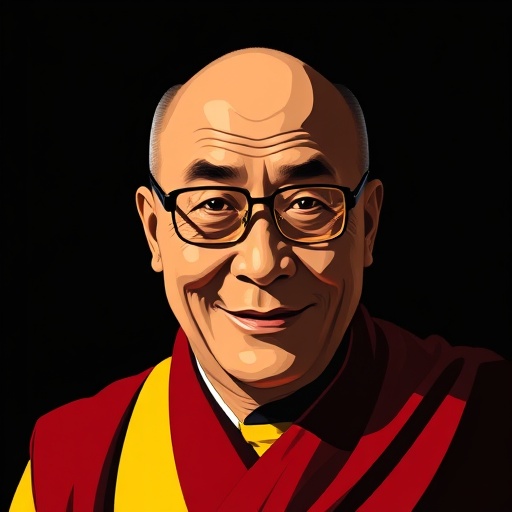
Dalai Lama (14th) — "I sometimes call myself a 'troublemaker' because I like to challenge people's as…"
I sometimes call myself a 'troublemaker' because I like to challenge people's assumptions.
I sometimes call myself a 'troublemaker' because I like to challenge people's assumptions.
Click any product to generate a realistic preview. Up to 3 at a time.
* Initial load can take up to 90 seconds — revising the preview in another color is nearly instant.
"Sometimes I think I am a little bit naughty, a little bit mischievous."
"China has turned Tibet into a hell on earth."
"If scientific analysis were conclusively to demonstrate certain claims in Buddhism to be false, then we must accept the findings of science and abandon those claims."
"Dialogue is the only way to resolve differences."
"Sometimes I think I am a little bit lazy."
Found in 1 providers: grok
1 source checked
The speaker embraces the role of intellectual provocateur, deliberately unsettling comfortable certainties rather than offering passive agreement. True growth requires questioning what we take for granted. By calling himself a troublemaker, he reclaims that word positively, suggesting that disrupting assumptions is an act of compassion — pushing people toward deeper, more honest understanding rather than leaving them in comforting but limiting beliefs.
Tenzin Gyatso has spent decades challenging global assumptions about Tibet, nonviolence, and happiness. Exiled from Tibet in 1959, he refused bitterness, instead questioning Western materialism and Cold War politics. His interfaith dialogues challenged religious insularity. His neuroscience collaborations with scientists like Richard Davidson questioned assumptions about meditation and mind. Even within Buddhism, he has questioned rigid traditions and patriarchal structures, including discussing female successors.
Born 1935, the 14th Dalai Lama has lived through revolutionary upheaval — Chinese occupation of Tibet, the Cold War, globalization, and the digital age. His era saw rigid ideological systems collapse and assumptions about capitalism, democracy, and religion face unprecedented scrutiny. Climate crisis, inequality, and rising authoritarianism make assumption-challenging existentially urgent. His voice consistently cuts against dominant narratives across geopolitics, psychology, and spirituality.
AI-generated insights based on extensive research and information for context. Factual errors? Email [email protected].
Your cart is empty