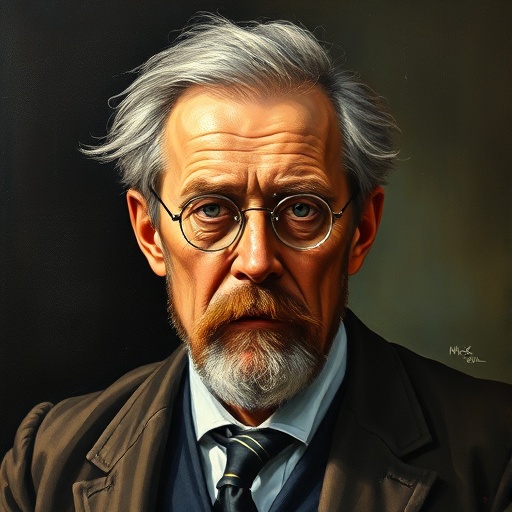
Max Planck — "I started from the assumption that the energy of an oscillator is quantized. I d…"
I started from the assumption that the energy of an oscillator is quantized. I did this in an act of desperation.
I started from the assumption that the energy of an oscillator is quantized. I did this in an act of desperation.
Click any product to generate a realistic preview. Up to 3 at a time.
* Initial load can take up to 90 seconds — revising the preview in another color is nearly instant.
"The quantum hypothesis will never be understood until one realizes that it is only a provisional stopgap."
"The history of science shows that even the most firmly established theories can be overturned by new discoveries."
"I learned more from my professors in one year than I have from all the books I've read."
"The greatest joy of a scientist is to see a new truth emerge."
"We have no right to assume that any physical laws exist, or if they have existed up to now, that they will continue to exist in a similar manner in the future."
Recalling the genesis of quantum theory, emphasizing his initial reluctance or surprise at the implications.
Date: Early 20th century, reflecting on 1900
GeneralFound in 1 providers: grok
1 source checked
Planck is admitting that he proposed a radical idea—that energy comes only in discrete packets rather than flowing continuously—not because he believed it, but because he had run out of other options. Classical physics could not explain the radiation patterns he was studying, so he tried a strange mathematical trick to make the numbers fit. He frames the birth of quantum theory as reluctant problem-solving, not visionary insight, driven purely by frustration with failed conventional approaches.
Planck was a deeply conservative physicist trained in classical thermodynamics who revered continuity and order in nature. He spent years trying to derive blackbody radiation using traditional methods before his 1900 quantum hypothesis. The word desperation captures his genuine discomfort: he later spent decades trying to reconcile quanta with classical physics. This quote reflects his intellectual honesty, his reluctant role as a revolutionary, and his lifelong tension between traditional Prussian scientific rigor and the strange new physics he accidentally founded.
Around 1900, classical physics seemed nearly complete, yet the ultraviolet catastrophe in blackbody radiation defied explanation. European physics was centered in German universities, where Planck worked in Berlin. Industrialization demanded better understanding of heat and light for lighting and steel furnaces. Scientists believed a few loose ends remained, but Planck's desperate quantum leap, followed by Einstein, Bohr, and Heisenberg, shattered that confidence and launched the quantum revolution that defined twentieth-century science and technology.
AI-generated insights based on extensive research and information for context. Factual errors? Email [email protected].
Your cart is empty