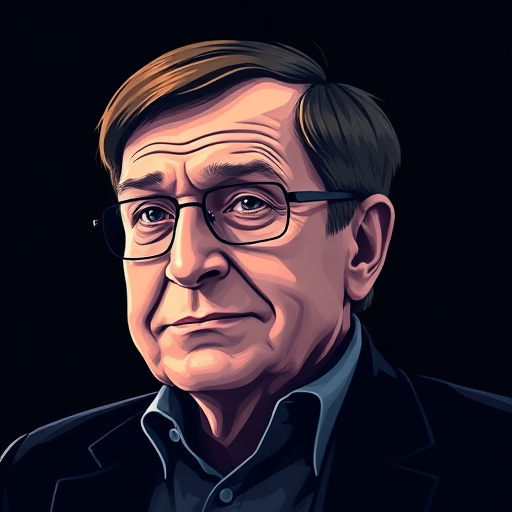
Stephen Hawking — "I think that the universe is a beautiful and complex place, and I'm very lucky t…"
I think that the universe is a beautiful and complex place, and I'm very lucky to be able to study it.
I think that the universe is a beautiful and complex place, and I'm very lucky to be able to study it.
Click any product to generate a realistic preview. Up to 3 at a time.
* Initial load can take up to 90 seconds — revising the preview in another color is nearly instant.
"There are no boundaries to human endeavor. We are all different. However bad life may seem, there is always something you can do and succeed at. While there's life, there is hope."
"I think that the human race has a destiny to explore the universe."
"The future of humanity depends on our ability to be able to make space travel possible."
"I want my books sold on airport bookstalls."
"I'm a physicist, and I believe in science. I don't believe in miracles."
British theoretical physicist whose Hawking radiation work and A Brief History of Time (1988) brought black-hole physics to a mass audience while he lived with ALS for 55 years. Closely associated with Roger Penrose (his collaborator on singularity theorems) and Carl Sagan (fellow popularizer who wrote Brief History's foreword). For an intellectual contrast, see William Lane Craig, American philosopher of religion — Craig's Kalam cosmological argument depends on the Big Bang requiring a divine first cause; Hawking's no-boundary proposal was specifically designed to remove the moment that would require one — the cleanest cosmology-vs-natural-theology contrast in modern thought.
Found in 1 providers: grok
1 source checked
The universe is both stunning in its elegance and staggeringly intricate in its workings. The speaker feels genuine gratitude for having the opportunity to investigate it professionally — not taking for granted that studying the cosmos is a privilege, not merely a career. Wonder and luck, not obligation or ego, define the relationship between the scientist and the subject.
Hawking spent decades confined by ALS, losing nearly all physical function, yet his mind ranged freely across black holes, singularities, and the Big Bang. This quote reflects his documented sense of wonder — visible in A Brief History of Time — and his refusal to let disability define his experience. Gratitude was central to how he spoke publicly about his life and work.
Hawking worked through the late 20th and early 21st centuries, when cosmology transformed from theoretical speculation into observational science — COBE, Hubble, WMAP, and gravitational wave detection all arrived in his lifetime. Public scientific literacy was also rising, making his role as a communicator meaningful. His era saw both profound discovery and existential anxiety about humanity's place in an increasingly understood universe.
AI-generated insights based on extensive research and information for context. Factual errors? Email [email protected].
Your cart is empty