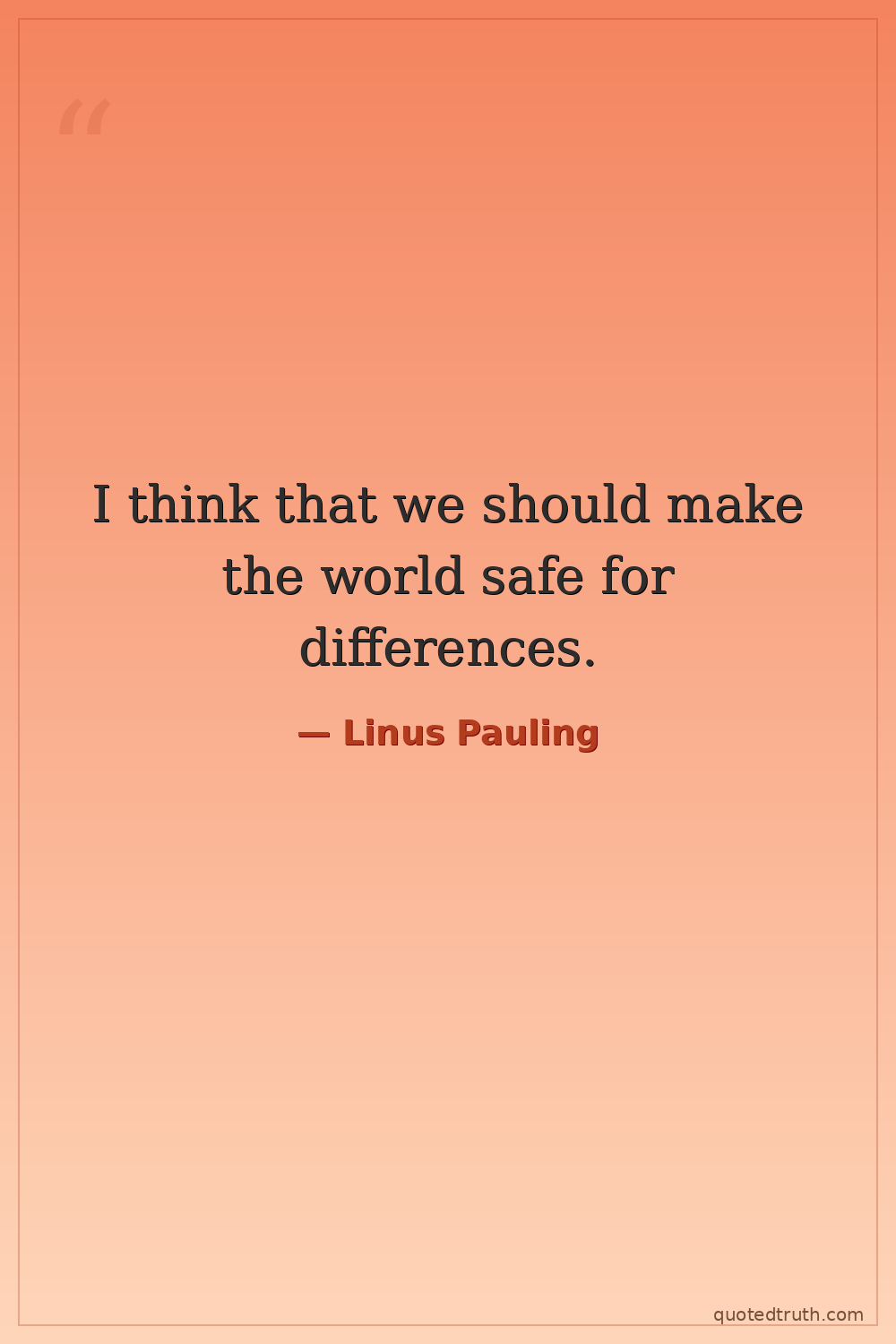
Linus Pauling — "I think that we should make the world safe for differences."
I think that we should make the world safe for differences.
I think that we should make the world safe for differences.
Click any product to generate a realistic preview. Up to 3 at a time.
* Initial load can take up to 90 seconds — revising the preview in another color is nearly instant.
"The only way to do great work is to love what you do."
"I think that the formation of [DNA's] structure by Watson and Crick may turn out to be the greatest developments in the field of molecular genetics in recent years."
"I have always been a curious person, and I believe that curiosity is the key to discovery."
"Every time you go to the doctor, the doctor asks you to take off your clothes, and then he looks at you, and he tells you what's wrong with you. But he doesn't know anything about you."
"The problem of an atomic war must not be confused by minor problems such as Communism versus capitalism. An atomic war would kill everyone, left, right, or center."
Found in 1 providers: grok
1 source checked
The world should be structured so that people, nations, and ideas that differ from dominant norms can exist without fear of persecution or elimination. Safety here means legal protection, cultural tolerance, and political structures that do not demand conformity as a condition of survival. Diversity of thought, identity, and approach is treated as a feature worth protecting, not a threat to be neutralized.
Pauling was a Nobel laureate in both Chemistry and Peace, rare dual recognition reflecting his dual commitment to scientific truth and human rights. He fought McCarthyism when the U.S. government revoked his passport for his peace activism. His willingness to hold minority scientific views, like early work on protein structure, and political views under pressure made tolerance for difference personally lived, not abstract.
Pauling was most active during the Cold War, when ideological conformity was enforced through McCarthyite loyalty oaths, nuclear brinksmanship demanded national unity, and colonized nations were being pressured into alignment with either superpower. His nuclear test ban advocacy and peace movement work positioned him directly against a world order that treated difference, political, national, ideological, as an existential danger to be suppressed.
AI-generated insights based on extensive research and information for context. Factual errors? Email [email protected].
Your cart is empty