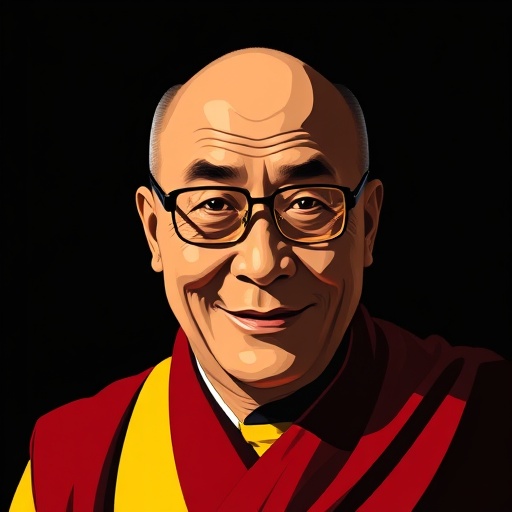
Dalai Lama (14th) — "I think the best way to solve problems is through dialogue and negotiation. Viol…"
I think the best way to solve problems is through dialogue and negotiation. Violence is never the answer.
I think the best way to solve problems is through dialogue and negotiation. Violence is never the answer.
Click any product to generate a realistic preview. Up to 3 at a time.
* Initial load can take up to 90 seconds — revising the preview in another color is nearly instant.
"My main interest is to promote human values, compassion, forgiveness, tolerance, self-discipline, contentment. That's my main interest."
"Dialogue is the only way to resolve differences."
"We are visitors on this planet. We are here for ninety or one hundred years at the very most. During that period, we must try to do something good, something useful, with our lives. If you contribute …"
"It is under the greatest adversity that there is the greatest potential for doing good, both for oneself and others."
"I am open to guidance from the universe, and I don’t let my limited perception of reality get in the way."
Found in 1 providers: grok
1 source checked
When problems arise — personal, political, or global — the most effective path forward is honest conversation and mutual compromise, not force. Violence breeds more violence, entrenching conflict rather than resolving it. Dialogue acknowledges the other side as worth engaging, while negotiation creates outcomes both parties can accept. The message is both moral and pragmatic: peaceful methods produce durable solutions that violence fundamentally cannot.
Tenzin Gyatso fled Tibet in 1959 after China's military occupation and has spent over six decades in exile advocating nonviolent resistance. His "Middle Way" policy seeks Tibetan autonomy through negotiation rather than independence or armed revolt. He engaged Chinese officials in direct talks and addressed world governments consistently. The 1989 Nobel Peace Prize honored this commitment, making dialogue not just a belief but the defining strategy of his entire life's work.
The Dalai Lama's public life spans Cold War proxy conflicts, Vietnam, the Rwandan genocide, and the post-9/11 "War on Terror" — eras when military force was the default response to political conflict. China's 1950 annexation of Tibet showed how easily state violence silences dissent. Against that backdrop, his repeated insistence on dialogue over force directly challenged the dominant logic of global politics, giving the statement urgency far beyond abstract philosophy.
AI-generated insights based on extensive research and information for context. Factual errors? Email [email protected].
Your cart is empty