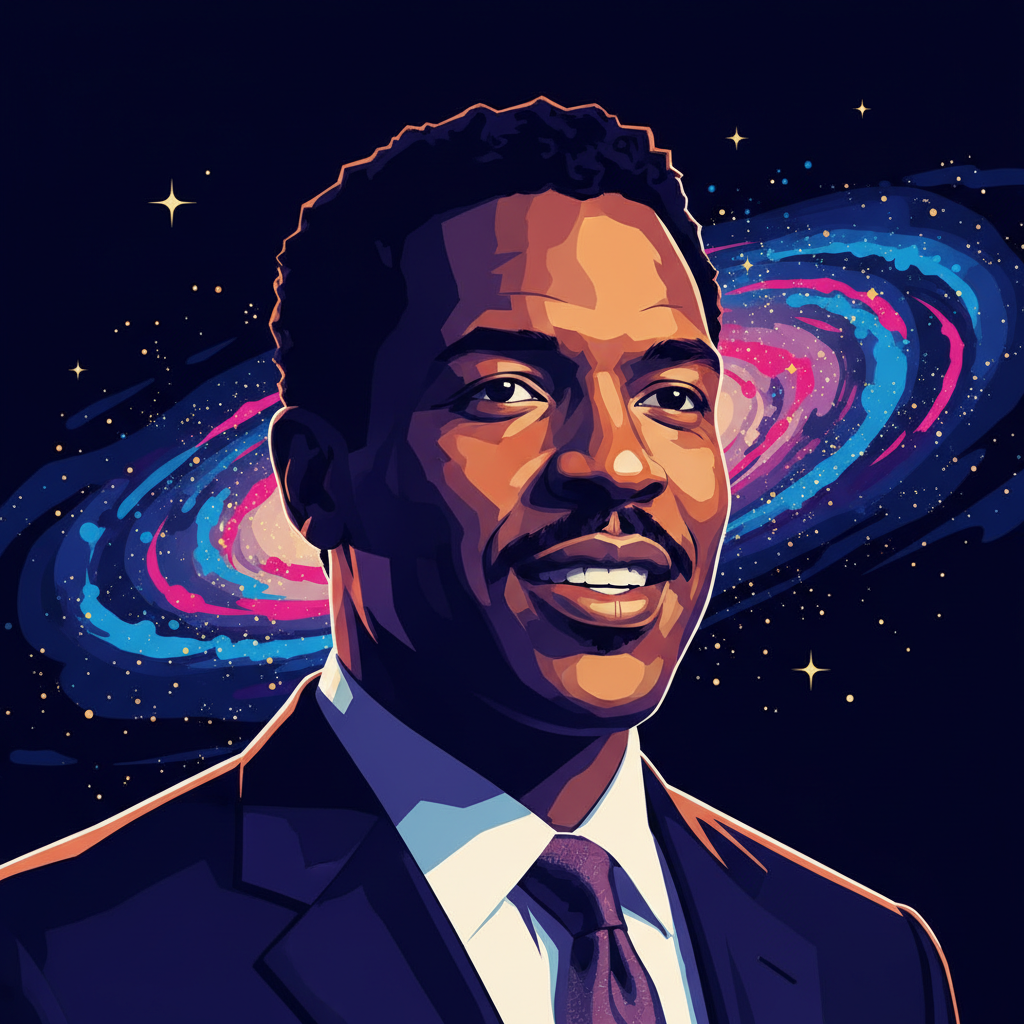
Neil deGrasse Tyson — "I think the greatest gift you can give someone is the gift of knowledge."
I think the greatest gift you can give someone is the gift of knowledge.
I think the greatest gift you can give someone is the gift of knowledge.
Click any product to generate a realistic preview. Up to 3 at a time.
* Initial load can take up to 90 seconds — revising the preview in another color is nearly instant.
"The great thing about science is that it's a self-correcting enterprise. It doesn't care about your feelings."
"For me, I am a cosmic optimist. I always think that we will find solutions to our problems."
"The universe is a vast and mysterious place, and we are just beginning to understand it."
"I'm not saying that science has all the answers. I'm saying that science is the only way we're going to get answers."
"The claim that the universe was made for us is a human vanity."
American astrophysicist, Hayden Planetarium director, and Cosmos: A Spacetime Odyssey host who carries the Carl Sagan public-science mantle. Closely associated with Bill Nye (fellow science communicator) and Brian Greene (theoretical physicist and string-theory popularizer). For an intellectual contrast, see Ken Ham, founder of Answers in Genesis and the Creation Museum — Ham's career has been organized around defending biblical 6-day creationism — exactly the science-education position Tyson's mainstream-science communication is structured to refute.
Found in 1 providers: grok
1 source checked
Sharing knowledge is the most valuable thing one person can offer another — more enduring than any material gift. Understanding how the world works empowers people to make better decisions, question assumptions, and build on ideas. Knowledge compounds: one insight unlocks others, creating a chain reaction of understanding that outlasts any physical possession and has the power to fundamentally transform a life.
Tyson built his career not just doing science but democratizing it — hosting Cosmos: A Spacetime Odyssey, directing the Hayden Planetarium, writing accessible books, and appearing on podcasts and late-night television. His mentor Carl Sagan shaped him as a teenager by giving him time and encouragement. Tyson has explicitly cited Sagan's generosity as the model for his own relentless commitment to public science outreach.
Tyson rose to prominence during a surge in science skepticism — climate denial, vaccine hesitancy, and flat-earth movements gained mainstream traction through the 2000s–2010s. Social media accelerated misinformation at unprecedented scale, making scientific literacy a civic emergency. The internet simultaneously democratized knowledge access as never before. Against this backdrop, framing knowledge as the supreme gift carries real urgency: an informed public is the only durable defense against manipulation.
AI-generated insights based on extensive research and information for context. Factual errors? Email [email protected].
Your cart is empty