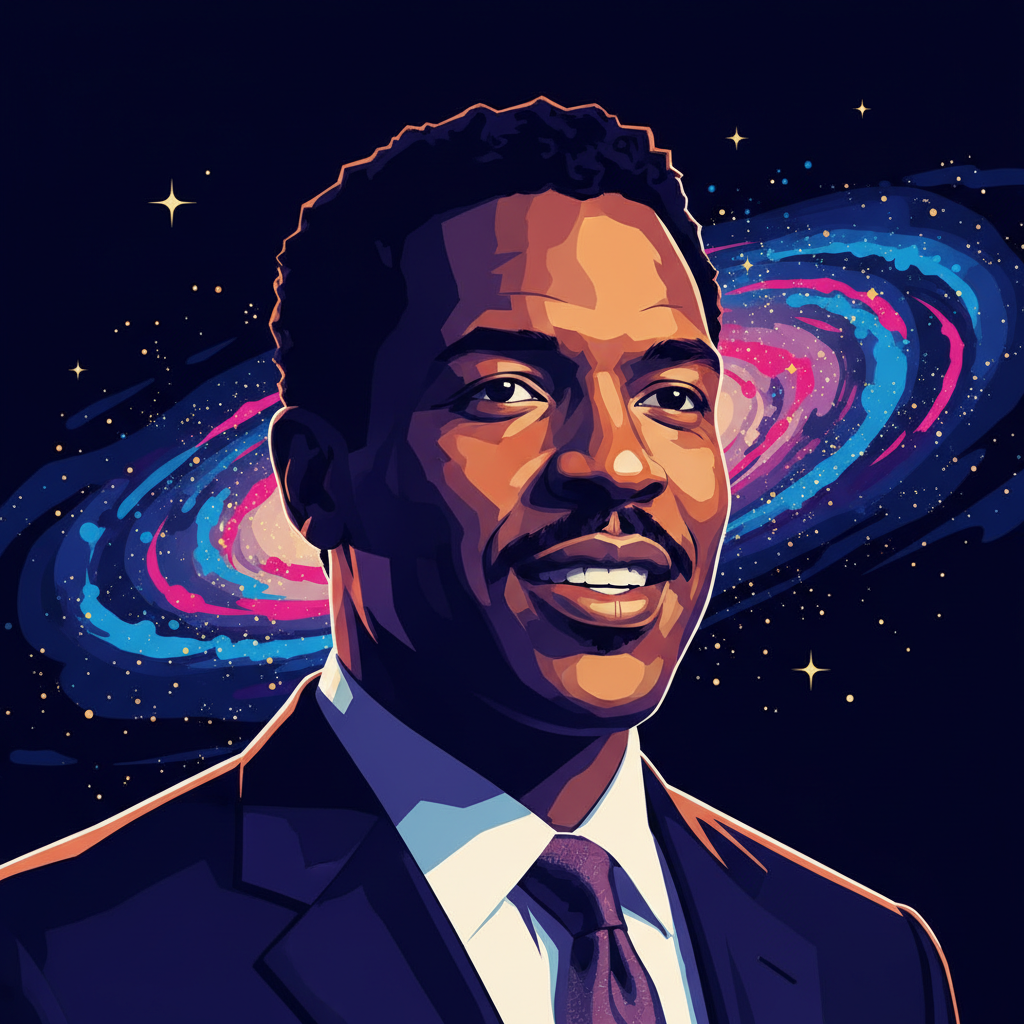
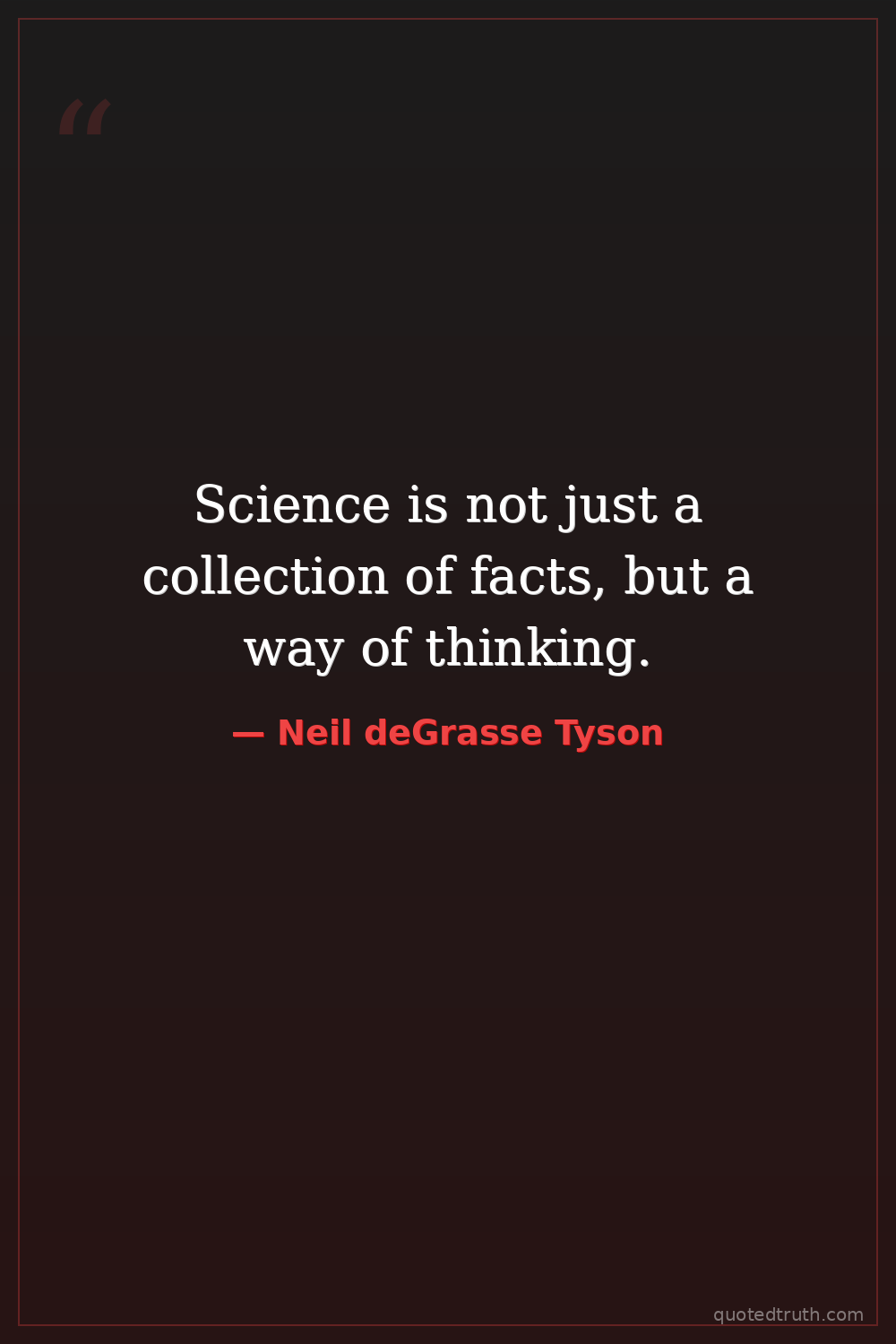
Neil deGrasse Tyson — "Science is not just a collection of facts, but a way of thinking."
Science is not just a collection of facts, but a way of thinking.
Science is not just a collection of facts, but a way of thinking.
Click any product to generate a realistic preview. Up to 3 at a time.
* Initial load can take up to 90 seconds — revising the preview in another color is nearly instant.
"If you are not in awe of the universe, you are not living."
"I'm not saying there's no God. I'm saying if there is a God, he's an absentee landlord."
"Knowing how to think empowers you far beyond those who only know what to think."
"I'm not saying I'm smarter than anyone. I'm just saying I've read more books."
"We spend the first year of a child's life teaching it to walk and talk and the rest of its life telling it to sit down and shut up. Is it any wonder the world is in the mess it's in?"
American astrophysicist, Hayden Planetarium director, and Cosmos: A Spacetime Odyssey host who carries the Carl Sagan public-science mantle. Closely associated with Bill Nye (fellow science communicator) and Brian Greene (theoretical physicist and string-theory popularizer). For an intellectual contrast, see Ken Ham, founder of Answers in Genesis and the Creation Museum — Ham's career has been organized around defending biblical 6-day creationism — exactly the science-education position Tyson's mainstream-science communication is structured to refute.
Found in 1 providers: grok
1 source checked
Science isn't merely memorizing data or cataloging discoveries — it's a disciplined mindset of curiosity, skepticism, and systematic inquiry. It means questioning assumptions, demanding evidence, testing ideas against reality, and revising beliefs when proof demands it. Anyone can adopt this way of thinking, not just credentialed scientists. The method matters more than the accumulated knowledge itself.
Tyson built his entire public career on democratizing science's mindset, not just its facts. As director of the Hayden Planetarium and host of Cosmos, he consistently argued that critical thinking protects society from misinformation. His books and StarTalk podcast prioritize teaching how scientists reason over reciting astronomical data, reflecting his belief that scientific thinking is a civic necessity.
In an era of viral misinformation, climate denial, vaccine hesitancy, and algorithmically amplified pseudoscience, this framing became urgently relevant. Post-2010 social media accelerated false claims faster than corrections could follow. Tyson emerged as a prominent voice arguing that teaching people to evaluate evidence — rather than simply trust authority — was essential for democratic societies to navigate complex technical and policy decisions.
AI-generated insights based on extensive research and information for context. Factual errors? Email [email protected].
Your cart is empty