Grace Hopper — "I think the Mark I was probably the most exciting thing I ever did."
I think the Mark I was probably the most exciting thing I ever did.
I think the Mark I was probably the most exciting thing I ever did.
Click any product to generate a realistic preview. Up to 3 at a time.
* Initial load can take up to 90 seconds — revising the preview in another color is nearly instant.
"I'm going to retire when I'm 100."
"In pioneer days they used oxen for heavy pulling, and when one ox couldn't budge a log, they didn't try to grow a larger ox. We shouldn't be trying for bigger computers, but for more systems of comput…"
"I am now going to make you a gift that will stay with you the rest of your life. For the rest of your life, every time you say, 'We've always done it that way,' my ghost will appear and haunt you for …"
"My father always told me, 'Grace, you can do anything you want, you just have to work for it.'"
"I've always been a little bit of a rebel."
Found in 1 providers: grok
1 source checked
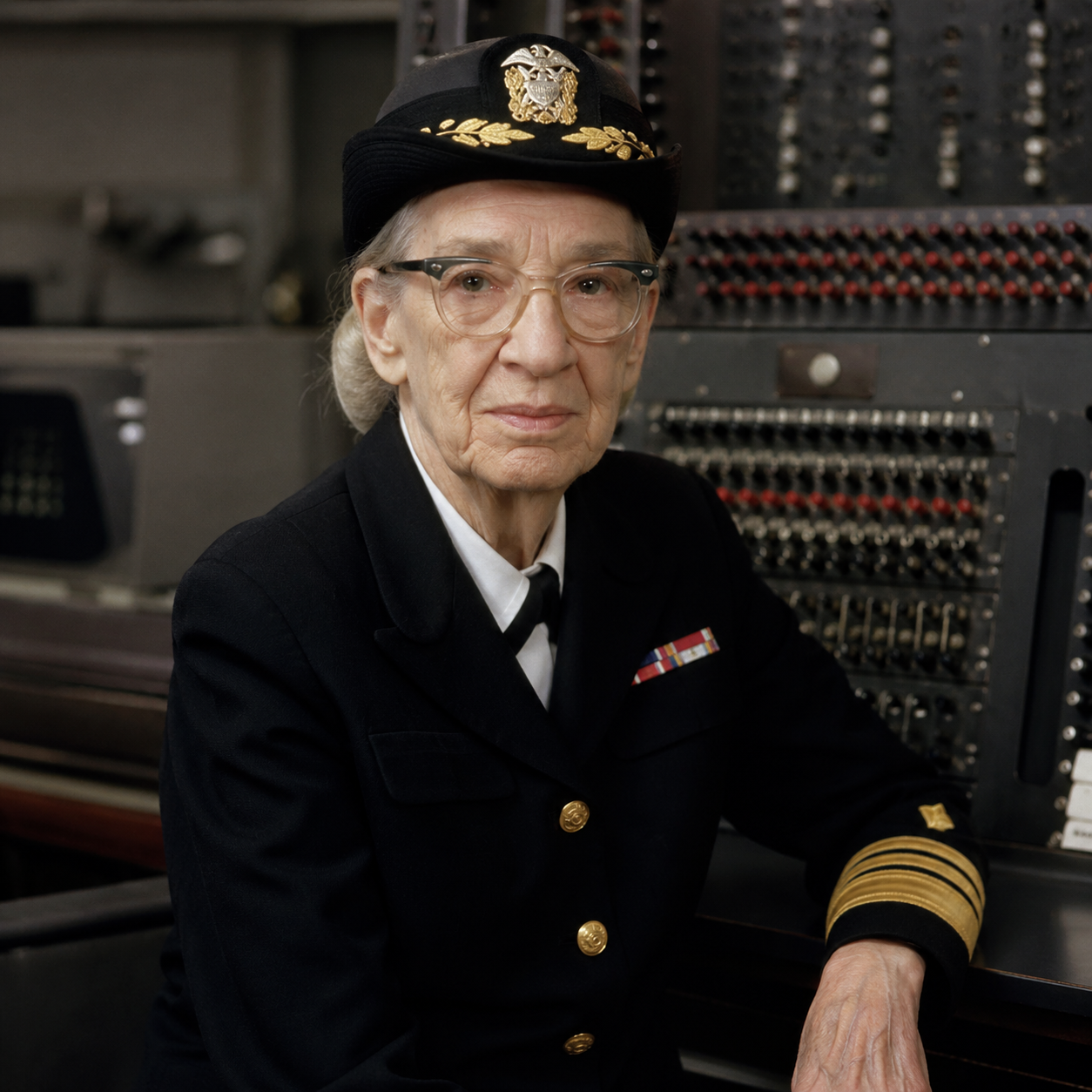
Despite a career spanning decades and landmark achievements, Hopper looked back at the Harvard Mark I — a 51-foot electromechanical computer completed in 1944 — as her greatest thrill. She's saying the raw excitement of being first, of figuring out something nobody had done before, outweighs later recognition and accolades. For her, the beginning, not the pinnacle, was the most alive she ever felt in her work.
Hopper joined the Harvard Mark I project in 1944 after enlisting in the Naval Reserve, becoming one of the first programmers of a large-scale electromechanical computer. She co-authored its comprehensive operations manual. Though she later developed the first compiler and shaped COBOL's creation, she reserved her deepest excitement for that origin moment — true to her character as someone who thrived on solving problems nobody had tackled before, not on accumulated prestige.
The Harvard Mark I was unveiled in 1944 during World War II, when military demand for rapid calculation — ballistics tables, cryptanalysis, logistics — drove computing from theoretical to operational. It was among the first large-scale automatic digital computers in America. Women entered technical and scientific roles in unprecedented numbers as wartime labor shortages opened previously closed doors, making Hopper's position both a product of her era and genuinely path-breaking in what she created.
AI-generated insights based on extensive research and information for context. Factual errors? Email [email protected].
Your cart is empty