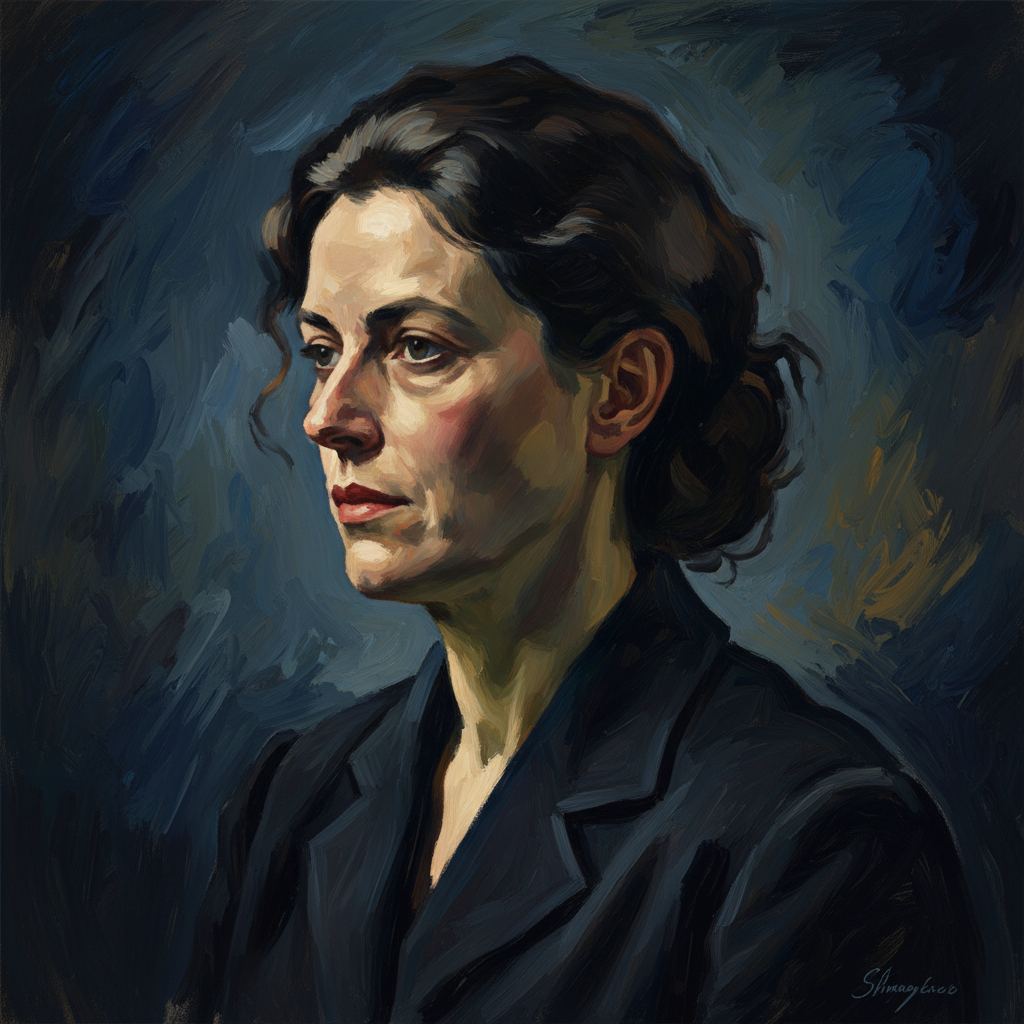
Simone de Beauvoir — "I tore myself away from the safe comfort of certainties through my love for trut…"
I tore myself away from the safe comfort of certainties through my love for truth—and truth rewarded me.
I tore myself away from the safe comfort of certainties through my love for truth—and truth rewarded me.
Click any product to generate a realistic preview. Up to 3 at a time.
* Initial load can take up to 90 seconds — revising the preview in another color is nearly instant.
"The future is a tool, not a destiny."
"One is not born, but rather becomes, a woman."
"Her wings are cut and then she is blamed for not knowing how to fly."
"I have always been aware that I am a woman, and that this is a disadvantage."
"The greatest adventure is to live your life as if it were a work of art."
French existentialist philosopher whose The Second Sex (1949) is the foundational text of modern feminist theory. Closely associated with Jean-Paul Sartre (lifetime partner and existentialist co-founder) and Albert Camus (existentialist contemporary in Paris). For an intellectual contrast, see Camille Paglia, American cultural critic and Sexual Personae author — Paglia argues for biological-essentialist roots of gender that Beauvoir's social-construction view — 'one is not born, but rather becomes, a woman' — explicitly rejects. The two are the cleanest constructed-vs-essentialist poles in feminist theory.
The standard scholarly entry points to Simone de Beauvoir's work: Toril Moi (Duke, James B. Duke Distinguished Professor) — Simone de Beauvoir: The Making of an Intellectual Woman (1994); Margaret A. Simons (Southern Illinois University, Emerita) — Beauvoir and The Second Sex (1999); Kate Kirkpatrick (Oxford, Regent's Park College) — Becoming Beauvoir: A Life (2019). These are the works graduate seminars cite when teaching Simone de Beauvoir.
Your cart is empty