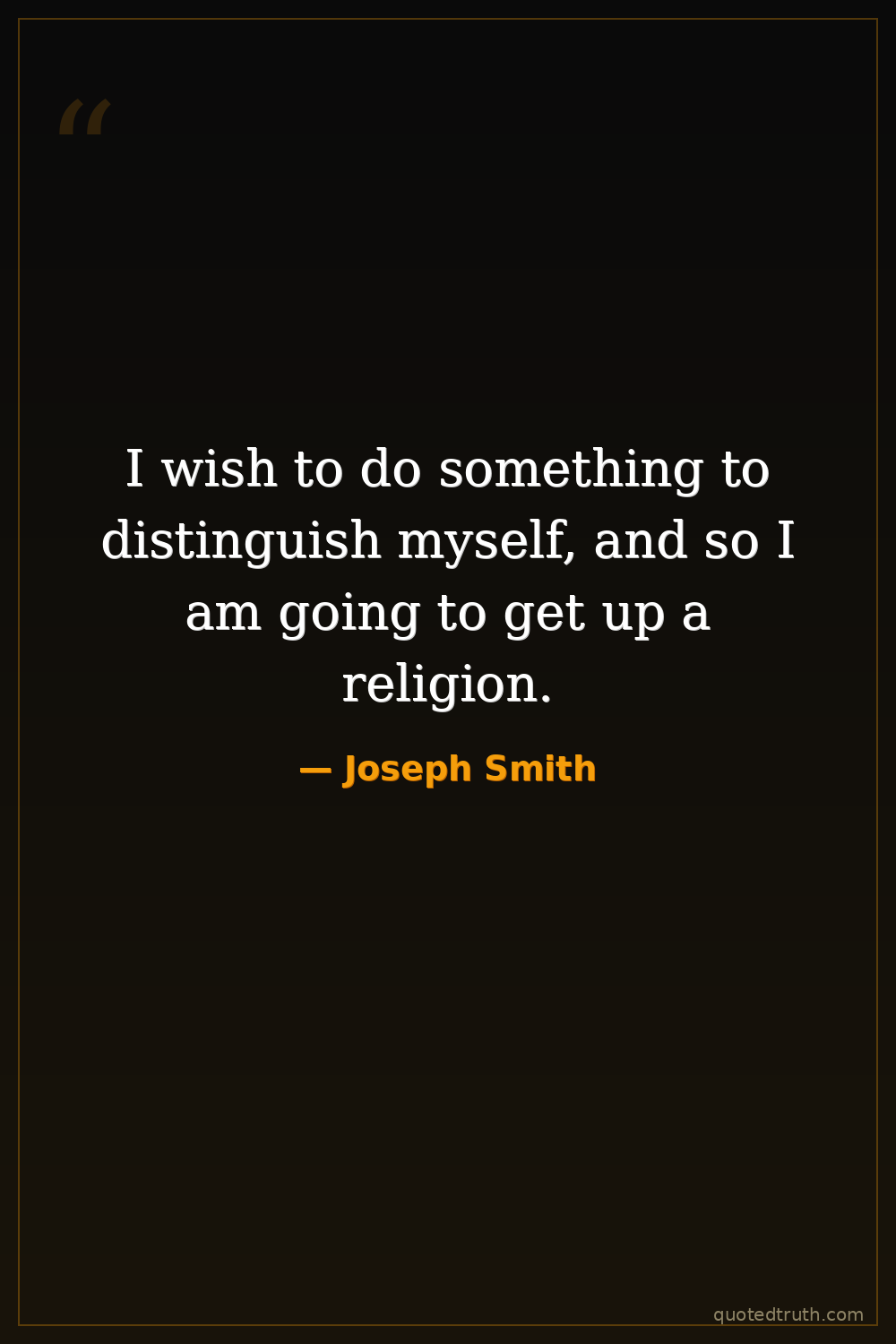
Joseph Smith — "I wish to do something to distinguish myself, and so I am going to get up a reli…"
I wish to do something to distinguish myself, and so I am going to get up a religion.
I wish to do something to distinguish myself, and so I am going to get up a religion.
Click any product to generate a realistic preview. Up to 3 at a time.
* Initial load can take up to 90 seconds — revising the preview in another color is nearly instant.
"I have seen the face of God, and I have seen the face of the devil."
"I am a lover of the Constitution, and I believe in the principles of republicanism."
"I have more to boast of than ever any man had. I am the only man that has ever been able to keep a whole church together since the days of Adam. A large majority of the whole have stood by me. Neither…"
"There are two churches only; the one is the church of the Lamb of God, and the other is the church of the devil; wherefore, whoso belongeth not to the church of the Lamb of God belongeth to that great…"
"For hundreds of years the world was wrapped in a veil of spiritual darkness, until there was not one fundamental truth belonging to the place of salvation that was not, in the year 1820, so obscured b…"
Allegedly said to his family and friends, reported by various early critics. While widely cited, direct contemporary evidence is scarce, making confidence lower.
Date: Circa 1820s
ShockingFound in 1 providers: grok
1 source checked
The speaker openly admits ambition as a motivation for founding a new religion—wanting to stand out, be remembered, and carve a distinct identity. It reframes religious founding not as divine mandate alone but as personal drive for significance. The candor is striking: instead of claiming pure revelation, the statement acknowledges the human desire to matter, to leave a mark that outlasts ordinary life.
Joseph Smith founded the Church of Christ in 1830 in upstate New York, claiming divine visions from age fourteen onward. Born into poverty in rural Vermont, he grew up in a family of seekers during a period of intense religious revival. His ambition was undeniable: he led thousands, ran for U.S. president in 1844, and built an entire theological system including new scripture, priesthood hierarchy, and temple rituals before his death at thirty-eight.
The early nineteenth century in America was the Second Great Awakening—a period of explosive religious fermentation across New York, Ohio, and the frontier. Dozens of new sects competed for converts. Social mobility was real but scarce, and founding a movement was one path from obscurity to influence. In this environment, religious entrepreneurship was both spiritually sincere and practically powerful, making Smith's alleged confession of ambition entirely plausible as cultural context.
AI-generated insights based on extensive research and information for context. Factual errors? Email [email protected].
Your cart is empty